Get Full Government Meeting Transcripts, Videos, & Alerts Forever!
Council revisits urban renewal financing, land-acquisition options for Willamette Riverfront
Summary
Consultant Elaine Howard and staff reviewed how the West Linn Willamette Riverfront tax-increment financing (TIF/urban renewal) area works, the plan’s $76.1 million maximum indebtedness and near-term revenue forecast. Council and staff discussed pacing projects, strategic property acquisition and the limits of the agency’s early-year cash flow.
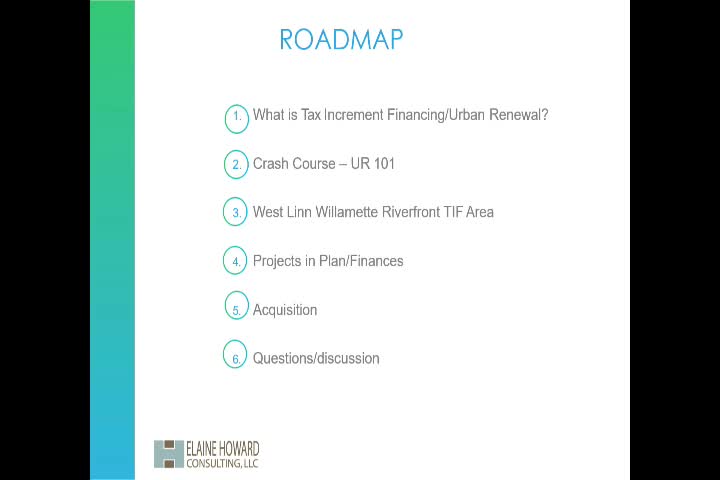
Consultant Elaine Howard and city staff reviewed the West Linn Willamette Riverfront tax-increment financing plan for the city council on Aug. 4, laying out how tax increment financing (often called “urban renewal”) generates revenue and when the agency could expect to issue debt to fund large projects. Howard told the council that the plan’s statutory maximum indebtedness is $76,100,000 and that the practical spending capacity in 2023 dollars was estimated at about $41.7 million.
The presentation explained how TIF works: the assessed value of properties inside the urban renewal area is set at formation and the incremental increase above that base (from 3% annual assessed-value growth and from new development) is captured by the urban renewal agency rather than going to other taxing districts. Howard said, “Tax increment is not a new tax,” and emphasized that only increases inside the defined area are captured.
The nut graf: the council received a detailed…
Already have an account? Log in
Subscribe to keep reading
Unlock the rest of this article — and every article on Citizen Portal.
- Unlimited articles
- AI-powered breakdowns of topics, speakers, decisions, and budgets
- Instant alerts when your location has a new meeting
- Follow topics and more locations
- 1,000 AI Insights / month, plus AI Chat