
Council revisits urban renewal financing, land-acquisition options for Willamette Riverfront
Get AI-powered insights, summaries, and transcripts
Subscribe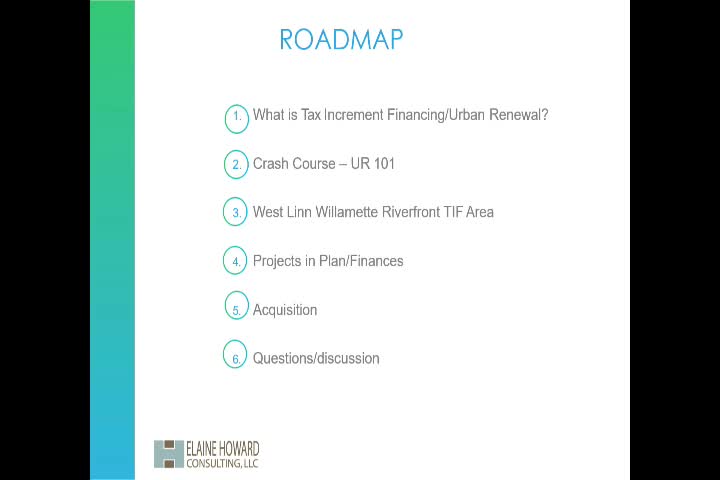
Summary
Consultant Elaine Howard and staff reviewed how the West Linn Willamette Riverfront tax-increment financing (TIF/urban renewal) area works, the plan’s $76.1 million maximum indebtedness and near-term revenue forecast. Council and staff discussed pacing projects, strategic property acquisition and the limits of the agency’s early-year cash flow.
Consultant Elaine Howard and city staff reviewed the West Linn Willamette Riverfront tax-increment financing plan for the city council on Aug. 4, laying out how tax increment financing (often called “urban renewal”) generates revenue and when the agency could expect to issue debt to fund large projects. Howard told the council that the plan’s statutory maximum indebtedness is $76,100,000 and that the practical spending capacity in 2023 dollars was estimated at about $41.7 million.
The presentation explained how TIF works: the assessed value of properties inside the urban renewal area is set at formation and the incremental increase above that base (from 3% annual assessed-value growth and from new development) is captured by the urban renewal agency rather than going to other taxing districts. Howard said, “Tax increment is not a new tax,” and emphasized that only increases inside the defined area are captured.
The nut graf: the council received a detailed finance timeline showing modest near-term annual cash flows and a recommendation to “bank” revenues for several years before issuing bonds for the largest projects. That sequencing matters because the agency’s largest listed priorities — roadway realignments, riverfront trail and Riverfront Park — require levels of funding that exceed the early-year cash receipts estimated in the plan.
Howard and staff walked council through projected receipts and an expected first bond-issuance opportunity in the early 2030s under the current revenue forecast. Howard said the plan intentionally shows little to no planned spending in years one through five so the agency can accumulate funds before issuing debt to build projects such as the Willamette Falls Drive realignment. Staff noted that updated financial modeling from Tiberias Solutions indicates a potential bond issuance in fiscal year 2031 with roughly $4.5 million in bond proceeds in that year under the current projection.
Councilors and staff discussed acquisition as an implementation tool. Howard explained acquisition is allowed under ORS 457.17 and is commonly used for right-of-way and to assemble parcels for larger redevelopment projects, but she noted eminent domain cannot be used to acquire property for redevelopment in Oregon — purchases must be from willing sellers. She described local examples where urban renewal agencies purchased key downtown parcels and later enabled private redevelopment or public uses (Lake Oswego Weiser’s block, Florence hotel site, Astoria Liberty Theater restoration).
Council members asked whether the plan’s allocations are adjusted for inflation. Howard confirmed the plan shows both 2023 dollars and year-of-expenditure projections for projects; allocations may be revised through minor or substantial plan amendments depending on scope and acreage changes. She cautioned that adding acreage above the statutory 1% minor-amendment threshold triggers a full substantial-amendment process, which is equivalent to adopting a new plan and can take roughly six months and be costly.
Staff recommended a cautious near-term approach: use urban-renewal funds for smaller programs (example: façade grants) or bank resources until the agency has scale to undertake major capital projects, and to pursue strategic acquisitions only when they align clearly with the adopted vision and available financing. City Manager John Williams and staff said they can provide follow-up financial and real-estate analysis if council identifies specific target parcels.
Ending: Council members asked staff to schedule a follow-up agency-level discussion to examine top-priority projects and consider whether selective early acquisitions make sense. Staff also flagged that multi-source funding (grants, SDCs, partner agencies) will likely be necessary to implement large roadway and riverfront projects under the current revenue outlook.