Get Full Government Meeting Transcripts, Videos, & Alerts Forever!
Get email alerts on the Stormwater topic
No spam. Unsubscribe anytime.
Council reviews two-option erosion-assistance proposal to help private creek-bank owners
Summary
Engineering staff presented two draft programs — a $10,000 rock distribution plan and a $50/50 cost-share program (proposed $30,000 annual budget, $60,000 reimbursement cap) — and said they will return with a formal procedure for council approval.
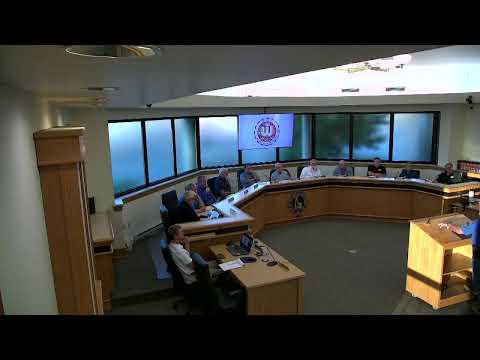
Engineering staff presented two draft programs on Sept. 2, 2025, to help Washington property owners stabilize creek-bank erosion on private property after repeated heavy spring storms. The proposals include a rock assistance program with a proposed $10,000 allocation for gabion rock and a larger 50/50 cost-share program with $30,000 proposed in next year’s budget and a $60,000 total reimbursement cap.
The proposals aim to address backyard and creek-bank erosion that staff said has increased with more intense rains and contributes sediment downstream. Charles, an engineering department staff member, said the city would assess sites, steer homeowners to one of the two programs and either deliver rock (rock program) or reimburse up to 50% of contractor costs (cost-share).
Under the rock assistance model, staff would buy gabion rock, store it, and deliver it to a homeowner’s driveway; homeowners would need to obtain any external permits required (for example, Army Corps of Engineers or Missouri Department of Natural Resources permits), place the rock themselves or hire a contractor, install within two weeks of delivery and call for a city inspection. Charles described the 50/50 cost-share as intended for larger projects that would likely require engineering and permitting; applicants would have to provide three contractor bids and the city would reimburse the lowest bid up to available annual funds.
Councilmembers raised legal and equity limits on using public funds for private-property improvements. Councilmember Jeff (last name not provided) cautioned that the city often lacks easements to perform stormwater work on private lots and said the city must avoid paying for improvements that benefit only one or two private property owners. “You can't be spending public dollars just to help 1 or 2 property owners when they've got a problem with regards on their own private property,” he said.
Staff said the idea came from the stormwater committee and from surveying other cities with similar programs. Charles said the program is intended to be a “happy medium” that lets residents apply for help on a first-come, first-served basis and that staff are open to tweaking the details.
No formal policy or expenditure was approved at the workshop. Charles said staff will prepare a full written procedure with eligibility criteria, permit requirements, delivery and inspection steps, and recommended start and effective dates; council will consider that procedure as part of the next budget cycle. Staff suggested including the program in the October 1 budget year but later said they preferred a January 1 start to allow time to finalize procedures.
Questions councilmembers asked that will be addressed in the written procedure include whether commercial properties are eligible (staff recommended starting with residential only), whether grants exist to cover residential work (staff said they had not found residential-focused grants and reiterated the public/private spending concern), how the city will limit liability for damaged driveways during delivery, and how to prioritize cases if demand exceeds the annual appropriation. Councilmembers also noted that an initial budget would likely not cover all backlog work in year one.
Staff will return with a formal program packet for council review that includes the eligibility checklist, sample permit language, per-project caps, inspection protocol and recommended funding level.