
Astoria council reopens debate on enhanced enforcement zone and camping ordinance; members split on enforcement vs services
Get AI-powered insights, summaries, and transcripts
Subscribe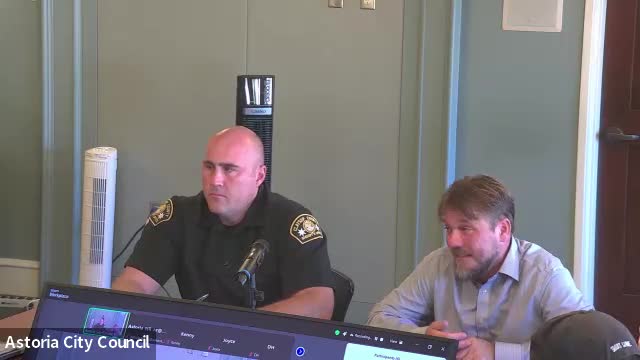
Summary
Astoria councilors reopened discussion of a previously failed enhanced enforcement proposal on July 28, weighing trespass and exclusion orders against concerns that enforcement without daytime services effectively criminalizes homelessness.
Astoria City Council members spent the July 28 work session debating a previously considered enhanced enforcement (limited-access) ordinance intended to deter repeat public-camping and related offenses in high-impact areas. The council discussed the ordinance's enforcement tools — exclusion orders and criminal trespass for violators — and whether those tools would improve public safety or merely criminalize homelessness without providing alternatives.
City Manager Scott Spence summarized staff concerns about compliance and community impacts and described the city's current enforcement limits. "If we continue not having some form of consequential enforcement, this issue will grow," Spence said, urging the council to consider the trade-offs among enforcement, services and costs.
Police Chief Kelly and others described how a limited-access or trespass mechanism could change enforcement outcomes for repeat offenders. Chief Kelly said the ordinance aimed to create a series of escalating consequences that would put persistent violators "on notice" and give law enforcement a tool to hold a person overnight for arraignment if they repeatedly violate exclusions. "If you are engaging in services, you would not be arrested for the trespass," Chief Kelly said, describing an exemption for people actively participating in treatment or case management.
Councilors were sharply divided. Councilor Kristin Lomp (spelling taken from transcript) and others voiced skepticism about criminal penalties without clear alternatives, saying enforcement must be paired with daytime services, shelter or treatment options. "For me to do something that does essentially like criminalize homelessness, I'm going to need there to be a place that they can go during the day to comply," Lomp said.
Councilor Andy Davis and others supported developing enforcement tools while simultaneously increasing service-provider coordination. Davis urged staff to seek presentations from the district attorney's office and local service providers — including Community Behavioral Health (CBH), Lifeboat and Helping Hands — to clarify what services are available and how enforcement would intersect with treatment pathways. Several councilors asked staff for cost estimates and municipal-court options if state-controlled criminal sanctions proved insufficient.
Chief Kelly and the sheriff's office noted the ordinance had a secondary aim: to create clearer consequences that would restore public confidence in law enforcement and reduce repeat offending in high-impact areas such as downtown and the South Slope. "Consistently applying the law is a secret ingredient," the sheriff said during the discussion.
No vote was taken. Councilors directed staff to compile data on bookings, detention timelines, program availability and costs, and to work to convene follow-up briefings with the judge, sheriff, the district attorney's office and service providers. Several councilors said they wanted to explore both lower-cost steps and the scope of municipal options before placing a revised ordinance on a future agenda.
Ending: The council agreed to reconvene with additional information and invited the DA and community providers to participate in a follow-up work session; staff will return with data and cost estimates in mid-August.