Get Full Government Meeting Transcripts, Videos, & Alerts Forever!
Get email alerts on the Inclusionary Housing topic
No spam. Unsubscribe anytime.
Antioch council continues study of inclusionary housing ordinance after wide public debate
Summary
City staff summarized draft inclusionary housing options and recommended a 15% set‑aside with on‑site priority; coalition and housing advocates pushed for 20% and deeper affordability. Council set a follow‑up study session for Sept. 16 to take more direction.
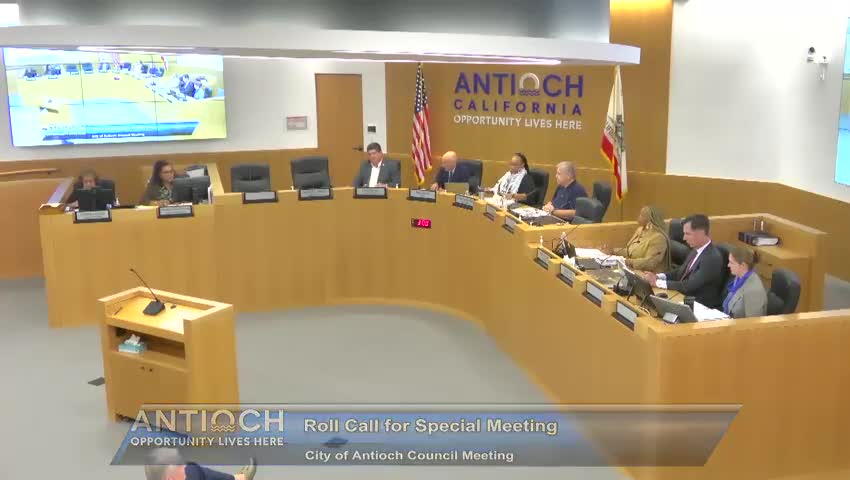
Lede: Antioch city staff returned to council on Aug. 26 for a follow‑up study session on a proposed inclusionary housing ordinance, asking elected officials for policy direction after public comment that ranged from legal cautions to demands for deeper affordability. Nut graf: The meeting focused on whether the city should require market‑rate housing projects to provide on‑site affordable units or allow alternatives (in‑lieu fees, off‑site units), how large a set‑aside to require, and how to structure incentives. Staff reiterated a preliminary 15% set‑aside and emphasized on‑site production; housing advocates urged a 20% baseline targeted to very low and extremely low income households. Council members agreed to continue the item for a longer, structured session on Sept. 16 for further direction. Body: City Manager Scott opened the Aug. 26 study session and said staff sought direction on core design choices: “Do you want a strong emphasis on on‑site construction? ... Is it in perpetuity, 55 years, 10 years, whatever?” (City Manager Scott). David Storer, interim community and economic development director, and Zoe, planning manager, reviewed staff analysis and options, saying the draft ordinance would typically include alternatives and incentives and that an in‑lieu fee would go into a housing trust fund, and they noted ‘‘this is not an impact fee so no nexus study is required’’ (Zoe, Planning Manager). Staff emphasized a 15% set‑aside as a common ‘‘sweet spot’’ because state law requires IHOs not to unduly constrain housing production and because AB 1505 (as discussed in staff presentation) can trigger additional state review for rental projects with inclusionary set‑asides above 15%. Staff recommended prioritizing on‑site construction, perpetuity or long‑term affordability controls, flexibility across income bands, in‑lieu fees, alternative compliance options (off‑site development, land dedication) and meaningful developer incentives (density, reduced parking) to align production and equity goals. A broad coalition of housing advocates and service providers told council a stronger standard was needed. Jasmine Tarkoff, representing a coalition including Public Advocates, East Bay Housing Organizations and Rising Juntos, urged a ‘‘strong equity driven inclusionary housing ordinance’’ and warned that without an IHO new development was unlikely to include homes affordable to Antioch residents. Kayla DiGiorgio of Hope Solutions said on‑site affordable units matter for neighborhood integration: “On‑site affordable homes allow families with lower incomes to live in the same neighborhoods, attend the same schools, and share the same opportunities as those paying market rate” (Kayla DiGiorgio, Hope Solutions). Several speakers — Greg Coley (Multi Faith Action Coalition), Joey Flagle Michlev (East Bay Housing Organizations) and others — urged a baseline of 20% and called for incentives tied to deeper affordability. Tahira Dean of Public Advocates supported in‑lieu fees where on‑site units are not feasible but urged that fees be set so they are not ‘‘a way for developers to opt out’’ and that fees feed a housing trust fund to leverage more construction. A small number of speakers opposed the ordinance. Mark Jordan, who identified himself as a resident, said a pending federal lawsuit challenging East Palo Alto’s IHO raised legal risk and urged tabling the proposal until litigation resolved; he referenced the Pacific Legal Foundation as counsel in related litigation. Staff and the city attorney noted legal considerations and the need to structure alternatives and incentives consistent with state law. Council direction and next steps: After public comment council members said more time and a structured discussion were necessary. Council member Freitas suggested a four‑hour follow‑up study session; Council member Torres Walker and others emphasized outreach and structuring specific questions for staff. By consensus the council directed staff to return with a revised package and scheduled a continuation study session for Sept. 16, 6:00–10:00 p.m., for extended deliberation and public input. City staff indicated they will bring refined questions, feasibility detail and draft ordinance language for the next session. Ending: The Aug. 26 session closed with council agreeing to more time for deliberation rather than making a final policy choice; staff and advocates will use the intervening weeks to refine options, cost estimates and proposed compliance tools for the Sept. 16 meeting.