Get Full Government Meeting Transcripts, Videos, & Alerts Forever!
Get email alerts on the Code Enforcement topic
No spam. Unsubscribe anytime.
Broomfield adopts streamlined civil penalty process for certain neighborhood code violations
Summary
Council approved an ordinance creating an administrative process for civil penalties on selected animal and property code violations — a tool designed to speed enforcement and prioritize compliance over prosecution.
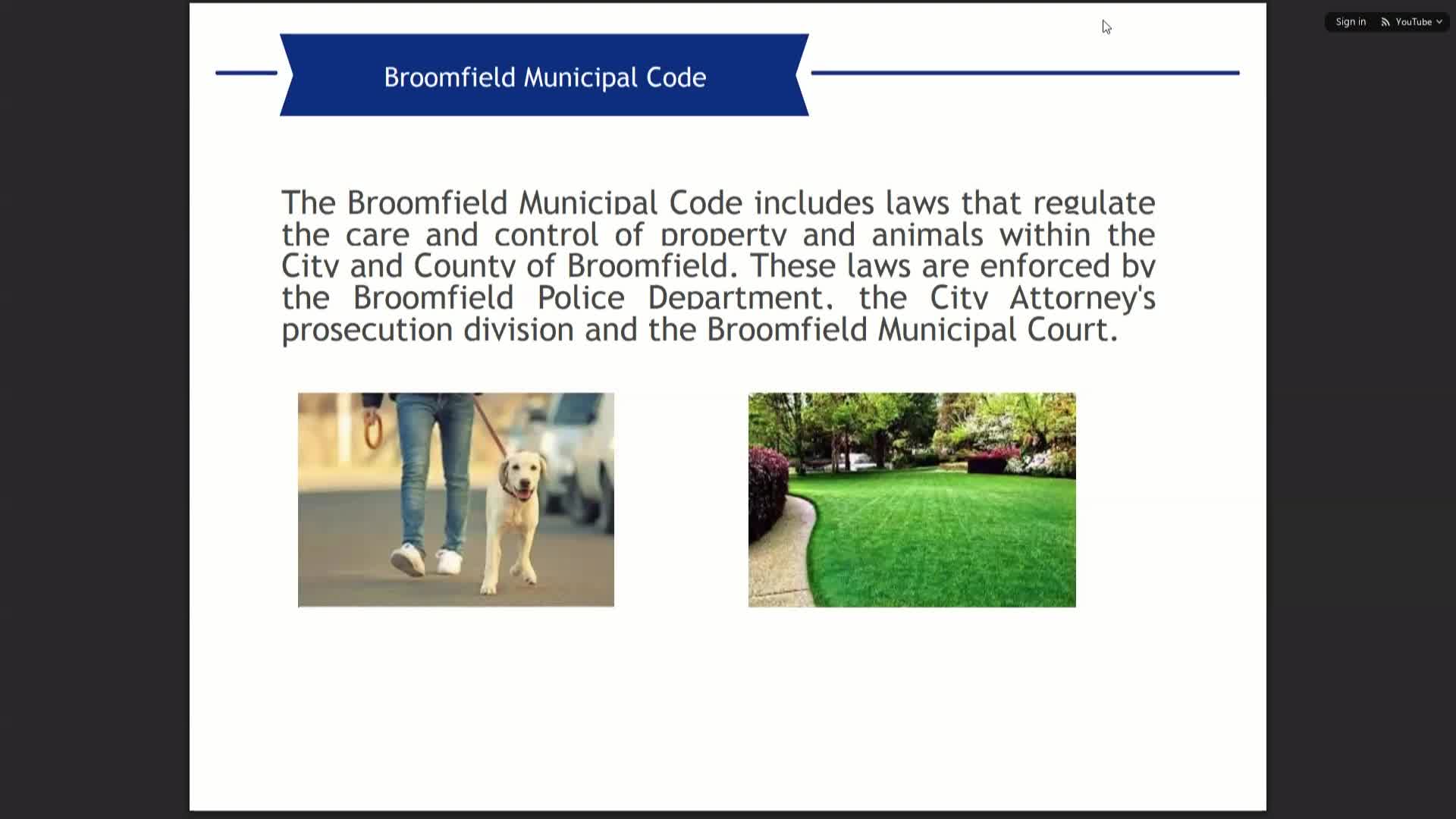
BROOMFIELD, Colo. — The City and County of Broomfield on Aug. 12 approved an ordinance (No. 2271) establishing a simplified administrative civil-penalty process for selected property and animal-code violations, a change intended to shorten enforcement timelines and reduce the courtroom workload for low-level offenses.
Courtney Thiemann, deputy city and county attorney, summarized the measure, which creates a citation-and-fine procedure similar to traffic infractions and preserves a simplified hearing process for residents who want to contest a citation. The ordinance establishes a civil fine schedule (to be set by the chief municipal judge) and allows default judgments rather than issuing warrants when appellants fail to appear, closing cases more quickly.
Commander Brandon Wychlots of the Broomfield Police Department explained the operational rationale: officers and code-enforcement staff now spend months working on repeat or prolonged cases. He gave examples where officers made multiple contacts and issued several notices over months, then the matter still required a summons and a court date that might be weeks away. The civil administrative path, he and city attorneys said, keeps education and compliance as the first step but provides a faster enforcement option when voluntary compliance does not occur.
Key details and limits: The new administrative process applies to a defined list of municipal code provisions (property maintenance, certain animal-control sections, and minor drug-paraphernalia possession for adults). Juveniles cited for marijuana or paraphernalia retain a mandatory court appearance. The ordinance leaves prosecutors and police discretion to pursue criminal or municipal-court charges when circumstances — such as repeat offenders or public-safety concerns — warrant a more formal path.
Vote and next steps: The ordinance passed unanimously on second reading (9–0). Council members asked that staff monitor outcomes so the city can assess whether the administrative system reduces repeat violations and shortens case closure times; the city attorney’s office will report back on implementation metrics.
Ending note: City officials said the change aims to balance efficient enforcement with due-process protections while keeping officers focused on serious public-safety matters.