Get Full Government Meeting Transcripts, Videos, & Alerts Forever!
Get email alerts on the Community Renewable Energy Grant topic
No spam. Unsubscribe anytime.
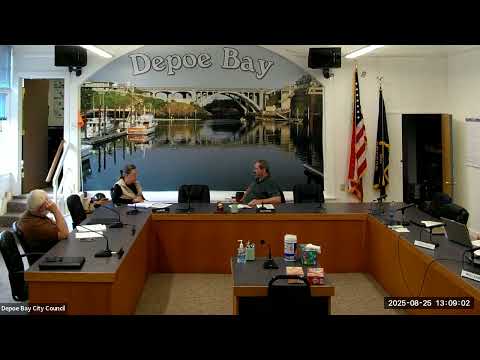
Energy committee moves to finalize state renewable-energy grant application, targets fuel-cell resilience at city facilities
Summary
The Energy Advisory Committee agreed to pursue an Oregon Department of Energy Community Renewable Energy Grant, set a Sept. 9 work session to review a Phase 2 proposal, and identified city hall, the community center and water facilities as priority sites for fuel-cell backup and microgrid planning.
Members of the city’s Energy Advisory Committee said they will pursue a Community Renewable Energy Grant from the Oregon Department of Energy and set a committee work session for Sept. 9 to review a Phase 2 construction proposal and related checklists. The committee discussed incorporating fuel-cell backup and other renewable generation into city facilities, and flagged application deadlines the group must meet.
The grant application deadline was cited as Sept. 19 (the committee was told applications are due “Sept. 19 by 5 p.m.” on the Oregon Department of Energy website) though one participant later cited Sept. 22 as a possible due date; the committee agreed to treat the earlier date as the working deadline and complete a draft review before the submission window closes. Committee members also said the city will seek council approval on Sept. 2 to move the application forward.
Committee members said the immediate focus is resilience: adding fuel-cell backup, solar and small-scale wind to critical city infrastructure so sites can operate during outages. The facilities singled out for near-term work are city hall, the community center, the water treatment plant and the wastewater treatment plant; committee members also discussed coordinating with the Depoe Bay Fire District on a possible second Phase 2 construction grant that could cover the fire station and associated cell-tower power needs.
Discussion included technical and programmatic constraints. Committee members noted the water treatment plant is scheduled for redesign in the coming years and that including fuel-cell resiliency in that redesign would let the city “build it in” rather than add it later. By contrast, the wastewater treatment plant was described as having a very high starter power load, which one attendee said may make on-site hydrogen/fuel-cell backup impractical without additional engineering.
The committee reviewed grant requirements described in the state checklist: detailed construction documents and project schedules with major milestones, documentation showing a project operator for at least five years, and estimates of construction and operations jobs. Members emphasized that a Phase 2 construction application will require robust design documents (not just conceptual drawings) and staffing/operations plans, and urged the consultant preparing the proposal to include line‑item estimates rather than lumped charges.
On budget and staffing, committee members reported a previously approved city agreement that allows up to $25,000 to proceed with preparatory work related to the project; they also said the budget includes funds for the consultant (identified in the meeting as the consultant working on the application) to continue work on construction estimates. The committee agreed to request a final, itemized invoice from that consultant before closing out an earlier grant and to press for specific cost estimates so the group can determine whether a second Phase 2 grant is needed for other facilities.
Next steps recorded during the meeting included: circulating the state checklist and a more detailed document to committee members, confirming whether the consultant is preparing the planning- or construction‑level materials needed, contacting the Depoe Bay Fire District chief and planning commission contacts to explore including the fire station in a construction application, and scheduling the Sept. 9 work session (1 p.m.) to review a draft Phase 2 package. Committee members also discussed following the state site guidance and continuing coordination with outside organizations, including Sustainable Northwest and regional partners, to explore hydrogen generation and distribution options.
The committee emphasized a policy focus on resilience and emergency operations (backup power for shelters, critical facilities and first responders) rather than immediately pursuing commercial, prime-power objectives. Members discussed multiple technical options—portable 4 kW fuel-cell units for small sites, modular additions up to tens of kilowatts for larger facilities, and larger central generation that could be scaled later—and said the group will model costs for different generation capacities before recommending whether the city should own operations, partner with a utility or enable private providers.
The committee expects the state to announce awards around January and noted that members will have a long waiting period after submission. Meanwhile, the group plans to refine cost estimates, finalize staffing and operations documentation, and confirm the consultant’s deliverables ahead of the Sept. 9 work session.