Committee reviews Excel and CTE program; no formal action taken
Summary
The Program and Curriculum Committee discussed changes to the Excel and CTE dual‑credit program — including limiting enrollment to juniors/seniors, aligning placement measures, stacking credentials and targeting funding — but took no action and asked staff for additional data.
The Program and Curriculum Committee of the Technical Education Authority discussed policy changes to the Excel and CTE dual‑credit program at its Aug. 7 meeting but did not take formal action.
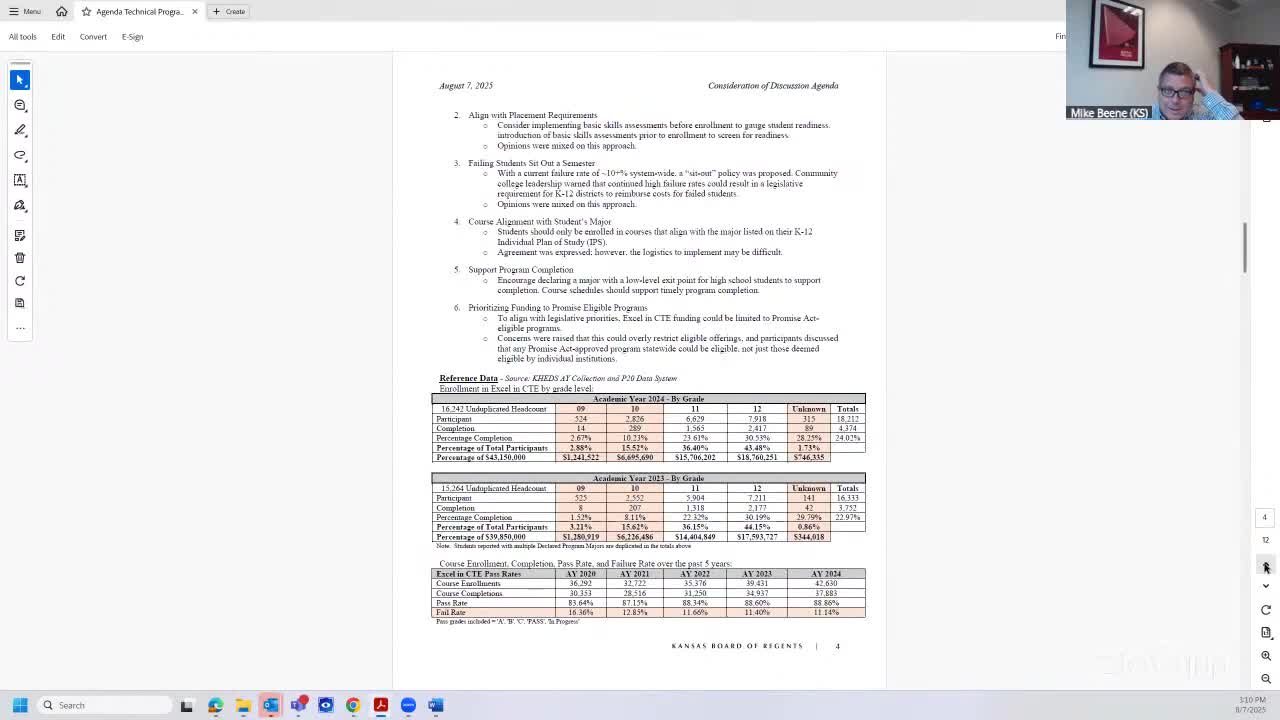
April White, KBOR staff, told the committee Excel and CTE (also known by statute as Cinevo 155) has grown rapidly and currently draws more than $47 million in state appropriation. “It’s a very popular program. We are up over $47,000,000, for that appropriation,” she said, and added that appropriations for traditional college‑age technical students are roughly $66,000,000, bringing the dual‑credit appropriation close to parity with other technical funding.
White presented six ideas staff and colleges discussed this summer to address accountability and completion: limit Excel and CTE funding eligibility to juniors and seniors; add reading or math placement requirements (or multiple measures) for program entry; impose a sit‑out semester for students who fail to emphasize consequences on the college transcript; align semester coursework with a student’s individual plan of study (IPS); promote stackable credentials (for example, a short Cert A of roughly 16–20 credits as an initial exit point); and prioritize funding for Promise Act‑eligible occupations (high wage, high demand, or critical‑need roles).
Representatives from community and technical colleges responded. Amber, a community‑college president, said the community colleges “support looking at those different areas and trying to find some efficiencies and and just making sure that we're following the intent and the sustainability of Excel and CTE over time.” Amber and other community‑college leaders asked staff to provide additional program‑level data on completions and failures so institutions and the committee can evaluate unintended consequences, particularly for programs such as certified nurse aide (CNA) where younger students enter the workforce in underserved areas.
Jim, speaking for the technical colleges, said the program has been successful and urged caution about narrowing eligibility too far: “the program has been successful. We'd like to make it more successful. We don't want effectiveness to get overshadowed by efficiency.” He said sophomores and freshmen should still be able to participate if they or their families can fund enrollment, and asked that any restriction consider rural workforce needs and CNA exceptions.
Heather, representing college practitioners, reported most community colleges currently use high‑school GPA rather than standardized placement tests to admit students to dual‑credit courses. Several committee members and presenters discussed bringing back or aligning placement testing — for example ACCUPLACER — but making it a multiple‑measure decision rather than a single high‑stakes test.
Dr. Anderson, a K‑12 representative on the call, warned the committee to weigh equity when considering age or placement limits: “I do worry about, equity issues when we start saying in order to, participate, you in T Calc, you have to be a junior or senior.” Committee members discussed data limitations: KBOR staff said unduplicated headcount in the state for high‑school students taking technical coursework was 16,242 in AY24, while the participant count (which counts students more than once when they take multiple programs) totaled about 18,212; staff said some data will be small‑cell suppressed at the program/institution level.
No motion or formal direction was taken. White said staff will gather additional institutional data (completion by program and institution, employment and post‑secondary persistence where possible) and return the analysis to the TEA for its Aug. 21 full meeting and for the committee’s further consideration.
Committee members asked staff to include KeyStats/K‑TIP employment and persistence figures where available and to work with college partners on any recommended policies before the TEA votes.