
TEA committee weighs narrowing Excel and CTE funding, asks staff for completion and failure data
Get AI-powered insights, summaries, and transcripts
Subscribe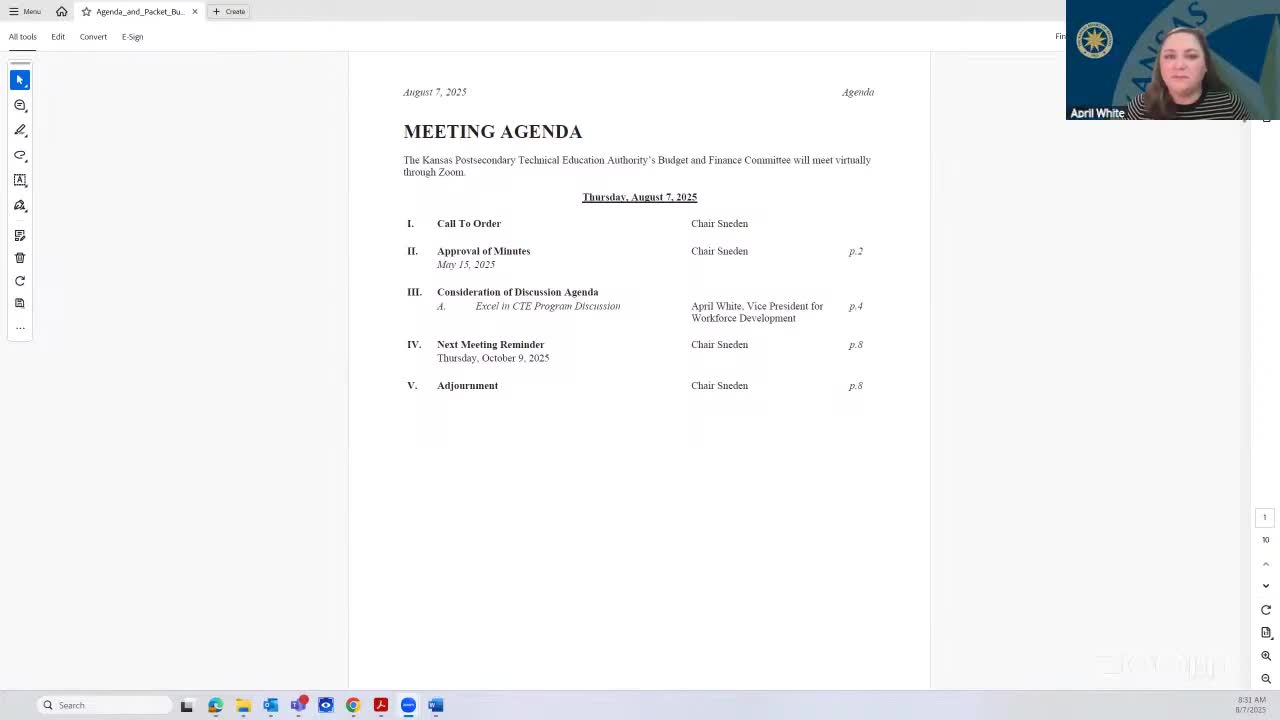
Summary
Members of the Technical Education Authority(TEA) program and curriculum committee discussed narrowing eligibility for Excel and CTE funding and steps to improve completion rates during a remote committee meeting, saying they expect state budget cuts and want to prioritize high-demand programs.
Members of the Technical Education Authority(TEA) program and curriculum committee discussed narrowing eligibility for Excel and CTE funding and steps to improve completion rates during a remote committee meeting, saying they expect state budget cuts and want to prioritize high-demand programs.
April White, vice president, opened the discussion by saying the committee was not taking a vote and that any formal decision would come before the full TEA: "this topic, we are not taking a vote today. it is something for you guys to consider, and the full TEA will have to take a vote at some point." White said the committee is preparing for a "conservative legislature" and noted the Excel and CTE appropriation is currently "over $47,000,000," compared with about "$66,000,000" for traditional college-age technical-course funding.
The committee discussed six categories of possible changes that staff and college representatives had drafted: limiting the use of Excel and CTE funds to high school juniors and seniors, aligning placement scores, setting a minimum reading level for program entry, requiring a sit-out semester after a failed course, aligning student enrollment with their high-school individual plan of study, and prioritizing funds for programs identified under the Promise Act.
Amber Schultz, president at Cloud, said the community colleges generally agreed with the draft list but had prioritized three items and cautioned that implementing all six at once may not be feasible: "Doing all 6 may be difficult or or not feasible right away, so out the gate. So we did prioritize 3 of those, which I'd be glad to share." Schultz and other college representatives said juniors and seniors should be the priority for state-funded slots while allowing younger students to participate if they pay their own way.
College and technical-college representatives emphasized completion and safety concerns. Jim (technical college representative) said placement guidelines were important to avoid "setting [students] up to fail," and noted health-care programs generally require an ability to read at about an eighth-grade level. The committee discussed using reading or placement tests as a gate for some programs, particularly health care, because of safety and patient-risk issues.
Committee members raised specific exceptions and operational points. Several speakers urged preserving CNA (certified nursing assistant) access for some sophomores where local workforce needs are acute. Dave Rice, a committee member, urged that satisfactory academic progress rules be enforced to avoid harming studentswho carry poor college transcripts into later financial-aid eligibility: "if you have 3 or 4 bad semesters where you're on probation or dismissal, and then you try to get into a college after you graduate from high school, you may go in you may not get in or you may go in on probation and, in effect, not be eligible for financial aid." Representatives also discussed the "low-level exit point" model used in programs such as welding, where students can earn an industry credential after a semester and enter the workforce or continue for a higher credential.
On data and next steps, the committee asked KBOR staff to provide institution-level completions and failure counts for Excel and CTE and, if possible, program-level data ahead of the full TEA meeting. Sharman (KBOR staff) said completions by institution and program were available and that failures could be pulled by institution, with program-level failure data to be investigated further: "we can get completions by institution and by program for Excel and CTE. And the fails, I need to take another look at. Pretty absolutely can get it by institution. Not yet sure about program." Curtis (committee member) agreed to include college priorities in the issue paper for the full TEA.
No formal actions or votes were taken at the meeting. Because the committee did not have a quorum, approval of minutes was postponed to the next meeting. Committee members said the program and curriculum committee would also consider the topic later the same day and that the data requests and comments would be returned to the full TEA later this month. April White said the group could continue discussion at the full TEA meeting and that decisions did not have to be made at the August TEA meeting.
The committee framed the discussion as preparatory work for anticipated legislative scrutiny of completion rates, industry certifications, and program alignment; members asked staff to quantify potential savings from proposed changes and to circulate the requested data before the full TEA meeting so members and college partners could review it in advance.