
Experts tell committee federal tax overhaul will affect New Mexico but exact revenue impacts hinge on conformity and timing
Get AI-powered insights, summaries, and transcripts
Subscribe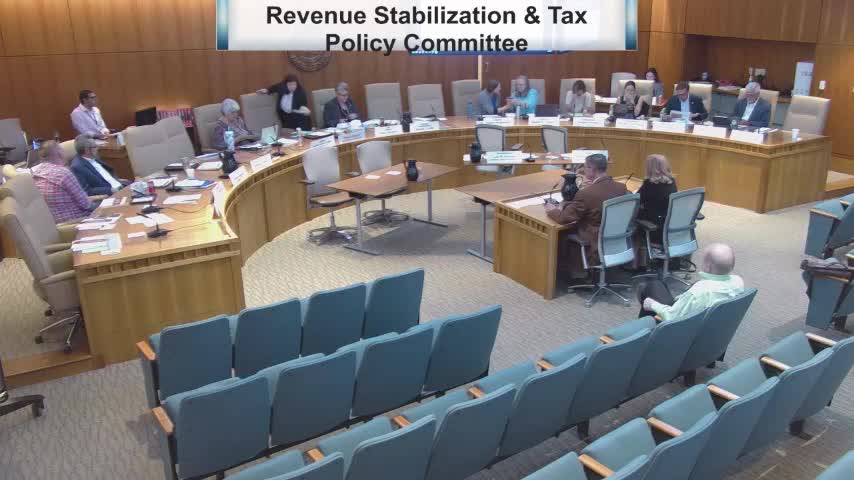
Summary
Presenters from the Multistate Tax Commission and the New Mexico Tax Research Institute told a legislative committee that parts of Public Law 119-21 will flow into New Mexico tax returns where state law “conforms” to the Internal Revenue Code, but many provisions will create timing differences or require statutory updates to take effect locally.
A panel of tax administrators and practitioners told a legislative committee that recent federal tax changes in Public Law 119-21 will affect New Mexico’s tax base where state law explicitly conforms to federal law, but the ultimate state revenue impact is uncertain and, in many cases, only a timing difference.
"The Internal Revenue Service is critical for that purpose," said Helen Hecht of the Multistate Tax Commission, explaining the practical link between federal tax administration and state returns. Hecht and Richard Enclam of the New Mexico Tax Research Institute briefed lawmakers on July 1 on how the new federal provisions interact with state conformity rules.
The presenters told the committee that New Mexico generally ties its individual income tax to federal adjusted gross income and its corporate tax to federal taxable income, but state statutes add and subtract many items in defined ways. That means some federal changes flow automatically to New Mexico returns, others do not, and still others change when state law is amended.
The nut of the briefing, presenters said, is that the same federal change can affect states differently depending on whether a state uses "rolling" conformity (adopting federal changes as they happen) or a fixed-date conformity (tying state law to the Internal Revenue Code as of a specific date). Hecht warned lawmakers not to assume all conforming states will be affected the same way: "You can't assume that the states that are in one category do it the same way."
The panel walked the committee through headline federal items that could influence state tax receipts or taxpayer behavior. Those included the permanent treatment of some standard deductions and charitable provisions, an increased cap for state-and-local tax (SALT) deductions at the federal level, the expansion of accelerated depreciation and immediate expensing for business assets, and new international provisions that broaden the federal base for taxed foreign income (a renamed and expanded category formerly known as GILTI).
Hecht noted that credits on the federal return generally come after a state's tax base calculations and therefore usually do not alter New Mexico’s tax base directly. Conversely, changes that affect what counts in adjusted gross income or federal taxable income can flow into state law unless New Mexico specifically excludes them.
Richard Enclam urged attention to business provisions that accelerate deductions: "Even though it's a timing difference ... it will affect us in the first year of its effect," he said, adding that states can see more volatile revenues because companies may expense large investments immediately instead of over many years.
Panelists singled out a few provisions with immediate state implications. They said states that adopt "rolling" conformity may see accelerated depreciation, bonus expensing, and other business deductions reduce state taxable income in the near term even if the effect reverses later. Multistate and international rules — including the federal Base Erosion and Anti-Abuse Tax (BEAT) and the broader foreign income base in the new law — complicate multinational reporting and are difficult for states to apply.
Lawmakers asked technical questions during the committee. Representative Terrazas asked whether the expansion of the federal interest-deduction limitation (IRC section 163(j)) raised a dollar cap; presenters responded that the change broadens the base and thus can increase the deductible amount for affected taxpayers but that the exact effect depends on a taxpayer’s borrowing and capitalization practices. Representative Terrazas also asked whether the new 100% bonus depreciation meant a later recapture when an asset is sold; Enclam summarized the panel’s view that the law treats such expensing effectively as a current-year deduction, not a later recapture event for federal purposes.
Committee members raised New Mexico-specific questions. Lawmakers asked whether businesses that operate in cannabis (a product still treated as illegal under the Internal Revenue Code) can claim the federal-style expensing at the state level. Hecht said New Mexico has chosen to allow deductions that the federal code disallows because federal law treats marijuana as illegal; "we would allow it" at the state level where statutes make that explicit.
Panelists also warned of practical limits to state administration. Hecht and Enclam said the Internal Revenue Service’s regulations and audits are resources states rely on; with an understaffed IRS the panelists said states may face greater uncertainty in interpreting new federal law and fewer shared audits to rely on.
The presenters recommended that lawmakers examine statutory conformity lines in New Mexico law, use form and instruction cross-references as a practical way to spot where federal changes will reach the state base, and consider which federal items the state wants to exclude or adopt expressly. They pointed attendees to further resources including the Federation of Tax Administrators and the Joint Committee on Taxation for detailed provision-by-provision lists.
The committee did not vote on any action during the session; lawmakers asked staff to follow up with more state-level fiscal estimates for particular provisions.
The briefing concluded with presenters urging lawmakers to keep tax administration capacity in view: "Tax administration is not just done by governments," Enclam said, noting both state revenue departments and tax practitioners need resources to implement and explain new rules.
Because the federal law contains many moving parts, the presenters emphasized that officials should not assume an automatic state revenue increase or decrease without reviewing New Mexico’s statutory conformity and the timing of deductions and credits.