Get Full Government Meeting Transcripts, Videos, & Alerts Forever!
Get email alerts on the Redevelopment Agency Budget topic
No spam. Unsubscribe anytime.
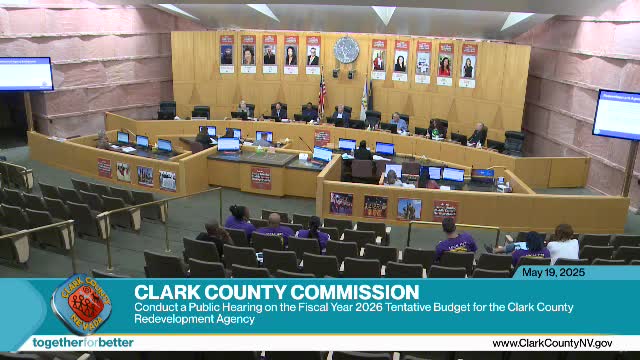
Board approves Clark County Redevelopment Agency FY2026 budget, sets $5.5 million reserve
Summary
The Board adopted the Clark County Redevelopment Agency FY2026 final budget and agreed to a $5,500,000 ending fund balance after discussion about preserving a portion of long‑term redevelopment funds; projected FY26 property tax increment revenue is roughly $20.2 million (Winchester Town driving majority).
The Clark County Board of Commissioners on Wednesday adopted the fiscal year 2026 budget for the Clark County Redevelopment Agency (RDA) and directed staff to include a $5,500,000 reserve rather than budgeting a zero ending balance.
Jessica Colvin, staff member, presented the RDA overview and said the agency was created in December 2002 with a 2003 base assessed value; increases above that base generate the property tax increment that funds the RDA. Colvin said the presentation did not include increment from areas expanded into the RDA in FY2025, noting a timing issue among finance, treasurer, assessor and the state. She said projected FY2026 property tax revenue for the RDA (excluding the expanded areas) is about $20,200,000 and that Winchester Town accounts for the majority of the incremental assessed value driving those collections.
Commissioner McCurdy urged the board to preserve a portion of the RDA fund balance rather than budget to zero, saying, “I just feel like how come we didn't save at least 10% Right?” Colvin responded that a 10% fund balance would be consistent with the general fund practice and offered to revise the June 1 filing to include a $5,500,000 reserve. Colvin told the board, “We will make that change.”
The RDA presentation included these fiscal details: an estimated beginning fund balance of about $34,200,000, projected property tax receipts of approximately $20,300,000 (excluding expanded areas), and a budgeted services and supplies allocation that, as proposed, would have left a zero ending balance solely to avoid limiting the agency’s appropriation authority. Colvin clarified that in practice some of the $54,000,000 total is already encumbered for planned projects and that future quarterly collections from the expanded areas will be forwarded to RDA staff as they are received.
After the discussion, the board moved to adopt the final RDA budget and to direct staff to transmit the approved documents to the State of Nevada Department of Taxation; the motion passed. Commissioners instructed staff to provide quarterly updates on actual collections from the expanded areas once those data are available and to return with recommendations for fee or program changes if necessary.
The RDA adoption closes the agency’s FY2026 budget process for now but staff will update the board as increment collections from the newly added areas begin to flow and as planned projects and encumbrances are finalized.