Get Full Government Meeting Transcripts, Videos, & Alerts Forever!
Get email alerts on the County Budget topic
No spam. Unsubscribe anytime.
Clark County adopts FY2026 budget, fronts $27.8 million structural deficit with one‑time capital transfer
Summary
The Clark County Board of Commissioners adopted the fiscal year 2026 final budget after staff disclosed a roughly 6% year‑over‑year drop in consolidated tax revenue and a $27,800,000 structural deficit; county officials plan monthly monitoring and one‑time capital transfers while reserving possible cost‑containment moves for later.
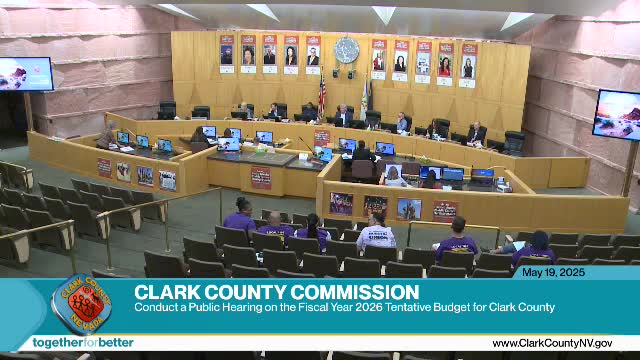
Clark County commissioners on Wednesday approved the fiscal year 2026 final budget after county staff warned of sustained declines in consolidated (C) tax collections and a resulting structural deficit.
For the record, Jessica Colvin, staff member, told the board the general fund relies heavily on consolidated tax revenue and that “we're 6% below the same period last year.” She said that drop — combined with weaker building permits and deed recordings — produces an estimated $27,800,000 structural deficit in the county’s operating budget for FY2026. “Operating revenues are not sufficient to meet operating expenditures, resulting in a $27,800,000 structural deficit,” Colvin said.
The budget matters because the county’s general fund budgeted roughly $2.1 billion in operating revenues, with nearly 43% coming from consolidated tax collections, Colvin said. A sustained decline in that revenue stream would pressure recurring services and could force future choices about capital projects, departmental spending or mandated services.
County staff and commissioners described steps to manage the shortfall without immediate cuts to core services. Colvin recommended funding the FY2026 gap with one‑time transfers from unallocated capital dollars and using vacancy savings while monitoring incoming revenues. She told the board staff would file the final budget on June 1 and provide monthly updates on consolidated tax collections; she said a more formal reassessment of trends would be appropriate in November.
The State of Nevada Department of Taxation informed county staff that it has “collected and distributed all C tax revenues to date,” Colvin said, and staff have discussed verification exercises with the state and the county’s financial advisors to confirm the distribution methodology.
Commissioner Jones pressed staff on internal process improvements tied to staffing and position reclassifications. “What are we doing to improve our process so it doesn't take a year in order to make that happen?” Jones asked. Colvin replied that the county is coordinating with Human Resources to speed reclassification and recruitment, noted HR currently has two people processing reclassifications, and said adding capacity and using existing job titles (rather than creating new titles) would shorten turnaround time.
County staff outlined a tiered set of cost‑containment tools that would be used before cutting mandated services: defer future capital projects, defer current capital projects in early stages, use long‑term liability reserves for retiree health/pension costs, and consider adjusting the fund balance target (the county previously lowered the balance to 8% during the pandemic but typically targets 10%). Colvin cautioned those are one‑time fixes and said recurring revenue recovery or further policy decisions would be required for long‑term balance.
Staff also notified the board of roughly $19,000,000 in potential state legislative fiscal impacts identified so far and referenced Assembly Bill 475 as providing $18,000,000 in rental assistance to the county; Colvin said those and other federal or state developments could change the outlook.
After discussion, a motion to adopt the final county budget and direct staff to transmit the approved documents to the State of Nevada Department of Taxation passed. The motion record in the meeting transcript shows the motion carried; no roll‑call tally was recorded in the transcript.
County staff said they expect to return with any recommended supplemental requests this summer for critical positions funded by non‑general revenues or to backfill positions where grant funding was lost, but that a larger supplemental to address structural deficits is unlikely before November unless revenues materially outperform current projections.
Looking ahead, commissioners directed staff to provide monthly consolidated tax updates, continue verifying the state distributions, and report any material grant losses. Staff said they will recommend additional cost containment if revenue trends deteriorate further.