
Santa Teresa industrial cluster drives $2B in annual revenue; leaders urge water, port and road investments
Get AI-powered insights, summaries, and transcripts
Subscribe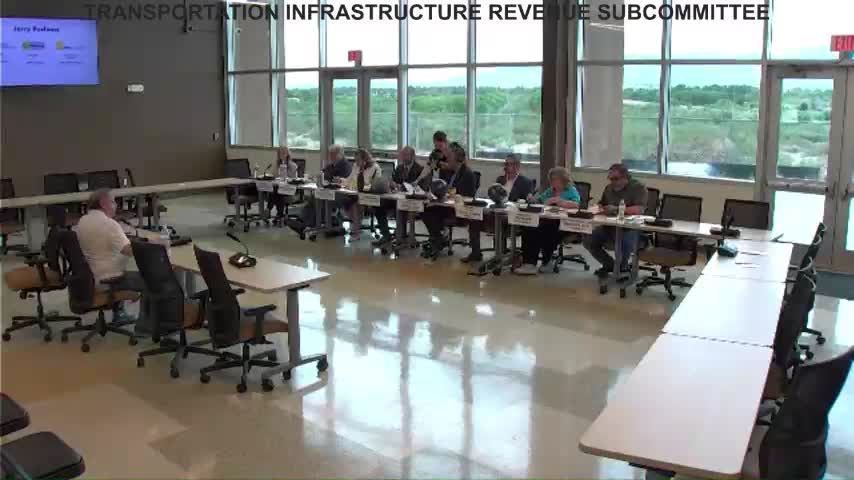
Summary
Jerry Pacheco of the Border Industrial Association told the committee that Santa Teresa’s industrial complex supports thousands of jobs and growing exports but faces infrastructure bottlenecks—especially water/wastewater, port modernization and additional bridge/overpass capacity.
Jerry Pacheco, president of the Border Industrial Association, told the Transportation Infrastructure Revenue Subcommittee that the Santa Teresa industrial region is a major export and jobs engine for New Mexico but needs targeted infrastructure investment to sustain growth.
Pacheco cited an NMSU‑commissioned economic study (updated 2023–24) that he said values the industrial base at roughly $2 billion in annual revenues and supports about 7,000 jobs. He told members Santa Teresa is the easternmost New Mexico port of entry and that the port has been among the fastest‑growing gateways; the port’s trade value rose 44% in a recent year and the region ranks among the top U.S.–Mexico land ports by trade value. Pacheco said New Mexico has led the nation in export growth percentage to Mexico in recent years, driven in large part by the Santa Teresa complex.
Why it matters: officials said the cluster anchors statewide exports, and that companies already in the park — including automotive suppliers, electronics makers and food processors — depend on reliable water, wastewater and freight access. Pacheco described recent private and international investment tied to Foxconn and other suppliers and said the park’s growth has generated roughly 4,000,000 square feet of recent or planned industrial construction.
Infrastructure needs Pacheco highlighted included: - Water and wastewater capacity: Pacheco called water the industrial base’s “Achilles’ heel” and said the region must invest before new firms can be reliably recruited and housed. - Port modernization: GSA work and a port modernization study have been cited; Pacheco said federal planning would likely expand Santa Teresa’s commercial capacity and that the port was on priority project lists. - Road and grade separation: he urged funding for more Rio Grande crossings and other connectors to avoid congestion and long permitting timelines for new bridges. - Airport/jetport improvements: Pacheco described state and federal commitments that he said total about $22.5 million for runway and airfield work to make the Santa Teresa Jetport capable of larger cargo jets and to support logistics growth.
Pacheco also described a 12‑mile overweight zone created by state statute that lets heavier inbound Mexican trucks access warehousing and distribution operations without costly re‑handling; he said that change has helped attract produce and logistics operations. He said the industrial base supports a diverse supply chain — from cold storage and corrugating plants to precision automotive suppliers — and that the Border Industrial Association’s supplier program has generated $63.6 million in contracts across the state by connecting local vendors to park tenants.
On workforce and local benefits, Pacheco said three partners (community colleges, industry and local economic development) are training workers; he noted Union Pacific’s and Dona Ana Community College’s training programs and the role of apprenticeships and forklift/warehouse certificates in hiring.
Committee members asked about housing, tariffs and lost opportunities. Pacheco told the committee that tariffs on steel and aluminum have delayed or deferred expansion by several firms and paused an EV school‑bus project; he urged congressional engagement on trade policy that affects supply‑chain siting decisions.
Ending: Pacheco invited committee members to the Border Industrial Association’s general meeting and emphasized that federal, state and local cooperation on water, roadway grade separations and port modernization will determine whether the region converts current interest into long‑term investments.