Get Full Government Meeting Transcripts, Videos, & Alerts Forever!
Get email alerts on the Transportation Funding topic
No spam. Unsubscribe anytime.
New Mexico DOT warns nearly $471 million gap puts federal grants and major highways at risk
Summary
Department of Transportation staff told legislators a roughly $471 million funding shortfall across priority projects could force the state to forfeit about $330 million in federal grants and delay major interchanges, bridges and the Santa Teresa border connector without new revenue or bonding authority.
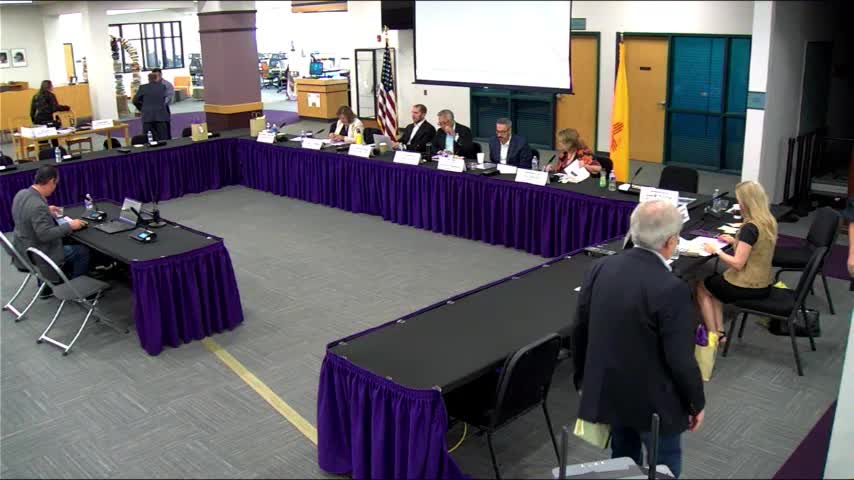
The New Mexico Department of Transportation told a legislative interim committee at Western New Mexico University that roughly $471 million in funding gaps across the department’s priority projects could jeopardize more than $330 million in federal grant awards and delay or cancel major highway projects statewide.
The department’s chief engineer, David Quintana, told the committee that total priority construction needs now total about $1.48 billion and that about $678 million is already obligated; the remaining shortfall across prioritized projects is approximately $471 million. Quintana said roughly $330 million of federal grant funding is at risk if the state cannot cover required matching or other gaps.
Quintana said several large projects face near-term deadlines tied to grant obligations. “We received a USDOT bridge improvement grant award in the amount of $71,500,000,” he said of the Nogal Canyon bridge project, then added, “we have to request FHWA to obligate those funds by next September, in order to to realize that funding. If not, there’s a potential we could lose them.” He gave similar deadlines for an INFRA grant on the new border-connector project at Santa Teresa and for other awarded grants.
Why it matters: Quintana and NMDOT staff said losing federal awards would not only delay construction but also undermine the state’s ability to attract and manage future competitive grants. Department officials and committee members repeatedly linked the funding gap to a wider, longer-term challenge: flat or slowly growing state road revenues while construction costs rise and federal competitive grants grow more prominent and conditional.
What the DOT presented and recommended - Project-level gaps: Quintana listed several high-priority projects with gaps. Examples included Nogal Canyon bridge (estimated construction cost about $146 million; gap roughly $74.5 million after a $71.5 million federal award), the Santa Teresa border connector (estimated construction cost $170 million; a $45 million INFRA award leaves an estimated $125 million gap) and other bridge and interchange projects across multiple districts. He said some grants carry firm obligation deadlines that require the state to prove its match within months. - Statewide totals: Quintana summarized priority project costs at $1.48 billion, grant funds at risk at $330 million, other obligated funds about $678 million and total gaps near $471 million. - DOT finances and workforce: Secretary Ricky Serna told the committee the State Road Fund is “just over $500,000,000 and so half of it goes directly to just paying DOT — just DOT salaries and benefits.” Michael Morrison, the department’s chief economist, cited the January trip-report data showing deteriorated roads cost New Mexicans roughly $3.6 billion annually in vehicle operating, safety and congestion costs. - Policy options discussed: DOT staff described the limits of the Statewide Transportation Improvement Program (STIP), the dependence on federal competitive grants, and the department’s preference to convert some new revenue into bonding authority for larger, multi-year projects rather than one-time appropriations that must be spent quickly. The DOT and allied lawmakers referenced language in a prior bill (House Bill 145) that would have issued bonding authority tied to new, dedicated revenue streams.
Legislative and industry reactions Representatives and stakeholders told the committee they had heard directly from contractors about layoffs and lost capacity after a recent legislative session failed to authorize more predictable bonding or other recurring road funding. Representative Terraz as read a statement written by Sterling Hamilton, owner of Hamilton Construction, that urged a one-time appropriation (Sterling’s statement recommended at least $200 million) to avoid losing matching funds and the jobs they support.
Lieutenant Governor Howie Morales and several committee members said predictable, recurring funding would allow contractors and DOT to plan projects and preserve local workforce capacity; several legislators cited the bonding authority in last year’s House Bill 145 as a rejected but viable path.
What DOT staff said about tradeoffs and timing Quintana emphasized the practical constraints of federal grants and the STIP: projects in the first four years of the STIP must be fiscally constrained and obligations for some grant awards require proof of state match by specific dates. “We’re scrambling to figure out how we’re gonna find that money,” Quintana said of at least one major corridor grant. Secretary Serna and the DOT economists urged the committee to consider a mix of funding tools — modest recurring revenue increases, targeted surcharges, and bonding tied to new revenue — so the state can meet grant matches without creating unsustainable recurring obligations.
What was not decided The committee did not take any votes. Lawmakers debated options, asked DOT to provide more comparative data and asked the executive branch for follow-up; no new appropriations or formal directions were adopted in the meeting.
Context and next steps DOT officials said that without additional state funding or bonding authority, some federal awards could be lost and construction schedules delayed, and that those outcomes would in turn raise costs for New Mexicans (through vehicle repairs, congestion and safety impacts) and reduce the state’s capacity to use future competitive federal funds. Several legislators urged renewed work on predictable revenue sources (registration fees, weight-distance tax adjustments, delivery surcharges or incremental fuel tax changes) and suggested reconsidering bonding tied to dedicated new revenue.
Quotations used in this article are taken directly from committee testimony and DOT staff presentations during the Western New Mexico University meeting.