Sandia director says lab growing job and small‑business impact while recapitalizing aging facilities
Loading...
Summary
Sandia National Laboratories’ director told legislators the lab is investing in facility upgrades, expanding microelectronics and quantum work and sustaining large payroll and subcontracting activity in New Mexico.
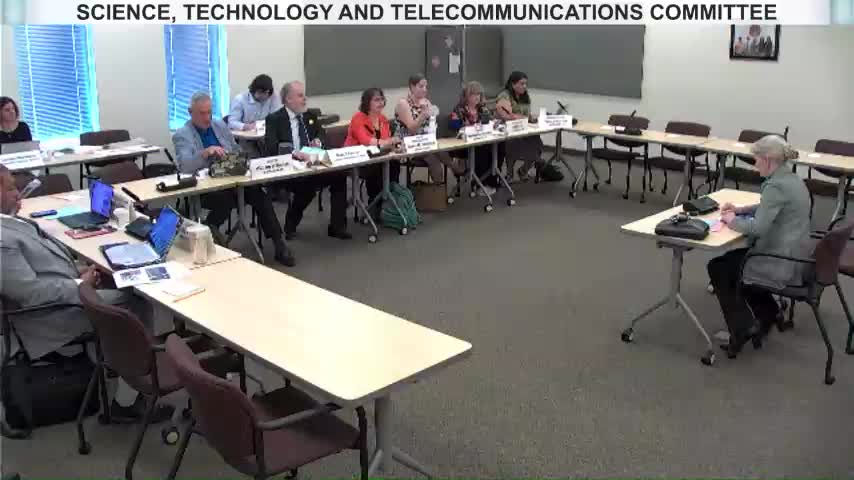
Sandia National Laboratories’ new director, who said she has led the lab for four months, told the Science, Technology and Telecommunications Committee that the laboratory continues to focus on nuclear deterrence while expanding work in cybersecurity, quantum and energy resilience and sustaining sizable local economic impact.
Director McGill said Sandia reported about $5.1 billion in revenue for fiscal year 2024 and that roughly 63–64% of that work supported nuclear deterrence programs. She said labor payments in New Mexico exceeded $1.8 billion and the laboratory’s average employee salary is about $145,000. She also said Sandia makes substantial local procurements and supported small businesses via technical-assistance programs.
McGill described an active recapitalization program for long‑aging facilities. She said construction of a new power‑sources capability would begin site work by September and that Sandia plans to replace its aging Annular Core Research Reactor facility with a Combined Radiation Environment for Survivability Testing (CREST) complex to continue radiation-exposure testing required for weapons-system qualification. She also described Mesa, a microsystems engineering and applications facility, as a future priority for photolithography and trusted microelectronics.
Sandia said it partners closely with Los Alamos and Lawrence Livermore national laboratories, Pantex, and military services and operates specialized test facilities across the country and overseas. McGill highlighted Sandia’s role as systems integrator for non‑nuclear components of the U.S. nuclear stockpile and described applied science initiatives in microelectronics, quantum computing, neuromorphic processors and AI for grid resilience.
On local economic impact, McGill said Sandia’s FY24 subcontracting and procurement included substantial New Mexico participation and said the lab has increased the number of New Mexico suppliers. The director reported $4.4 million in employee charitable contributions to United Way of North Central New Mexico and described volunteer STEM outreach that reaches thousands of students and hundreds of teachers each year.
Committee members asked about federal research funding trends and potential budget pressures. McGill said Sandia expects to remain in generally stable fiscal position because its core NNSA funding is steady and that the lab used a voluntary separation program to reduce indirect costs by about 2% amid rising operational expenses. She also said Sandia supports student pipelines through internships and partnerships with community colleges and universities and that small businesses can compete for work through public procurements and vendor outreach events.
McGill also acknowledged aging buildings and said the lab is prioritizing line‑item projects to modernize facilities essential to the nuclear deterrent and to maintain small‑business engagement and workforce development.