
Los Alamos County officials brief state Science, Technology & Telecommunications Committee on broadband, utilities and resiliency plans
Get AI-powered insights, summaries, and transcripts
Subscribe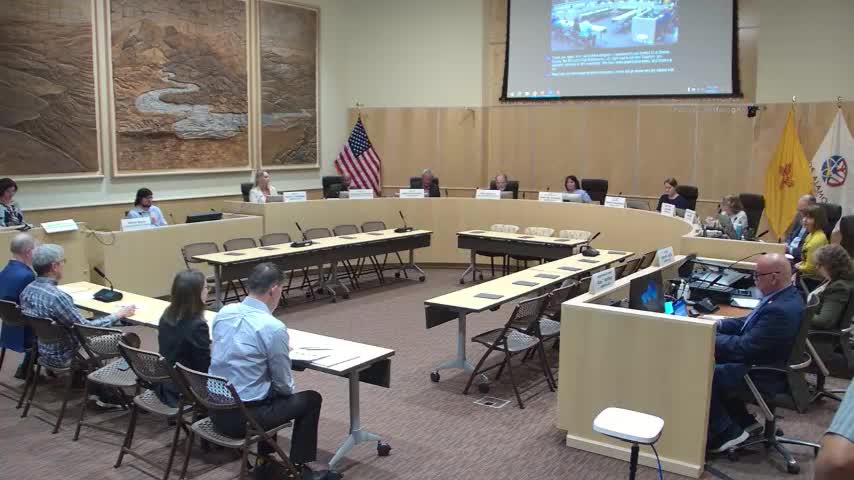
Summary
Los Alamos County officials described ongoing broadband buildout, cybersecurity upgrades, energy projects and wildfire/flood resiliency work, and said the county faces a projected gross-receipts-tax revenue shortfall that may require a GRT increase to preserve operations.
Los Alamos County officials told the New Mexico Legislature's Science, Technology & Telecommunications Committee on a field visit that the county is building a county-owned open-access fiber network, upgrading cybersecurity and pursuing a mix of local generation and storage to improve resiliency.
Anne Laurent, representing Los Alamos County, opened the presentation and described the county as a combined city-county of about "just over 19,000 residents," with a daily commuting workforce of "around anywhere from 8,000 to 12,000." She said the county's recently adopted general fund revenues are about $122,000,000 and that roughly 72% of that total comes from gross receipts tax (GRT).
That dependence on GRT, Laurent said, leaves the county exposed to federal and programmatic shifts at Los Alamos National Laboratory and other large local employers. "We anticipate a $10,000,000 reduction. We are on track to see more like a 14, dollars to 15,000,000 reduction," she told the committee, and said the county is "looking at doing a gross receipts tax increase to try to offset some of those reductions." She added the likely increase would "cover the operational part" but not the entire shortfall.
The nut of the briefing was the county's mix of infrastructure work to reduce outage risk and to expand connectivity. Jerry Smith, Los Alamos County's broadband manager, told the committee that in November the county council committed $35,000,000 to build a fiber-to-the-home and business network covering "10,000 plus homes and businesses," and that the county entered a design and construction agreement with a vendor called Bonfire. Smith said the county intends the network to be county-owned and open access, with "4 to 6 ISPs" available over a single fiber into each home or business.
Smith said the county also is pursuing a second fiber "off the Hill." He described an 11-mile build led by the Pueblo de San Ildefonso to connect White Rock down the hill to regional middle-mile provider Redinet; Los Alamos County provided a local grant match for that project and hopes the new line will be turned up by the end of the year to provide a resilient path off the mesa.
John Roy, the county's chief information officer, described cybersecurity steps the county has implemented since 2022, including two-factor authentication (Cisco Duo), use of DNS inspection services, a disaster recovery site in Albuquerque, immutable nightly backups of more than 70 terabytes of county data, and a newly deployed cybersecurity suite that produces automated alerts. Roy pointed to a sample report showing the suite produced nearly "99,000,000 observations in 7 days," and said his team has repeatedly tested failover to the Albuquerque disaster recovery site.
Ben Ullrich, deputy utility manager for power supply, described the county electric utility's planning. He said the county has a formal integrated resource planning process and is contracting a large solar-plus-storage project expected to come online "at the end of next year, if all goes well." Ullrich told the committee the county's contracted price for the forthcoming solar resource is approximately $38 per megawatt-hour and contrasted that with higher current price indications for geothermal (about $105/MWh) and new natural-gas units ($125'$150/MWh). He said battery storage remains costly (county figures cited roughly $112 per MWh capacity in a cited example) but is essential to reliability and resiliency.
Ullrich and others also discussed longer-term technologies the county is exploring, including pumped hydro, emerging gravity and CO2-based storage concepts, and possible small modular reactor participation, but he noted licensing and federal review costs are high.
Committee members pressed county staff on interoperability between Los Alamos National Laboratory networks and the county system, the choice to build fiber rather than rely on satellite services such as Starlink, availability of wind resources, and whether the county coordinates cybersecurity work with the local public school district. Jerry Smith and others said LANL operates its own internal network but currently rides the same physical fiber; an additional line would allow a separate path and greater resiliency. Smith and Ullrich said fiber is a long-lived, "future proof" investment and that Starlink and other satellite services can be useful but do not provide the same long-term capacity and shared-medium limitations apply in high-density use.
The county also described public-safety and stormwater measures tied to wildfire recovery. Laurent said the county has implemented Wildland-Urban Interface building-code standards, offers free home fire assessments, upgrades stormwater retention and riprap for gullies burned by past fires, and maintains emergency recovery and continuing-operations plans on an electronic "living document" platform maintained with quarterly updates.
Committee members including Representative Christine Chandler and Senator Ant Thornton thanked county staff for the briefing and raised follow-up questions about funding, potential GRT changes and the timeline for fiber and energy projects.
The presentation did not include a committee vote. County officials provided documents and slides and said staff would be available for follow up questions and technical briefings.
Ending: County staff asked legislators to consider technical and funding questions as the county proceeds with construction of a public, open-access fiber network, cybersecurity upgrades and a transition toward more local renewable generation and storage.