Get Full Government Meeting Transcripts, Videos, & Alerts Forever!
Get email alerts on the Wastewater Infrastructure topic
No spam. Unsubscribe anytime.
Clark County Water Reclamation District details $1.8 billion, 15-year CIP and septic-conversion pilot
Summary
The Clark County Water Reclamation District briefed the commission on wastewater treatment capacity expansion, a 15-year capital improvements program totaling about $1.8 billion, a septic-to-sewer conversion pilot (133 conversions completed) and an expanded wastewater surveillance program used as a public-health tool.
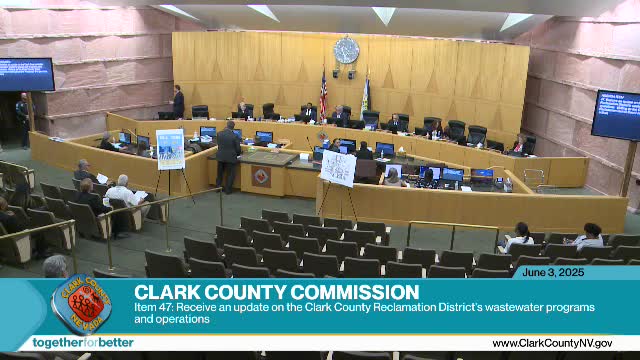
Tom Minwigan of the Clark County Water Reclamation District told the County Commission on June 3 that the district is advancing a broad capital improvements program, a septic‑conversion pilot funded in part by ARPA and a wastewater surveillance program used as a public‑health early warning system.
"The water reclamation district is the largest discharge on the Colorado River. We are the largest wastewater collection system and treatment plant in the state of Nevada," Minwigan said, describing the district's scope and mission. He said the district serves more than 274,000 accounts and more than 1.4 million people, including tourists from the Las Vegas Strip, and employs roughly 375 people.
Sean Mullis, deputy general manager for engineering and construction, presented the district's capital improvement program (CIP): a 15‑year plan broken into five‑year increments with an aggressive near‑term focus on capacity expansion at the Flamingo Wastewater Treatment Plant. Mullis said the district invested about $1.2 billion over the previous 10 years and is budgeting about $1.1 billion for the next five years, with a 15‑year look‑ahead of roughly $1.8 billion. The near‑term work includes a 30‑million‑gallon‑per‑day expansion at Flamingo (from about 120 mgd toward 150 mgd) and three major on‑site projects (primary/preliminary treatment clarifiers, new secondary treatment basins and primary sludge thickening improvements) with an estimated combined construction value described on-site as about $626 million for three projects and $237 million for the secondary treatment project alone.
Minwigan and Mullis described technical details of the expansion: tying into three 84‑inch sewer lines that carry valley flows to the plant, installation of 120‑foot primary clarifiers and 140‑foot secondary clarifiers, on‑site batching for concrete to reduce truck traffic, and work sequencing so the system remained in service during construction. The presenters said the expansion work has used significant materials and labor, including about 67,000 cubic yards of concrete and more than 1,000,000 contract hours across projects.
Tom Minwigan also reported on the district's septic‑system conversion pilot, funded with county ARPA dollars. He said the district has completed 133 conversions to date, recovering roughly 23.4 acre‑feet (about 7.6 million gallons) of indoor water that previously went to septic systems. The district identified about 2,000 acre‑feet of recoverable water across jurisdictions as a program magnitude target and prioritized properties with an existing sewer in the street frontage. Minwigan noted the Southern Nevada Health District maintains the septic records and that access to accurate records has been a challenge; the water reclamation district is collaborating with the health district to improve GIS recordkeeping.
Dan Fisher, deputy general manager for plant operations and laboratory services, summarized the district's wastewater surveillance program. Fisher said the district has collected more than 1,200 samples since the start of COVID‑19 surveillance and that wastewater data showed the Omicron spike days earlier than clinical indicators. Fisher described the program's partners and laboratories, noted the surveillance table the district maintains for pathogens (currently including SARS‑CoV‑2 and norovirus, and with measles recently added), and explained that the data can provide a leading indicator to public health agencies.
Minwigan described ongoing studies and partnerships with NV Energy on power stability and potential recovery of roughly 250 acre‑feet per year from the Clark Generating Station, and conversations with Republic Services on whether treatment of landfill leachate could reclaim additional water (leachate estimates discussed on‑site were about 250–300 acre‑feet). He said the district is watching federal funding programs and the state revolving fund for clean water financing and that the district would apply for capital improvement grants tied to AB 104 should the bill become law.
Commissioners asked about public‑education and tour options for youth; staff said plant tours have been scaled back for safety but that the district's strategic services group conducts school outreach and that staff would work on special activities for youth. There was no formal action requested; the presentation concluded with no vote.