
New Mexico officials outline how gross receipts tax, excises and income taxes fund state budget
Get AI-powered insights, summaries, and transcripts
Subscribe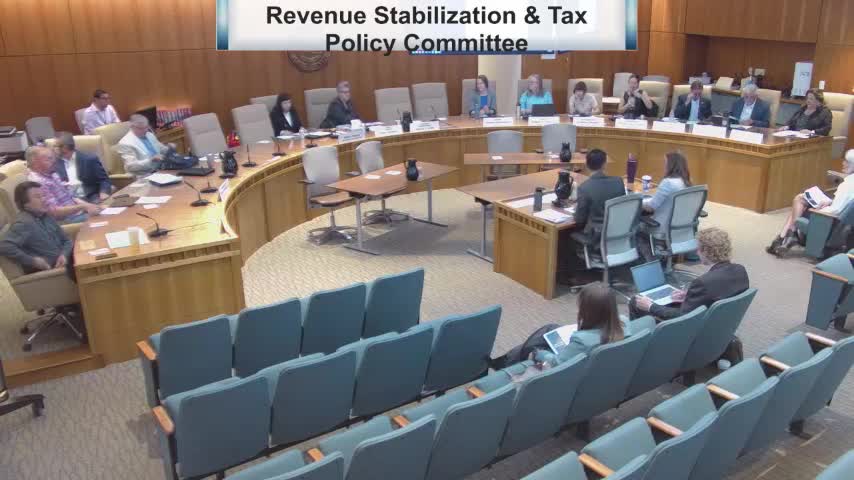
Summary
State tax officials briefed the New Mexico Tax Policy Subcommittee on how the gross receipts tax (GRT), compensating tax, excise taxes and income taxes together supply the general fund, explaining sourcing rules, pyramiding risks and how credits and deductions shape revenue volatility.
SANTA FE — State officials on June 12 told the New Mexico Tax Policy Subcommittee that the gross receipts tax, income and corporate taxes, and a set of excise levies remain the backbone of the state general fund and that the GRT’s treatment of services makes New Mexico’s sales-equivalent tax broader and more volatile than typical sales taxes. "A sales tax traditionally is going to be taxed on goods," said Stephanie Chardon Clark, Secretary of the New Mexico Taxation and Revenue Department. "A GRT incorporates services."
The department’s presentation explained why New Mexico uses a gross receipts tax rather than a sales tax: a GRT taxes sellers, which allows the state to capture economic activity tied to federal facilities and their vendors. Secretary Chardon Clark said a U.S. Supreme Court ruling, "Wayfair," and subsequent legislative changes moved New Mexico to destination‑sourcing for remote sales, implemented 07/01/2021, expanding collections from out‑of‑state vendors while shifting some business‑sourced receipts away from oil‑patch municipalities. "That shift has reduced revenue to those municipalities," the secretary said.
Why it matters: GRT collections are the single largest source of general fund revenue and—together with oil and gas production taxes and permanent‑fund distributions—determine the state’s near‑term budget capacity. The department told legislators the statewide base rate recently was 4.875 percent at the state level, but local option taxes and compensating taxes push total local rates as high as about 10 percent in tourist municipalities. The compensating tax, imposed on buyers for goods acquired outside New Mexico but later used in state, is a mirror to the GRT and now provides a local revenue stream that previously was mostly a state distribution.
Tax code design trade‑offs: Officials noted two common policy tradeoffs. First, because New Mexico’s GRT includes services, lawmakers get a broader base and can keep statutory rates lower, but the GRT is prone to "pyramiding," where tax burdens accumulate through multiple production stages. "Many provisions of our tax code...are designed to prevent pyramiding," Chardon Clark said. Second, credits and targeted deductions narrow the base and can increase volatility; the department’s new tax expenditure reporting will show how exemptions and credits change state and local foregone revenue.
Income and corporate taxes: The brief explained that New Mexico conforms corporate and personal income tax definitions to federal taxable income (with state additions and subtractions). The personal income tax is graduated with a top marginal rate of 5.9 percent; the corporate income tax is a flat 5.9 percent. The department described pass‑through entity and apportionment rules, citing the state’s adoption of the Uniform Division of Income for Tax Purposes Act (EDIPTA in statute) for multistate apportionment.
Excise taxes and special levies: Officials summarized smaller targeted excises—cigarettes ($2 per pack), vaping taxes, liquor excise levies set at fixed per‑unit rates (not indexed to inflation), motor vehicle excise (4 percent), gaming excise on racino net take, and the phased cannabis excise (13 percent in the current fiscal year, rising to 18 percent by FY2030). Chardon Clark cautioned that some excise amounts have not kept pace with inflation and noted earmarks: e.g., roughly 50 percent of liquor excise revenue goes to the general fund, 45 percent to local DWI grants and 5 percent to drug courts.
Questions from legislators highlighted concerns about municipal revenue impacts from sourcing changes, the structure of credits (refundable, transferable or carryforward), and competitiveness of income and corporate rates relative to neighboring states. The department said it could provide comparative rate tables and additional breakdowns in follow‑up materials.
Ending: Committee members said they would follow up with staff requests for data on county impacts, breakdowns of tax expenditures by refundability, and state‑by‑state comparisons of income and corporate rates ahead of future interim work.