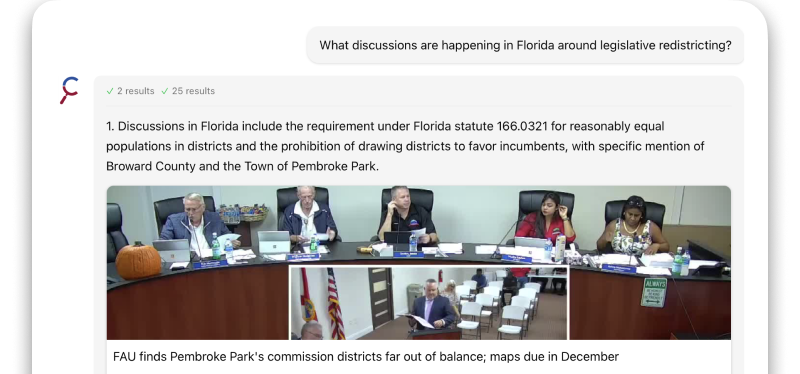
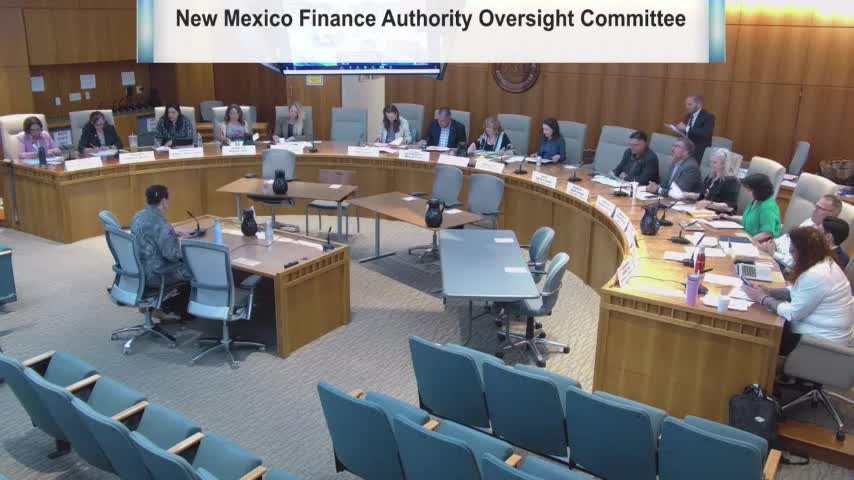
Legislators Hear Wide-Ranging New Mexico Finance Authority Update; Committee Adopts Interim Work Plan
Summary
The interim Legislative Committee on New Mexico Finance Authority (NMFA) oversight received a broad briefing from NMFA CEO Marquita Russell on the agency's programs, recent growth, and new federal funding streams. The committee adopted its 2025 interim work plan and schedule by unanimous voice consent.
Marquita Russell, chief executive officer of the New Mexico Finance Authority, told the Legislative Interim Committee on NMFA Oversight that the agency has grown rapidly in recent years and is managing an expanding set of state and federal programs that finance water, wastewater, roads, housing, and economic development projects.
Russell said NMFA now operates roughly 27 programs under 13 statutes, has doubled staff in five years (about 75 employees with a budgeted headcount rising to 80 in July), and administers several boards including the Water Trust Board and the Colonias Infrastructure Fund. “We are rich with authority and not necessarily with money in all of our programs,” Russell said, adding the authority continues to use bond issuance and program design to leverage additional capital for local projects.
The presentation focused on three signature NMFA programs: the Public Project Revolving Fund (PPRF), the Water Project Fund administered via the Water Trust Board, and the federal Drinking Water State Revolving Fund. Russell said the PPRF is the authority’s flagship bonded program (rated AAA by S&P), has made more than 2,200 loans since inception, and has enabled low- or zero-interest financing for school bonds, fire trucks, and other public infrastructure. The Water Project Fund now receives 8.1% of senior severance tax bond proceeds and has been a major driver of recent activity. The Drinking Water SRF has received significantly increased federal capital in recent years (including funds for lead service line replacement and emerging contaminants), which Russell said amounts to roughly $105 million available for projects in the recent funding rounds.
Committee members asked about several programs that were discussed or authorized in the 2025 session. Russell described the Opportunity Enterprise and Housing Development board and its two funds (about $120 million for commercial/site-ready development and $125 million for workforce housing-related infrastructure). She said NMFA is developing rules for the solar access fund (statute created in 2025 with a $20 million appropriation) in partnership with the Energy, Minerals and Natural Resources Department and expects rulemaking in the fall. Russell also described the childcare facility revolving fund (about $10 million appropriated in HB2), adjustments made by Senate Bill 175 to allow employer-based childcare centers, and program development underway for that fund.
Members pressed NMFA on capacity and risk management as the agency has grown. Russell said the agency is implementing an integrated business application and a multi-year data and records management project to move away from spreadsheets and multiple disconnected systems. She emphasized efforts to document procedures and implement “guardrails” so the agency does not depend solely on institutional memory: “We have to replace the guardrails with systems,” she said.
Legislators questioned whether New Mexico’s overall sovereign credit rating affects NMFA. Russell said S&P has rated the PPRF AAA; Moody’s applies different constraints (NMFA cannot be more than one step above the state’s rating under Moody’s approach). She described regular, project-level collaboration between NMFA analysts and state partners such as DFA and the Legislative Finance Committee when underwriting local-government financings, and said informal coordination among state finance entities has increased.
Other topics raised in the Q&A included the primary care capital fund (Russell said it targets nonprofit primary-care providers and local-government clinics and that it has historically been underfunded), technical assistance and regionalization efforts for small water systems, the venture-capital program (state dollar allocation plus federal capitalization invested in private funds), and the need for more robust reporting to show outcomes and economic impact beyond dollars disbursed.
The committee then considered and adopted its interim work plan and meeting schedule for 2025 (meetings in July, August, September and November). Representative Debbie Sariana moved adoption; Senator Carlos Brandt seconded. The chair asked, “Is there any objection?” and, after none was raised, the committee accepted the plan by voice consent.
The committee asked NMFA to provide recurring statutory reports (PPRF activity, Water Trust Board awards, Drinking Water SRF activity, colonial infrastructure awards, venture capital investments and delegated-bond reports) and requested additional materials on technology and data systems, dormant or underutilized funds that could be reprogrammed, and outcome metrics for NMFA investments. NMFA said it will continue developing program rules (solar access fund, childcare facility fund, charter school facility fund), and staff signaled they will bring follow-up materials to the committee during the interim.