
Kirtland bulk‑fuels leak: regulators, Air Force and water authority say pumps and monitoring are limiting spread but work will take years
Get AI-powered insights, summaries, and transcripts
Subscribe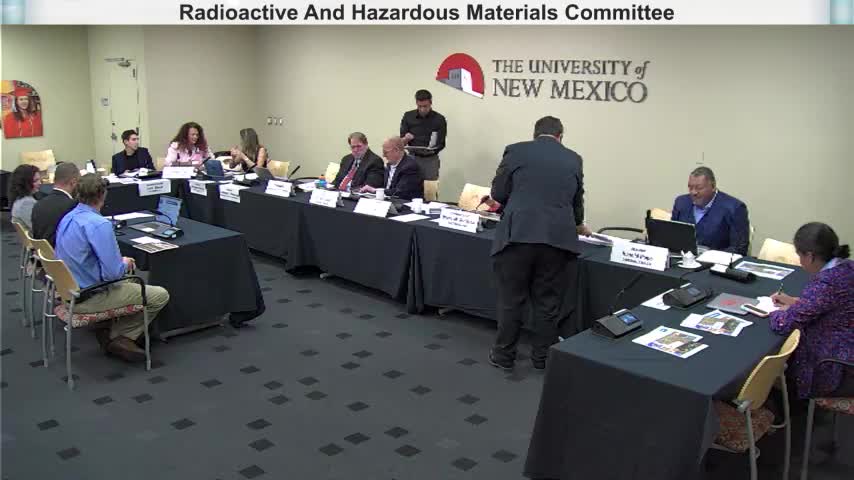
Summary
State hazardous‑waste regulators, the Albuquerque Bernalillo County Water Utility Authority and Air Force engineers told a legislative committee that a long‑running jet‑fuel release near Kirtland Air Force Base is being managed with monitoring and an active pump‑and‑treat system that prevents current drinking‑water impacts but that a full remedy will take years and requires more site characterization.
New Mexico hazardous‑waste regulators and the Albuquerque Bernalillo County Water Utility Authority updated the Radioactive & Hazardous Materials Committee on a decades‑old jet‑fuel release near Kirtland Air Force Base and described current monitoring, interim measures and the timeline toward a formal corrective remedy.
Nature and scope of the release
John David “JD” Nance, Hazardous Waste Bureau chief at the New Mexico Environment Department (NMED), said the bulk fuels facility is being managed under the state’s RCRA corrective‑action framework. Nance described the process: investigation, corrective measures evaluation, remedy selection and corrective measures implementation. He said recent work has focused on better characterizing the source zone and the dissolved‑phase plume—particularly benzene and ethylene dibromide (EDB)—and on adding monitoring wells and samples for light non‑aqueous phase liquid (LNAPL) to guide remedy evaluation.
Kelsey Bicknell, environmental manager for the Albuquerque Bernalillo County Water Utility Authority, told the committee the utility treats the plume as a priority groundwater contamination site because the aquifer supplies a large fraction of the city’s water. "We serve about a third of the population of New Mexico," Bicknell said, noting that drought increases reliance on groundwater supplies. She described utility modeling showing that without action the contamination’s impact on drinking‑water assets could last centuries; the current pump‑and‑treat system reduces that horizon substantially, she said.
Interim remedies, monitoring and risks
Air Force project manager Ryan Wortman and NMED explained ongoing interim measures. Wortman said four extraction wells installed between 2015 and 2018 continuously pump groundwater that is treated with granular activated carbon (GAC) to remove EDB and other constituents; treated water is reinjected or used for on‑base irrigation. "We've never seen any breakthrough of EDB through our treatment system," Wortman said.
Bicknell cautioned that the pump‑and‑treat is an interim measure only. She said modeling indicates that with the pump system in place cleanup could take roughly a century, while no action could leave impacts for centuries (utility models gave a worst‑case estimate of roughly 800 years). The utility has installed a monitoring well through state capital outlay to provide an early warning for migration. Nance said NMED is reviewing a Phase‑2 RCRA Facility Investigation report submitted April 29, 2025, and is using a third‑party contractor to ensure thorough technical review and a timely back‑and‑forth with the Air Force.
Next steps and public involvement
All presenters described a collaborative, iterative review: NMED will provide comments on the Phase‑2 RFI; the Air Force will respond; and the corrective‑measures evaluation (CME) phase will use the assembled data to propose specific remediation alternatives and launch a formal public comment period. Wortman said the Air Force has contracted remediation experts and believes enough information exists to move the project into the CME. Nance said NMED is aiming for a collaborative review (early questions and iterative exchanges) to keep the long review from stalling.
Why the public should care
Bicknell said the site is the most serious of the water‑quality risks the utility tracks; while extraction and treatment have held the plume away from supply wells so far, she said changes to the pump‑and‑treat operation would be necessary as characterization improves. "There is a possibility of breakthrough under these conditions," she told the committee, and the authority seeks a contingency agreement with the Air Force to ensure replacement supply aif a supply well is impacted.
Ending
Officials asked the committee for continued oversight and support while technical reviews proceed. NMED will publish its comments and continue stakeholder meetings; the Air Force will pursue the corrective‑measures evaluation and then a public remedy selection and comment period.