
New Mexico reports near‑universal PFAS in Curry County blood tests; regulators outline rules, inventory and litigation
Get AI-powered insights, summaries, and transcripts
Subscribe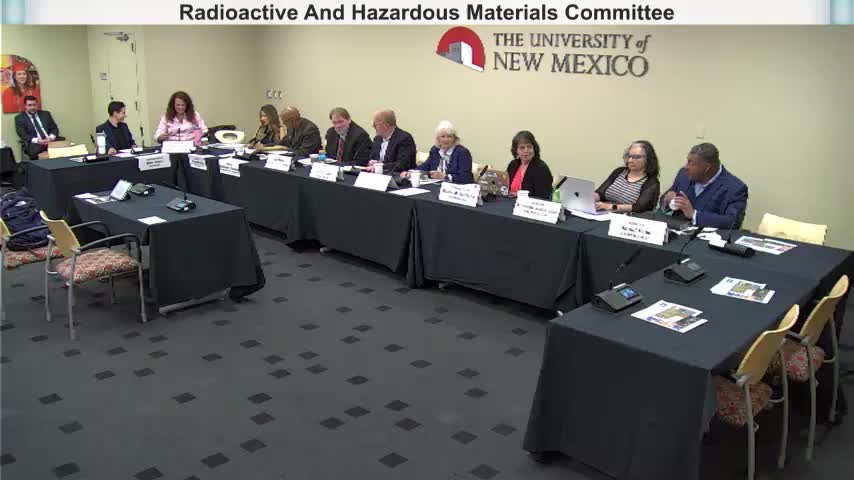
Summary
Secretary James Kenney of the New Mexico Environment Department told the Radioactive & Hazardous Materials Committee that a recent Curry County blood‑testing project found PFAS in 99.7% of participants and a chemical mix "fingerprint" consistent with firefighting foam, and described forthcoming state rules, funding and litigation tied to the findings.
Secretary James Kenney, New Mexico Environment Department, told the Radioactive & Hazardous Materials Committee on Sept. 1 that a state‑funded blood testing project in Curry County found PFAS in nearly every participant and identified chemical patterns the state links to firefighting foams.
The testing program—organized by the Environment Department with the Department of Health and conducted in Curry County after community requests for study—set out to measure exposure and guide public health responses. Secretary Kenney described the numbers and next steps: draft rules on consumer goods and hazardous waste, capital outlay to connect rural Curry County to public water and litigation the state has launched and faces with the Department of the Air Force.
The testing results
The department said volunteers made 724 testing appointments and 638 blood samples were collected; 628 were analyzed. "Ninety‑nine point seven percent of the participants had PFAS in their blood," Kenney said. He told the committee that while low‑level PFAS is now widely detectable in U.S. populations, the Curry County samples showed a distinctive pattern: "what we found was the types of PFAS that were in people had what I'll call a fingerprint for firefighting foams." The department reported one PFAS (PFHxS) at about 3.23 times a prior national average and PFOS at about 2.2 times the prior average; roughly 26% of participants fell into the previously defined national highest‑concentration tier for PFAS.
Why the state is regulating PFAS now
Kenney reviewed two 2025 legislative outcomes the Environment Department is implementing. House Bill 212 (PFAS Protection Act) requires product labeling, reporting and an "unavoidable use" exemption process; the department plans stakeholder draft rules in September and to seek Environmental Improvement Board (EIB) action this winter. He said the department will propose enforcement tariffs and a public comment period before rules are finalized ahead of a January 2027 effective date for initial protections.
Separately, the legislature amended the state Hazardous Waste Act to designate AFFF (aqueous film‑forming foam) as hazardous waste and to preserve the state's hazardous‑waste list unless the Legislature changes it. "We listed AFFF ... as a hazardous waste," Kenney said, adding the law also exempts agriculture from certain impacts and authorizes EIB rulemaking to inventory on‑base and unused foam, plan for treatment and disposal, and integrate those controls into the state's hazardous‑waste framework.
Community response, health guidance and funding
Kenney described extensive community outreach in Curry County—meetings at kitchens, coffee shops and public events—and said the state supplied individual test results and medical follow‑up options. He said the state will continue DOH education for clinicians and a public meeting in Clovis on Oct. 23.
On funding, Kenney told the panel that capital outlay includes roughly $12 million to connect rural Curry County to public water and about $2 million to identify and help residents on private wells get filters and maintenance; the department is working on distribution plans.
Litigation and next steps
Kenney updated the committee on litigation: the federal government sued New Mexico over the state's permitting authority (10th Circuit briefing pending), and New Mexico has mounted a bellwether case in multi‑district litigation in South Carolina against the Department of the Air Force seeking monetary and remedial relief. He described both federal and state court tracks as central to the state's strategy and urged continued monitoring, rulemaking and community outreach.
Why this matters
The department characterized the Curry County study as a validation of community concerns and a metric for how environment and health agencies can work together: testing, clinical outreach, and funding to reduce exposure pathways. Committee members pressed for technical details—sampling methods, whether military personnel were included, and how the state will compare its data to new CDC datasets expected this fall. Several members urged broader deployment of baseline testing and expanded outreach to other communities with potential PFAS exposures.
Ending
Kenney requested continued legislative support for rulemaking and funding and described the work as a long‑term program: testing, monitoring, litigation and potential remediation. The department said it will return with rule drafts and that the EIB will consider the state’s consumer‑product and hazardous‑waste rules in coming months.