
NMFA outlines multiple revolving funds to spur loans to businesses; SSBCI tranche progress tied to participation programs
Get AI-powered insights, summaries, and transcripts
Subscribe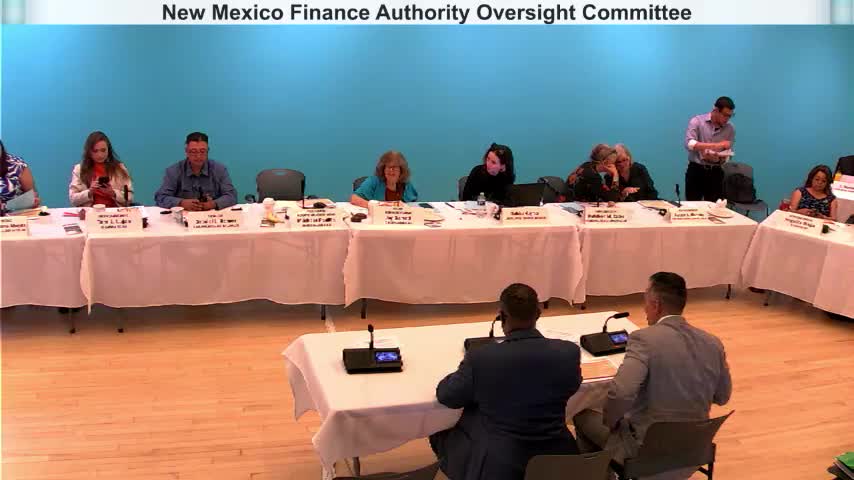
Summary
New Mexico Finance Authority staff reported on the Economic Development Revolving Fund and its six subaccounts — including smart money, essential services loans and SSBCI‑funded capital access and loan participation programs — and described program goals, participation targets and early portfolio outcomes.
John Brooks, chief of programs at the New Mexico Finance Authority, told the oversight committee the Economic Development Revolving Fund comprises six subaccounts that provide loan participations, direct working capital and targeted support to startups and essential service providers. The programs include Smart Money, Essential Services working capital loans, a cannabis microbusiness pilot, SSBCI‑funded capital access and loan participation programs, and an energy efficiency revolving loan fund in partnership with the Energy Minerals and Natural Resources Department.
Why it matters: Brooks said the structure is intended to match New Mexico’s small business profile and to give banks and Community Development Financial Institutions (CDFIs) tools to lend where private markets under‑serve. Several committee members asked how the programs translate to tangible loans in local communities and about steps to ensure tranches of SSBCI funding are unlocked.
Program highlights and terms: Brooks summarized each subprogram: Smart Money is a state participation program with loans up to $2 million and NMFA participations averaging 32% on projects; Essential Services provided direct working capital loans up to $1 million (1% interest, no application/closing fees) to hospitals, childcare, pharmacies and other essential providers during COVID‑19; the cannabis microbusiness pilot made working capital loans up to $250,000 but is not accepting new applications because underwriting costs, collateral issues and industry volatility constrained success; the SSBCI suite includes a venture capital tranche (to anchor funds), a capital access pool guarantee program and a loan participation product intended to leverage bank lending. Brooks reported 14 loan participation conversations in progress with banks and $27 million earmarked for the loan participation product.
SSBCI status and tranche mechanics: Brooks explained SSBCI funds are released in tranches; the state must hit deployment thresholds to receive subsequent tranches. NMFA and the Economic Development Department have used early SSBCI allocations to stand up a venture capital program and a collateral support program; Brooks said these deployed activity that permitted moving into tranche two and increased the state’s retained SSBCI allocation.
Cannabis pilot and lessons learned: Brooks and committee members discussed why the cannabis microbusiness pilot struggled: smaller growers often lacked saleable collateral, many operators leased space rather than owning property, and licensing volume from regulators rapidly increased local competition in some markets, compressing prices and returns. “The industry was quite frankly very volatile,” Brooks said; several loans are being restructured and one required an out‑of‑court settlement.
Energy efficiency revolving loan fund: Fernando Martinez, deputy director, presented the Department of Energy formula grant‑backed Energy Efficiency Revolving Loan Fund (EERLF). The Energy Conservation and Management Division awarded NMFA underwriting responsibility for a $5 million DOE award; eligible borrowers are commercial building owners doing energy retrofits and must work with an energy service company and complete an audit. Loan sizes range from $250,000 to $1 million, at a roughly 2% interest rate, with terms not to exceed project useful life or 15 years; EMNRD provides technical assistance and client outreach.
Questions and next steps: Committee members probed portfolio outcomes, participation by community banks and whether SSBCI‑backed products will lower borrower rates meaningfully. Brooks said NMFA hopes to lower blended borrowing costs and reduce lender risk to catalyze bank lending; he listed participating banks engaged for loan participation discussions. NMFA staff said they will continue reporting quarterly on SSBCI program rollout and will seek legislative reauthorization for operating authority that sunsets in June 2026 to avoid reverting to an annual project authorization model.
Ending: Brooks framed the package as a set of complementary tools — direct loans, participations, collateral pools and venture investments — intended to expand access to capital for New Mexico businesses, especially in underserved and rural areas, while acknowledging the programs require ongoing legislative and market coordination to deliver expected local outcomes.