
Clark County officials outline plan to fund about 8,000–10,000 affordable units over next decade as need climbs
Get AI-powered insights, summaries, and transcripts
Subscribe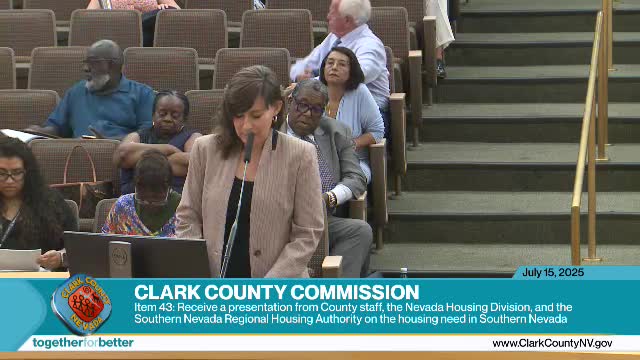
Summary
County staff and state and regional housing partners presented updated needs and financing plans, saying Southern Nevada still faces a gap of more than 90,000 affordable units and that county funds plus partners could support roughly 8,000–10,000 units over 10 years.
Clark County officials and statewide housing partners said Thursday that Southern Nevada faces a widening shortage of affordable homes while laying out how county, state and federal programs could fund thousands of units over the next decade. “We had a need of about 80,000 units in Southern Nevada for households at 50% of the AMI and below. Updated data puts that number at approximately 96,000,” Community Housing Administrator Dagne Stapleton told the Clark County Commission. The presentation, led by Stapleton with remarks from Steve Acroft of the Nevada Housing Division and Louis Jordan of the Southern Nevada Regional Housing Authority, summarized local need, recent investments and funding tools the county will rely on through 2035. Why it matters: Stapleton and partners said cost and availability remain the primary barriers for low‑ and moderate‑income households; nearly 70% of households at or below 50% of area median income (AMI) pay more than half their income on housing. The county has ramped up funding since 2022 through the Community Housing Fund (CHF) and state ARPA dollars but still faces a substantial gap between supply and demand. Key facts presented: County staff said CHF and HOME funds have supported about 4,600 new units since 2022, a 25% increase in the region’s affordable inventory. Stapleton told the commission that county funds could support roughly 400 new and rehabbed units per year and HUD HOME funds about 100 per year, or roughly 5,000 county‑funded units over the next 10 years. Acroft, administrator of the Nevada Housing Division, described additional state programs — including low‑income housing tax credits (the “4%” and “9%” programs), the supportive housing development fund, and the newly created attainable housing account and infrastructure fund — that state lawmakers recently funded and that will supplement county dollars. Acroft used a capital‑stack analogy: “If you walk into the dollar store with 91¢, you walk out with nothing. But if you walk in with a dollar, you can actually get a product,” illustrating the role of CHF and other gap financing in closing financing shortfalls on projects. Supportive and supportive‑services housing: County social services estimates the region will need about 1,800 permanent supportive housing units by 2027; Stapleton said the need is increasing. The county has prioritized supportive units in recent funding rounds and extended county affordability deed restrictions to 50 years. Role of the housing authority: Louis Jordan said the Southern Nevada Regional Housing Authority has been using project‑based vouchers as a financing tool and has committed project‑based voucher capacity to dozens of projects. “Project based voucher is a tool that HUD allows us to use as housing authorities where the subsidy stays with the property,” Jordan said, adding that the authority has deployed roughly 304 project‑based units in recent rounds. Limits, uncertainties and next steps: Speakers told the commission several federal and market variables could affect production: changes in federal HOME and other funding levels, uncertainty about tax credit pricing, construction costs and tariffs, and workforce constraints. Stapleton and Acroft urged continued regional coordination and recommended maintaining existing programs — CHF, HOME, state gap funds and project‑based vouchers — while scaling where possible. No ordinance or appropriation was adopted at the hearing; the presentation was received by the board and commissioners asked staff to continue coordinating with state and housing authority partners and to return with follow‑up data as requested.