Get Full Government Meeting Transcripts, Videos, & Alerts Forever!
Get email alerts on the Health Insurance Compensation topic
No spam. Unsubscribe anytime.
Analysis shows Brightwood's total compensation above BLS public-sector range; committee probes insurance handbook error
Summary
A Budget Committee presentation on Sept. 8 showed Brightwood's sample total compensation ratios averaged 1.89, above a cited BLS public-sector range of 1.41.6, and committee reviewers discovered a handbook/implementation mismatch that had increased the town's share of health-insurance premiums.
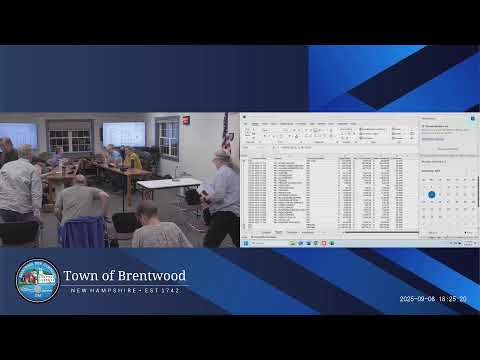
A Budget Committee presentation on Sept. 8 laid out two linked personnel-cost issues: a compensation-ratio analysis intended to show the full employer cost of municipal employees, and a separate, detailed review of the town's employee health insurance contributions that identified a handbook/implementation mismatch that has shifted costs from employees to taxpayers.
Compensation-ratio analysis: The committee heard a nine-scenario sample of total compensation calculations that compare base salary to total employer cost (salary plus employer-paid benefits and payroll taxes). The presenter said the nine scenarios produced compensation ratios ranging from 1.59 to 2.24 and an average of 1.89. The presenter used example cases including a $50,000 police officer with five years' service whose total employer cost was shown as $97,118 (a ratio of about 1.94). By comparison, the Bureau of Labor Statistics (March 2025) was cited as showing a public-sector typical range of about 1.4 to 1.6 of salary for total compensation.
Retirement and payroll components were emphasized as major drivers of the total compensation figure. The presenter recorded the town's employer retirement contribution rates (2025): Group 1 employees, 12.75% of salary; Group 2 (fire) 29.15%; Group 2 (police) 30.95%. Payroll-tax assumptions used in scenarios were 7.65% for Group 1 (Social Security plus Medicare) and 1.45% for Group 2 (Medicare only). The presenter and committee members explained that as gross wages increase, the compensation ratio generally trends downward because some benefit costs (for example, health insurance) do not scale proportionally with salary.
Health insurance and handbook mismatch: Separately, a Committee subteam and the finance director (Julie Stevens) reported a review of the town's 2025 health-insurance budget and the employee handbook. The town budget had an appropriation for health insurance of $596,674 for 2025. The committee analysis applied the handbook's stated contribution rules (the handbook describes three options, with the town to pay 100% of single coverage and 75% of two-person/family coverage using the middle plan as the basis for town contribution) to the 2025 plan options that were actually in use. The committee concluded the town had been using the highest-cost plan as the town's reference point for employer contributions, which resulted in the town paying a larger share than the handbook calls for.
Using the handbook method and the 2025 enrollment mix the committee reported, the health-insurance appropriation would have been $502,099, a reduction of $94,575 (about 16%) from the $596,674 actually budgeted. Committee members and members of the public noted that correcting the approach reduces the taxpayers' appropriation but would increase employee premiums or out-of-pocket cost for some family/couple plans.
HealthTrust and proposed mitigations: Representatives from HealthTrust (Andrew) and a resident benefits consultant (Sean Cameron) joined review discussions previously and offered options the committee could consider before changing contribution policy. Suggestions discussed included eliminating a very low-deductible, high-premium plan that few employees select; moving to higher-deductible tiers (for example, a $1,000, $3,000 and $5,000 option) that materially lower premiums; and offering employer-funded Health Reimbursement Arrangements (HRA) or contributions to Flexible Spending Accounts (FSA) to help employees manage deductibles and co-payments (example suggested funding: $500 single / $1,000 couple / $1,500 family). The presenters also noted "site-of-service" provider networks in the Seacoast region that can reduce out-of-pocket costs for certain services if employees use those providers.
Next steps and staff actions: The finance director said she would model a transitional scenario (an example provided in the meeting was an 8% phased change toward handbook-based contributions) and circulate results once health-plan rates are available from HealthTrust. HealthTrust indicated rates would be available in early October (a date given was Oct. 7), and the committee expects to review finalized scenarios before open enrollment, commonly held during the fall with coverage effective Jan. 1. The Select Board chair told the committee the Select Board will take this up as a policy matter and consider transitional approaches; the chair suggested any implementation be coordinated with a full Select Board and the newly appointed finance and administrative staff.
Public comment and concerns: Several members of the public commented. Some taxpayers urged that the town correct the budgeting error and align contributions with the handbook, saying taxpayers have been overpaying; several commenters and committee members expressed concern for employees who will face higher premiums or deductibles if the town switches the reference plan without mitigation. Committee members and Select Board representatives said they plan to present several scenarios to employees and the Select Board and to weigh options such as phased implementation, HRAs/FSAs, or alternative plan structures to reduce immediate employee impact.
Ending: No formal vote on insurance policy or contributions occurred at the Sept. 8 meeting. Committee members requested scenarios and cost models from the finance director and agreed to work with the Select Board and HealthTrust (and to solicit employee input) before any policy change. The compensation-ratio material will be complemented by a wage-level comparison if the Budget Committee elects to pursue regional benchmarking.