Get Full Government Meeting Transcripts, Videos, & Alerts Forever!
Get email alerts on the Wireless Infrastructure topic
No spam. Unsubscribe anytime.
Commission approves AT&T's palm-tree camouflaged tower near Paradise after conditions and off-site contributions agreed
Summary
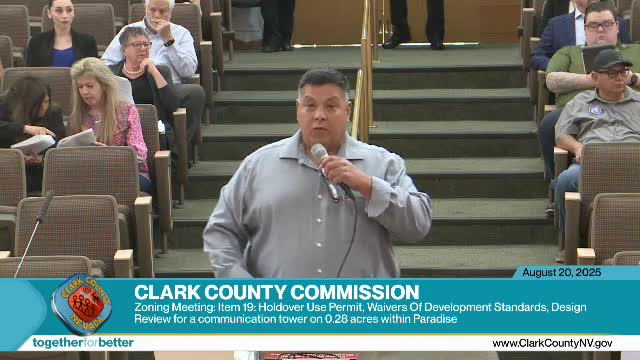
The Clark County Commission on Aug. 20 approved a use permit and related waivers allowing AT&T's palm-tree-camouflaged communication tower in Paradise, subject to public-works conditions including a cost contribution for off-site improvements and a $10,000 payment in lieu of trees.
The Clark County Commission on Aug. 20 approved a use permit and related waivers for a proposed communication tower in Paradise, allowing the applicant to install a palm-tree camouflaged structure, subject to conditions including a public-works cost contribution for off-site improvements and a $10,000 in-lieu fee for trees. Nut graf: Centerline Communications, representing AT&T Wireless, presented the proposal for a palm-tree-styled monopalm tower; public-works staff and the applicant agreed on conditions that led the board to approve the permit and waivers, and commissioners discussed aesthetics and the option to return with a different design. Applicant presentation and conditions: Rich Conte, a consultant for AT&T Wireless with Centerline Communications, described the proposed communication tower, said co-location opportunities were evaluated and not feasible, and described tower height and landscaping. Public works read into the record a condition that the applicant would pay a cost contribution as determined by public works for construction of off-site improvements along Twain Avenue; in light of the cost contribution, staff requested deleting a condition requiring execution of a restrictive covenant agreement. Public works and the applicant also confirmed the applicant would contribute $10,000 in lieu of trees and would be allowed to install a chain-link fence surrounding the equipment compound rather than other fencing options. Public-works comments were read into the record and the applicant accepted them. Board discussion: Commissioner Christopher Jones noted personal distaste for monopalm towers, saying, "I think that, cell phone, cell tower, palm trees, and pine trees are ugly and that we should ban them," but he deferred to the permitting process. Commissioners discussed the possibility of returning with a different design; one commissioner suggested the applicant could present a new design for further review. Action: A motion to approve the use permit and waivers was cast and, after the conditions and applicant concessions were read into the record, the motion passed. What approval allows and does not allow: Approval authorizes the use permit and waivers as conditioned; it does not replace building permits, inspections or other required final development approvals. The record shows the applicant agreed to make the public-works cost contribution and the $10,000 in-lieu tree payment, and to retain a chain-link fence around the equipment yard as allowed in the approved condition. Ending: With conditions reflected in the motion, commissioners approved the permit and waivers; staff will track off-site improvement contributions and the project's permitting through standard public-works and building-permit processes.