
Longmont council rejects amendment to narrow open-space disposition rules
Get AI-powered insights, summaries, and transcripts
Subscribe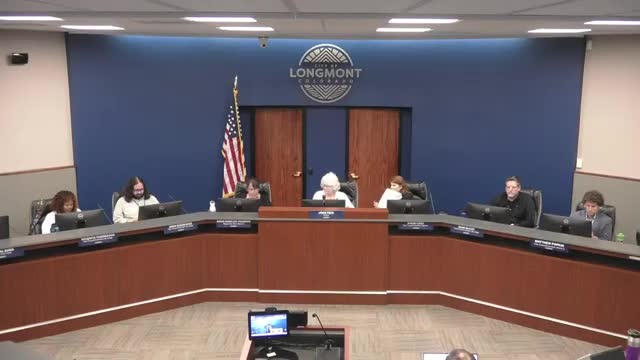
Summary
A proposal to amend the city’s open-space disposition ordinance to explicitly prohibit disposition for industrial, housing or private-entity uses failed 3–4 at the Sept. 2 study session after legal and policy concerns and active negotiations were cited.
Mayor Peck, Mayor Pro Tem Hidalgo Faring and two council members sparred over how strictly the city should define “public purpose” for disposition of open space at the Longmont City Council study session on Sept. 2, 2025, and a proposed amendment to the city’s open-space disposition rules failed on a 3–4 vote. Mayor Pro Tem Hidalgo Faring introduced the measure, asking the council to revise Section 14.52.032, Process A, Section 1 to state what cannot be considered in disposition of open space, including industrial uses, housing and transfers to private entities.
The measure would have changed the ordinance’s wording from a permissive “means and includes but is not limited to” test for public purpose to a definition that explicitly excludes certain uses. “What I’m hearing is that you want to close that gap,” Hidalgo Faring said as she framed the motion, adding she meant to “put guardrails” around how council interprets a ‘net benefit’ for the open-space program.
City Attorney Eugene May explained the ordinance language the council was discussing and flagged how the existing provision leaves room for interpretation. “Section A1 goes on to state the term public purpose means and includes but is not limited to use of the property for right of way and easements for city roads, utilities and life essential infrastructure and…sale or exchange of property interest that result in a net benefit to open space,” May said. “There is room for interpretation and the net benefit is not defined — it is to be determined by council.”
Council discussion focused on the practical effect of the change and on timing. Several members said they supported the intent of the amendment but worried it could interfere with an active negotiation — repeatedly referred to in the meeting as the “distal toll” negotiations — or create unequal rules for ongoing deals. Councilor Kelser Popkin and Councilor Yarbrough pressed that changing the rules while negotiations were underway could be counterproductive. “When something’s tabled, it seems like it should stay tabled, and we shouldn’t talk about it until it comes back,” Popkin said.
After debate, the council voted and the motion failed. The clerk’s tally recorded Mayor Peck, Mayor Pro Tem Hidalgo Faring and Councilor McCoy voting yes; Councilors Popkin, Yarbrough, Christ and Rodriguez voted no.
Why it matters: The vote preserves the current, broader language that allows council to determine whether a disposition of open space serves a public purpose. Supporters of a stricter rule told council they wanted to prevent the use of open space for industrial or housing development without voter approval; opponents said the pending negotiation and the ordinance’s exception for swaps and “net benefit” situations required more study. Mayor Pro Tem Hidalgo Faring said she planned a second motion directing staff to draft ballot language requiring any land exchange or disposition of open space be approved by voters; council discussion left the timing of that work for a later meeting.
The council gave no formal direction at the Sept. 2 study session to change the ordinance immediately; staff and council members instead discussed how and when a separate ballot measure — if pursued — might proceed and whether to survey public opinion beforehand. The city attorney advised that changes to the disposition rules could affect any active negotiations, so the council must weigh timing and legal consequences before altering the ordinance.
What comes next: The council’s packet and staff noted the issue will return for future consideration if council directs staff to draft specific ordinance language or ballot language. No ordinance amendments were adopted at the Sept. 2 session.
Sources: Council discussion and vote at the Sept. 2 study session; remarks by Mayor Pro Tem Hidalgo Faring and City Attorney Eugene May (study-session transcript, Sept. 2, 2025).