
Greeley approves Willow Vista annexations and zoning for about 222 acres
Get AI-powered insights, summaries, and transcripts
Subscribe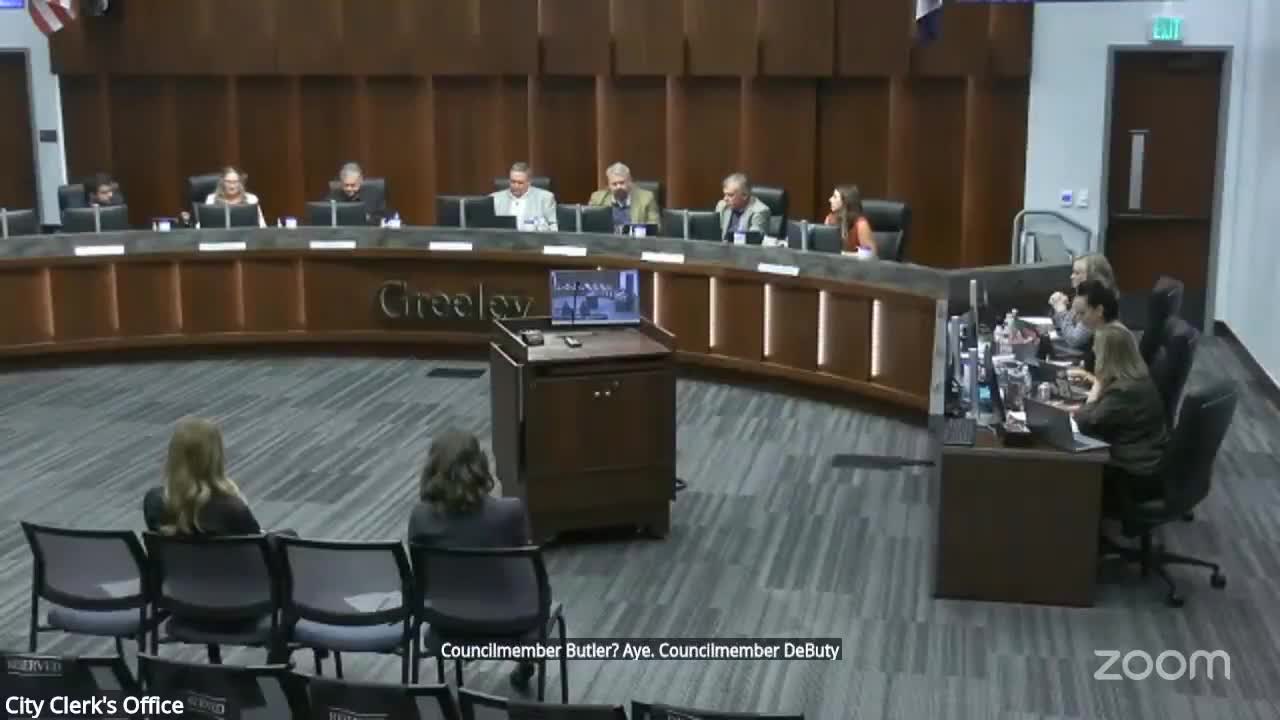
Summary
The Greeley City Council on Sept. 12 approved three related annexations and an establishment-of-zoning ordinance for the Willow Vista area—about 222 acres in total—adopting the staff-recommended holding-agriculture (H-A) designation and requiring future master planning for development.
GREELEY, Colo. — The Greeley City Council on Sept. 12 approved three related annexation ordinances and an establishment-of-zoning ordinance for the Willow Vista area, a combined set of applications that together cover roughly 222 acres east of County Road 35 and south of AA Street.
City planning staff explained the annexations would satisfy contiguity requirements and that the applicant requested a holding-agriculture (H-A) zone consistent with the city's comprehensive plan Urban Reserve designation. Don Threewood of the city’s community development department presented the case and noted the parcels are currently agricultural and that no development proposal is before the city at this time.
The council adopted the annexation ordinances (ANX2024-0001, ANX2024-0002, ANX2024-0003) and the related zoning ordinance on second reading after a public hearing. Votes on each measure were 6-0 with Council member Payton excused due to a disclosed conflict of interest.
Planning staff said a master-planning process will be required if the property owner later proposes development beyond holding-agriculture uses, and that city services (for example, emergency services) are available upon annexation. Staff also said school-district impacts will be addressed by required intergovernmental agreements with Greeley-Evans School District 6 and Eaton RE-2.
Public comment at the hearing included a county resident who asked whether potential light, noise and construction impacts would be mitigated for adjacent county properties; staff replied that the development code contains lighting and buffering standards and that any future proposal would be reviewed for compatibility.
Why it matters: annexation and initial zoning set the legal framework for future development and ensure the city can require master planning and public improvements before urban-level development occurs. The Urban Reserve designation signals that development is contemplated but subject to coordinated planning.
Next steps: the H-A zoning designation holds the land in a low-intensity status; future, specific development proposals would go through master planning, public hearings and required intergovernmental agreements for school and infrastructure impacts.