Get Full Government Meeting Transcripts, Videos, & Alerts Forever!
Get email alerts on the Capital Improvement Plan topic
No spam. Unsubscribe anytime.
City budget team outlines 2026 capital improvement priorities amid lower revenue projections
Summary
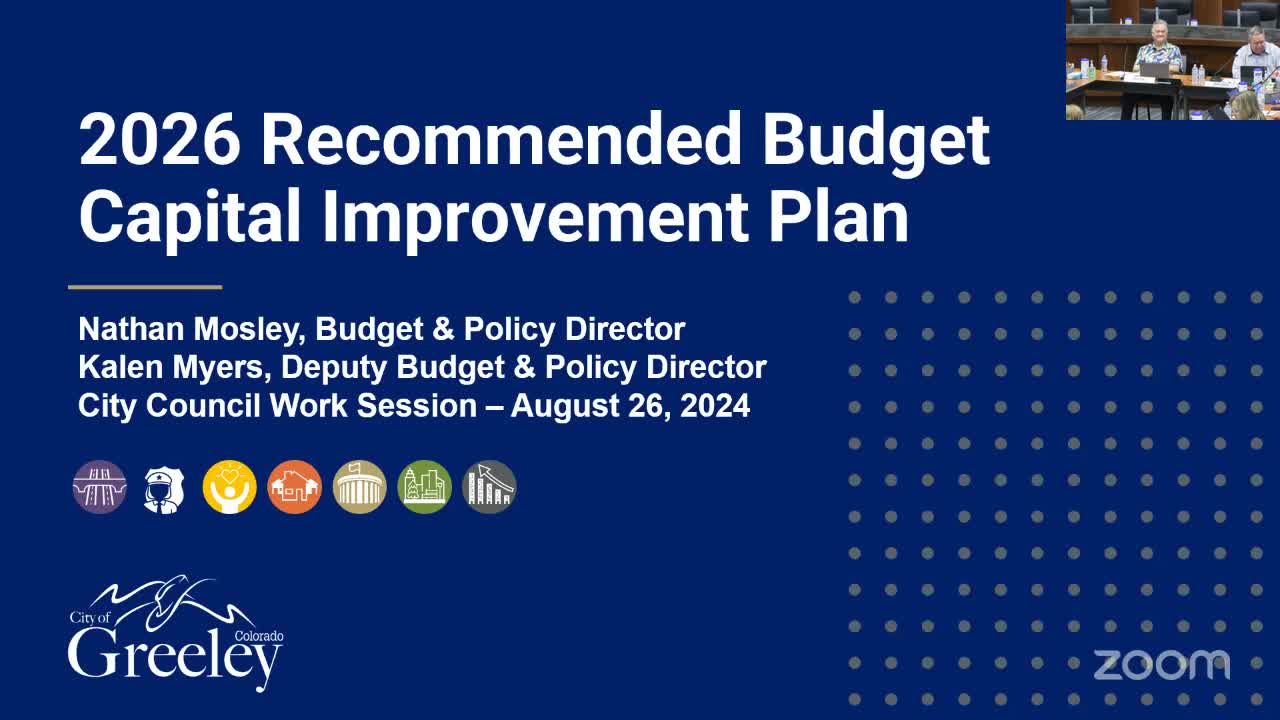
GREELEY, Colo. — The city’s budget and finance staff presented an overview of the recommended 2026 Capital Improvement Plan (CIP) at a Greeley City Council work session in August 2025, signaling lower revenue projections from slowed development and asking council for feedback ahead of the formal recommended budget release in September.
GREELEY, Colo. — The city’s budget and finance staff presented an overview of the recommended 2026 Capital Improvement Plan (CIP) at a Greeley City Council work session in August 2025, signaling lower revenue projections from slowed development and asking council for feedback ahead of the formal recommended budget release in September.
Nathan Mosley, director of Budget and Policy, and Caitlin Myers, deputy director of Budget, told council the recommended 2026 capital budget totals about $185 million, and the five‑year plan approaches $958 million. Staff said utility enterprise projects account for more than half the five‑year total and noted that reduced development activity required deferral of some transportation projects.
Why it matters: The CIP sets capital priorities for streets, parks, utilities and facilities and determines which projects will be funded, deferred or pushed to grant‑dependent schedules. Changes in development and grant availability will affect the timing of projects and maintenance work important to residents and businesses.
Revenue sources and notable amounts
Staff identified three primary CIP funding streams: dedicated sales taxes (including the food tax and the Quality of Life tax), utility rate revenues and development impact/plant investment fees. Key details from the presentation:
- Food tax and maintenance: The food tax supports city facility maintenance; staff said the plan currently funds about $5.5 million per year for capital maintenance (roof replacements, HVAC, parking lots and similar items).
- Quality of Life tax and MERGE: The Quality of Life tax is programmed for a $30 million contribution to the MERGE transportation project over the life of that project, and quality-of-life dollars also support culture, parks and recreation priorities and Island Grove maintenance.
- Keep Greeley Moving tax: The Keep Greeley Moving dedicated street tax is scheduled to expire in 2029; staff noted council may need to consider a renewal vote in 2027 to maintain the current level of street funding.
Staff also flagged a substantially lower baseline for development fee revenue because of reported slowdown in new development; that reduction led to deferral of several transportation projects and a re‑scoping of future work.
Projects highlighted and deferred items
Caitlin Myers highlighted several funded 2026 items by fund: airport contributions ($11.0 million city share across phases, with county as a partner), maintenance and replacement at Island Grove (50% reimbursement from Weld County for certain items), continued downtown civic campus predevelopment and design work on trail priorities. The plan includes $1.5 million for a critical Fundplex replacement in 2026 and funding for repairs to a narrow section of the Poudre River Trail.
Myers also provided a partial list of high‑priority projects that are currently unfunded for 2026; staff noted the 10‑year unfunded totals are substantial—about $115 million in food tax projects and about $514 million in quality‑of‑life items, the latter including facility replacements such as future rec center or active adult center replacements.
Council questions and staff responses
Councilors focused on deferred maintenance, project timing and transparency for changes to the CIP. Councilor Hall pressed for a clearer plan to “knock out” deferred maintenance before adding new facilities; staff said departments are compiling prioritized lists and that an asset management system and improved capital programming are in progress.
Councilor Butler asked whether shifts in CIP dollars midyear require council action; staff said the adopted budget authorizes year‑one spending but acknowledged that specific policy choices about how and when to reallocate major items could be brought back to council for further direction. Several councilors asked for more regular updates on CIP execution and for clearer triggers that would require council appropriation when projects deviate from the approved plan.
Timing and next steps
Staff will post the recommended 2026 budget on September 5 and hold a budget work session on September 9. First reading of the 2026 budget is scheduled for Oct. 7, with a public hearing and final reading scheduled for Oct. 21. Staff also noted that many projects are largely grant‑dependent and that deferral increases costs over time because of escalation and inflation.
Ending: Council members generally praised the presentation and urged staff to return with more detailed asset and project‑level information before final appropriations are made.