Get Full Government Meeting Transcripts, Videos, & Alerts Forever!
Get email alerts on the Transportation topic
No spam. Unsubscribe anytime.
Grand Junction council votes 4-3 to revert Fourth and Fifth Street pilot south of Grand and restore two driving lanes
Summary
After more than a year of debate and a lengthy public comment period, Grand Junction City Council voted 4–3 to restore two driving lanes and remove the bike lane south of Grand Avenue on Fourth and Fifth streets and to not spend the roughly $250,000 estimated to address pinch points.
Grand Junction City Council voted 4–3 on Aug. 20 to revert the downtown Fourth and Fifth Street pilot south of Grand Avenue to two driving lanes and remove the south-of-Grand bike lane, rejecting a roughly $250,000 amendment staff said would be needed to fit a bike lane through several curb pinch points. Mayor Scott Kennedy cast a yes vote; council members Ballard, Cole and Van Dyke joined him. Council members Balfus, Wynne and Stout voted no.
The city manager told council at the meeting that staff previously estimated about $250,000 to add asphalt, concrete and landscaping revisions at “pinch points” on Main Street to accommodate a bike lane south of Grand. That figure and the schedule to begin work the week of Sept. 2 were cited by council during debate. City staff said the physical work to restore the roadway would take approximately three weeks if the council approved reversion.
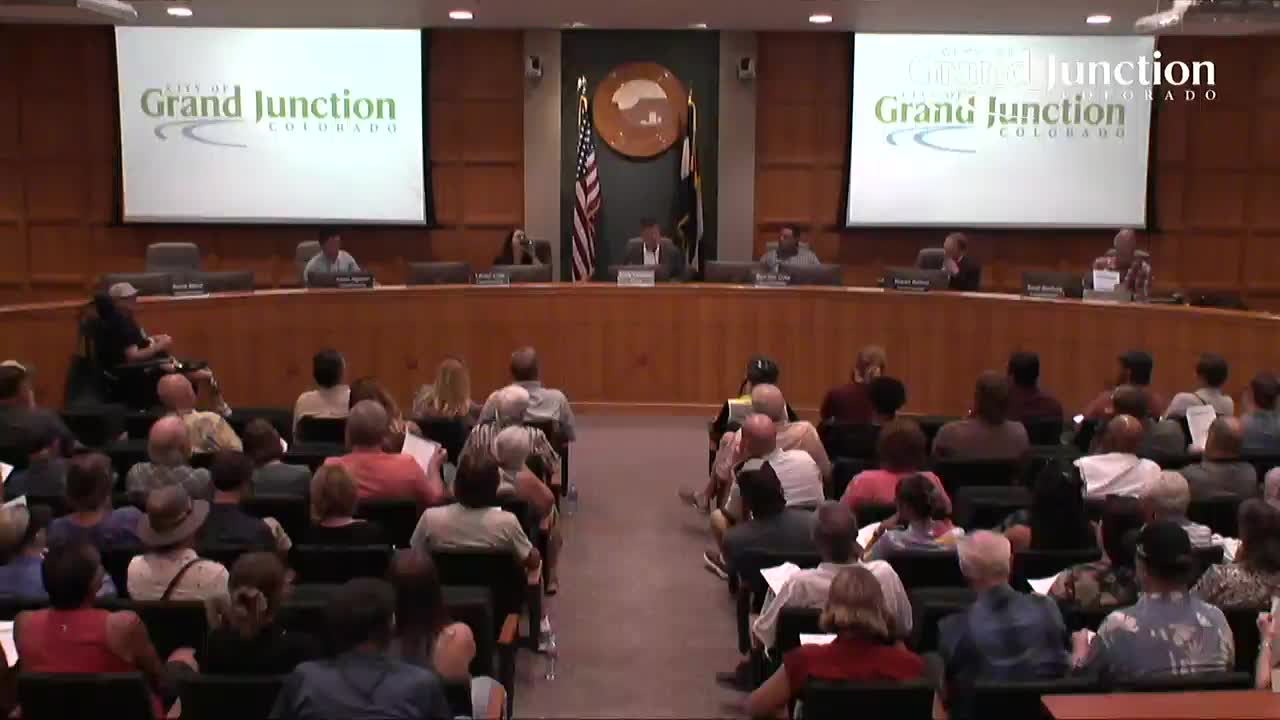
The vote followed nearly four hours of public comment during a meeting that repeatedly returned to the subject. Thousands of words of testimony were offered from downtown business owners, residents, cyclists and safety advocates. Some speakers urged the council to retain the pilot’s lane reconfiguration because they say it reduced speeds and injuries; others — including downtown business owners — said the changes have reduced customer parking and foot traffic.
“Fourth and Fifth are both classified as major collectors,” said Trent (last name not given in the transcript), the city’s traffic engineer, during Council Q&A, adding that pre‑pilot traffic counts indicated capacity on two‑lane configurations exceeded current demand. The city’s police chief, Lisa (last name not given in the transcript), told council that Fourth and Fifth are not part of her department’s STEP (Selective Traffic Enforcement Program).
Engineers and civic advocates appeared on both sides. Carrie Schultes, identified in public comment as a licensed professional civil engineer and transportation instructor, urged council to keep one travel lane plus a painted bike lane and to follow the city’s Transportation Engineering Design Standards. “To create safety for the road users … one lane of traffic with a painted bike lane is required,” Schultes said.
Opponents emphasized business impacts and accessibility. Downtown merchants and several residents testified that the pilot’s bollards and reconfigured parking created access and maintenance problems and, they said, deterred customers. Multiple speakers described incidents and near-misses they attributed to the new geometry.
Council members debated whether narrower 11‑foot lanes and opening the public parking lot access points would achieve the stated goals without continuing the pilot. The mayor framed the decision narrowly as whether to make the $250,000 expenditure to retain the bike lane through the pinch points; council members who voted to revert said they preferred to return to the pre‑pilot striped cross‑section south of Grand and restore meters and lot access.
The resolution directing the city manager to proceed with reversion (Resolution 53-25) passed on a roll call that recorded: Ballard — yes; Balfus — no; Cole — yes; Wynne — no; Stout — no; Van Dyke — yes; Kennedy — yes.
Council directed staff to begin striping and other reversion work on the schedule staff presented; staff said work would begin on Tuesday, Sept. 2 and last about three weeks. Council and staff also discussed traffic calming tools such as additional speed limit signage and flashing radar feedback signs funded through a recent Safe Streets for All federal grant, and the mayor urged the public to address broader multimodal questions beyond the narrow finance vote the council was taking that night.
The action applies only to the pilot segment south of Grand Avenue; the council indicated the north‑of‑Grand configuration would remain as previously implemented. The council record shows the vote was taken as a public decision after extended public comment, and staff were directed to implement the reversion and restore parking meters and lot entries as described in staff’s presentation.
The council’s vote ends a yearlong local debate that included earlier council decisions to Try pilot configurations and subsequent workshops. Several council members said they regretted the erosion of public trust caused by repeated reversals and extensive public debate.
What’s next: staff will schedule the reversion work and return to council if additional funding or policy direction is needed for future multimodal projects in the downtown area.