Get Full Government Meeting Transcripts, Videos, & Alerts Forever!
Get email alerts on the Energy Policy Grid Planning topic
No spam. Unsubscribe anytime.
City staff brief committee on grid planning, electrification pilots and oversight of Xcel Energy
Summary
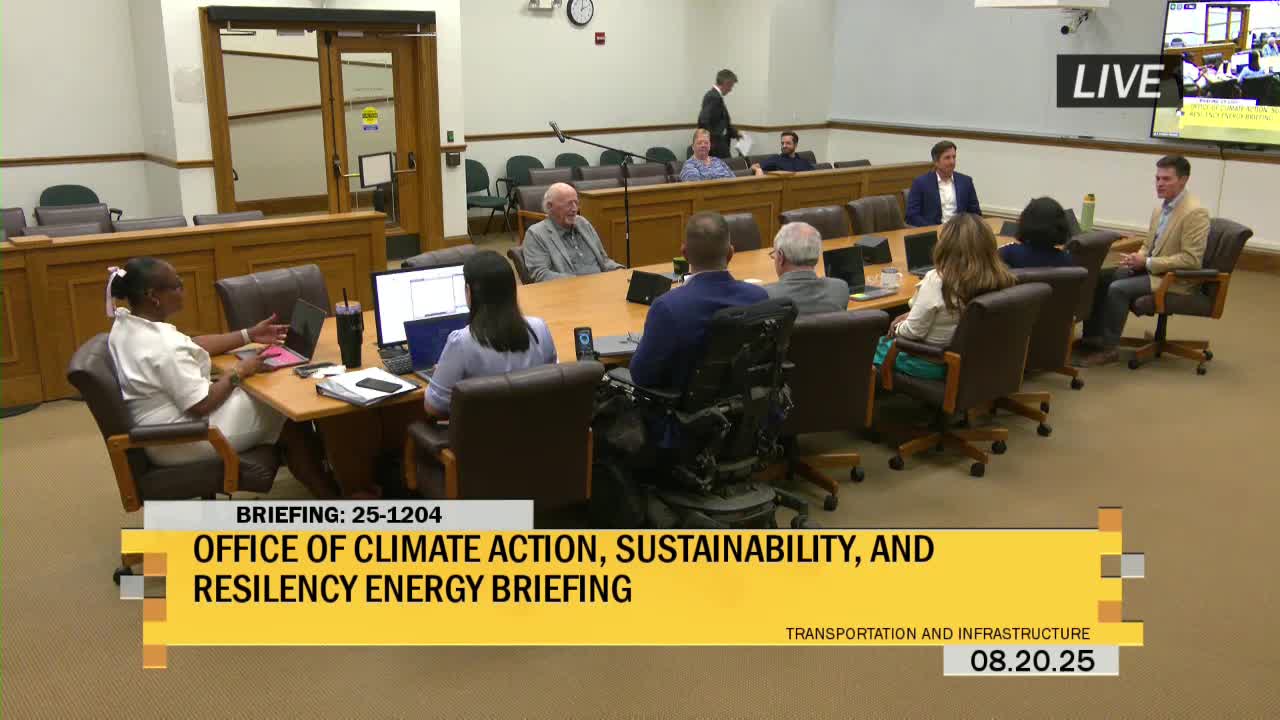
The Office of Climate Action, Sustainability and Resiliency briefed the Transportation and Infrastructure Committee on Denver’s energy strategy, neighborhood electrification pilots and the city’s role in state Public Utilities Commission proceedings and the Xcel Energy franchise conversation.
Jonathan Rogers, acting deputy executive director of the Office of Climate Action, Sustainability and Resiliency (CASR), told the Transportation and Infrastructure Committee that Denver’s path to deep decarbonization relies on influencing large institutional investments and coordinating local pilot programs.
“our mission is that the climate crisis is solvable and together, we're the ones to solve it,” Rogers said, framing the city's work as oriented around electrification, equity and grid planning. He told members the city seeks to use its municipal investments — cited in the presentation as about $50,000,000 of lead‑by‑example projects — to influence an estimated roughly $50,000,000,000 in electric utility investment that Xcel Energy has proposed through the next decades.
Why it matters: City staff said energy and transportation represent most of Denver’s greenhouse gas emissions, that grid distribution and interconnection constraints are the main near‑term technical challenges to rapid electrification, and that coordinated policy work at the state Public Utilities Commission (PUC) and local pilot projects are both needed to achieve the city’s goals.
Key points from the briefing
- Emissions and sectors: Staff said Denver has roughly 225,000 fossil‑gas customers and continues to add about 1,000 per year; the city was selected as a gas planning priority community to test neighborhood‑scale electrification strategies.
- Funding, pilots and programs: Rogers described $10,000,000 of PUC‑approved funding to support neighborhood residential retrofit pilots (the transcript named Valverde as a tentative community and noted portions of funds could support other jurisdictions), a new on‑bill financing option under development, and expanded heat pump rebates that were increased compared with earlier proposals.
- Regulatory engagement: Rogers emphasized that the PUC and state regulatory process govern how Xcel recovers costs and what investments are allowed; the city participates in that process to influence transmission, distribution and program design. He said the city helped secure a plan to reduce electric‑sector emissions by more than 85% and that Colorado plans to retire all coal plants by 2030 under the current regulatory pathway.
- Distribution capacity and substations: Staff said Xcel’s distribution system plan for the Denver metro planning division currently shows 11 substations and a plan to add nine more in the next five years in the planning division referenced in the filing; staff cautioned that Xcel’s planning divisions are not perfectly coterminous with city limits.
Council feedback and outstanding requests
Council President Sandra Wood‑Sandoval (on camera) and multiple councilmembers raised concerns about franchise negotiations with Xcel Energy, equitable access to EV charging and reliability. Sandoval urged continued public conversation and expertise‑driven community engagement, saying the goal was not to “publicly roast” providers but to obtain independent technical input for the city’s franchise and regulatory work. Several councilmembers described constituent complaints about Xcel property‑maintenance issues in the Golden Triangle and other reliability concerns.
Councilmembers asked for follow‑up materials including: - A public map or briefing of proposed substation locations in Xcel’s distribution system plan for the Denver metro planning division. - An estimate of the city’s projected emissions reductions (metric tons) by 2050 under the city’s decarbonization pathways. - An audit or briefing on the city’s municipal building stock and the status of efficiency and electrification upgrades for roughly 156 municipal buildings cited in the discussion.
What was not decided
This session was a briefing and discussion; no ordinance, resolution or formal council action was recorded in the transcript. Councilmembers and staff identified several follow‑up briefings to provide maps, more granular cost and emissions modeling, and updates on pilot design and community engagement.
Ending
City staff said they will return with more detailed mapping, cost comparisons and program metrics; councilmembers requested continued engagement on the PUC processes and the local franchise discussion.