Get Full Government Meeting Transcripts, Videos, & Alerts Forever!
Get email alerts on the Host Rapid Resolution Rapid Rehousing topic
No spam. Unsubscribe anytime.
Host seeks committee approval for rapid resolution contracts and a $5.05 million Salvation Army rapid‑rehousing agreement
Summary
Denver’s Department of Housing Stability asked the Community Planning and Housing Committee to forward a group of rapid‑resolution contracts and a $5.05 million rapid‑rehousing agreement with The Salvation Army to the full City Council.
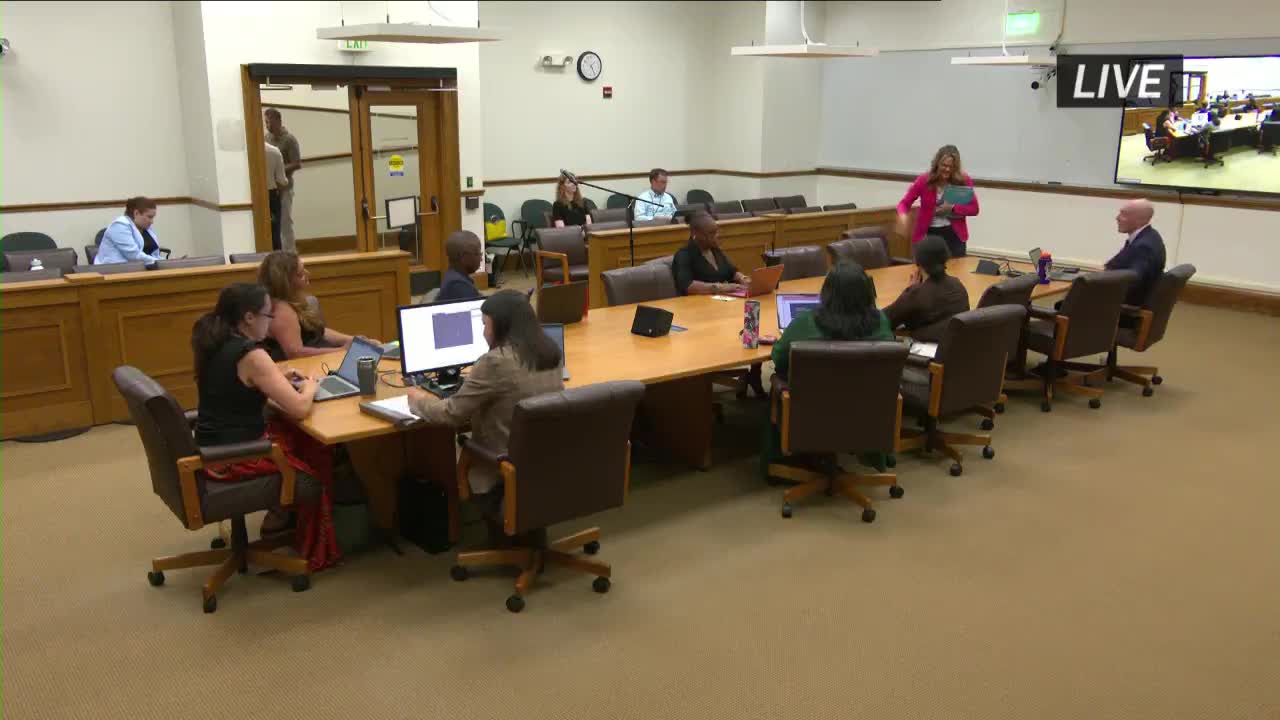
Denver’s Department of Housing Stability (HOST) asked the Community Planning and Housing Committee on Aug. 19 to forward a group of contracts that fund rapid resolution services and an 18‑month rapid‑rehousing agreement with The Salvation Army.
Kevin Kelly, program officer at HOST, and Jamie Reif, executive director of HOST, said the city is seeking approval for five rapid‑resolution contracts that exceed the $500,000 threshold and for an additional five smaller contracts that operate under the $500,000 threshold. HOST described rapid resolution as a flexible, one‑time financial‑assistance model aimed at stabilizing households within 90 days and avoiding longer shelter stays or more intensive, costly interventions.
"We shoot to have that happen within 90 days or less," Kelly said of the rapid‑resolution model. He told the committee the majority of participants exit rapidly — often within one or two weeks — and that staff build budgets to support protective factors such as existing relationships and income. Kelly said the current cohort, which began operation in September 2023, served 787 unique households during its first full year of operation in 2024; 94% exited in 90 days or less and 95% exited to a positive outcome (stable or permanent housing).
Jamie Reif said several smaller organizations received contracts under the $500,000 threshold to enable locally based providers to pilot the model and build capacity. Reif highlighted Senior Support Services, which serves people age 60 and older, noting a rising number of first‑time homelessness cases among seniors.
The committee also considered a separate rapid‑rehousing contract: Evangeline "Evie" Benja, assistant director of Homelessness Resolution at HOST, presented a request for a $5,050,000, 18‑month agreement with The Salvation Army to provide “transformational rapid rehousing.” That program combines up to 12 months of time‑limited rental and utility assistance with critical‑time‑intervention‑based case management, unit acquisition support, and mobile stabilization services. Benja said referrals would come through HOST’s Housing Central Command, a centralized intake and navigation model intended to connect people to housing quickly.
"Our goal is to get folks housed in 30 days," Benja said, adding that HOST’s current average for navigation‑to‑housing is 28.6 days. Benja described the housing stabilizer role as a 1:20 staff‑to‑client ratio providing tailored, mobile case management, landlord mediation and exit planning from day one so participants are aware when subsidies will end.
Committee members asked how the rapid‑resolution and rapid‑rehousing models interact with eviction prevention, landlord partnerships and family‑specific needs. Kelly and Reif said rapid resolution is meant to be short term (ideally under 90 days) and is often used for problems such as employment disruption, transportation or one‑time emergencies; they gave examples of funds used to replace a stolen bicycle that enabled someone to keep their job or to buy tires so a household could reunify safely with family out of state.
On landlord engagement and unit acquisition, HOST said its partner Housing Connector maintains an inventory of units — including options appropriate for households with higher barriers — and partners range from large property managers to small landlords. That inventory is presented to clients so they can exercise choice; HOST said its partners typically value the program because rent is paid reliably and stabilizers mediate landlord‑tenant issues.
Councilmembers probed contracting practice and timing: some contracts started below $500,000 to allow smaller providers to pilot the model and receive technical assistance before scaling up; larger shelter providers received larger awards based on shelter size during the 2023 RFP cycle. HOST said all contracts began operating in September 2023 and were reimbursed as normal; the new contract cycle will run through 2027 with a request for proposals planned for 2028.
The committee voted to forward the set of rapid‑resolution contracts to the full council, and later voted to forward the Salvation Army rapid‑rehousing contract (agenda item 25‑1195) — the motion was moved by Councilmember Jamie Torres and subsequently by Council President Stacie Sandoval for the rapid rehousing item, with committee consent to move both items to the floor for council consideration.
Why it matters: HOST officials described rapid resolution and rapid rehousing as complementary tools to lower shelter use, shorten homelessness episodes and preserve more intensive resources for people with long‑term support needs. HOST reported strong short‑term outcomes for rapid resolution in 2024 and highlighted that the program reached a higher share of Black/African American households (34%) and families (21%) than some other interventions. The Salvation Army rapid‑rehousing contract would continue time‑limited rental subsidies and case management for households already in housing and provide new placements through Housing Central Command.
Sources: testimony and slides presented to the Community Planning and Housing Committee; statements by Kevin Kelly, Jamie Reif and Evangeline Benja; committee members’ questions and motions.