Get Full Government Meeting Transcripts, Videos, & Alerts Forever!
Get email alerts on the Police Discipline topic
No spam. Unsubscribe anytime.
Denver police chief proposes education-based development to shorten complaint timelines and steer low-level misconduct to training
Summary
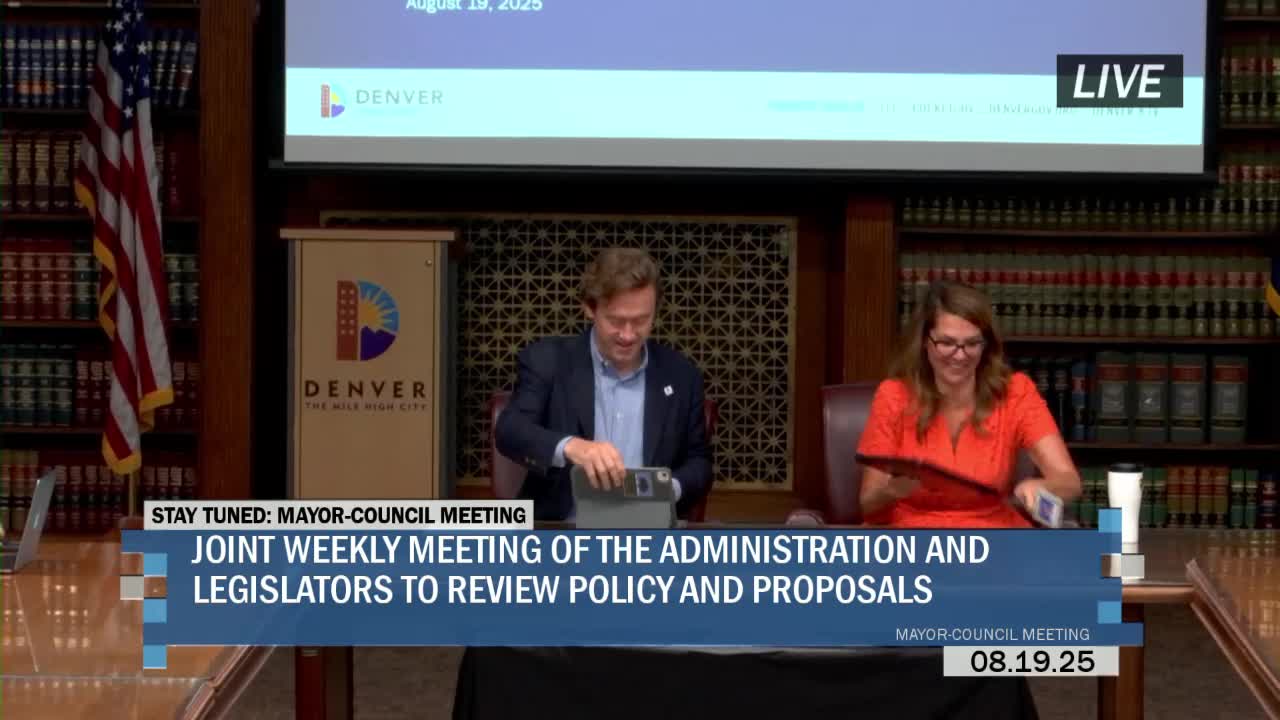
Denver police leaders on Tuesday presented a plan to divert certain low-level misconduct complaints away from lengthy disciplinary proceedings and into targeted training, saying the change could shorten case resolution times and reduce repeat violations.
Denver police leaders on Tuesday presented a plan to divert certain low-level misconduct complaints away from lengthy disciplinary proceedings and into targeted training, saying the change could shorten case resolution times and reduce repeat violations.
The concept, which Denver Police Chief Thomas described as “education based development,” would preserve full investigations and review by the Office of the Independent Monitor while allowing investigators and the department to offer officers an agreement to complete incident‑specific training in lieu of traditional discipline in eligible cases.
Chief Thomas told the mayor and council that every complaint would still be investigated thoroughly and reviewed by the independent monitor and that “there will be no shortcuts. Every case accepted for education based development will be tracked and there will be no second chances.” He said the program is not intended for serious or repeat misconduct and that departments elsewhere have used similar approaches, though he acknowledged there is limited published, policing-specific evidence of effectiveness.
Why it matters: City officials said long complaint timelines have eroded public trust and delayed corrective action. Chief Thomas told the council that disciplinary investigations often take six to eight months and sometimes a year or more, and he argued a narrower diversion program for low-level administrative violations could deliver faster, incident‑specific remedies for complainants while freeing resources to resolve more serious cases.
How the proposal would work: Under the chief’s description, after a full internal affairs investigation certified as thorough and complete by the Office of the Independent Monitor, the department would determine whether a case is eligible for education‑based development. If approved, an officer would be offered a written agreement and would have three business days to accept. Training would be scheduled within 30 days and completed within 90 days of signing. If the officer declines or fails to complete the training, the case would continue through the normal disciplinary process and the record would remain in the shared database.
Chief Thomas gave several quantitative and procedural details: an internal audit of 2022–2025 cases indicated roughly 66 percent of the 127 listed violation types would be ineligible for diversion; the department reported 713 internal affairs cases filed in the prior year with outcomes that included 45 written reprimands, 68 oral reprimands, 37 fines of one to two days, 33 suspensions or fines over two days, and 21 terminations or resignations in lieu of termination. He also said the department contracted with a university partner to evaluate outcomes.
Questions and concerns from council members and oversight representatives focused on scope, safeguards and evidence. Councilwoman Savannah Gonzalez Gutierrez asked the chief to avoid loose use of the term “evidence‑based,” saying rigorous academic evidence specific to policing was not available and asking for clarity about evaluation plans. Councilman Cashmore warned that the department and the Office of the Independent Monitor were not yet aligned and urged further work to reconcile differences. Several council members, including Councilman Kevin Flynn and Council President Watson, emphasized that the full investigative review and certification by the independent monitor must remain intact.
Chief Thomas said he had incorporated many recommendations from the Office of the Independent Monitor into the draft policy and had adjusted plans after council and community feedback — for example, making any training hours required by diversion count in addition to the department’s annual continuing‑education minimums rather than substituting for them. He said the department has posted the policy draft and appended a list of eligible and ineligible violation types for public comment and that the University of Nevada, Las Vegas is under contract to measure outcomes and recidivism.
What remained undecided: Council members and oversight advocates asked for more clarity about which specific violations would and would not be eligible for diversion, how investigators would objectively determine whether an incident was a “mistake of the head” (lack of knowledge) versus a “mistake of the heart” (willful misconduct), and how the monitor and department would jointly certify eligibility decisions. Several council members asked that the director of the independent monitor be further consulted to resolve outstanding differences before any formal implementation.
Next steps: Chief Thomas said he would continue discussions with the Office of the Independent Monitor to narrow remaining areas of disagreement, continue public comment on the posted policy draft and proceed with the university evaluation if the program moves forward. No formal vote or legislative action was taken at the meeting.
Ending: Council members said they appreciated the briefing and requested follow‑up materials, including the posted slide deck and the appendix listing eligible violations, and some asked that the proposal be reviewed in committee and with the citizen oversight board before any final departmental implementation.