
Fort Collins council refers multiuse plan for Hughes Stadium site to November ballot after protests; amends language to increase tribal consultation
Get AI-powered insights, summaries, and transcripts
Subscribe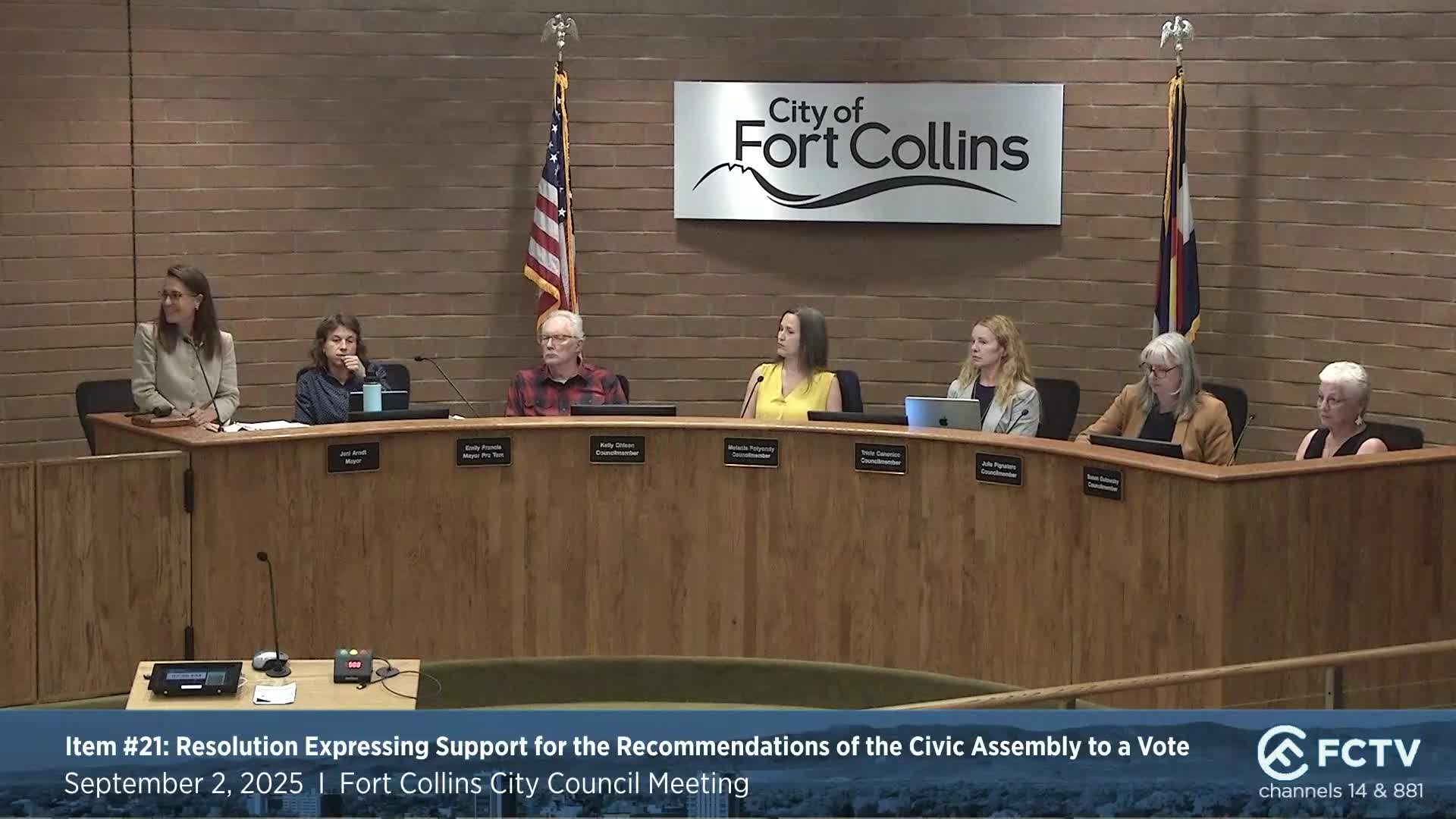
Summary
Fort Collins City Council voted 6-1 on Sept. 2 to refer a council-drafted multiuse framework for the former Hughes Stadium site to the Nov. 4 ballot after a consolidated protest hearing and after amending referral language to strengthen tribal consultation.
Fort Collins City Council voted 6-1 on Sept. 2 to refer a council-drafted ordinance setting a multiuse framework for the former Hughes Stadium site to the Nov. 4, 2025, municipal ballot and simultaneously denied six formal protests that argued the ballot language was misleading.
The council’s referral followed a consolidated protest hearing in which six residents and petitioners said the council’s submission clause and accompanying ordinance misstated the civic assembly’s recommendations, left up to 40 acres of the site unspecified, and allowed broad discretion to develop the site. After the hearing the council adopted specific edits to the referral language to clarify Indigenous consultation and to change phrasing about existing uses before voting to send the matter to voters.
Why it matters: The Hughes site vote will let city voters decide between competing measures and a city-referred multiuse framework. Protesters said the council’s language could permit large built facilities — including a bike park and a wildlife/conservation campus — in ways they said were inconsistent with the civic assembly’s recommendations. Supporters, including delegates to the civic assembly, said the council’s measure implements the assembly’s work and appropriately frames a multiuse outcome for voter consideration.
What the council did and why: The council first adopted an ordinance on second reading earlier in the evening, then considered a separate resolution to refer the ordinance to the ballot. Council members amended the referral language to replace weaker phrasing — changing “endeavor to engage” to “consult” or “engage in ongoing consultations” with Native American tribes in multiple places — and to make small structural edits to the submission clause so it would read as a description of proposed city action rather than as a comparative accusation that the city-drafted measure “differs” from the citizen initiative.
Public testimony and protests: Representatives of six protests addressed the council during a consolidated hearing. Key points raised by protesters and speakers included: - Ambiguity in acreage ranges: Protesters said the ordinance’s phrase “not to exceed” for three categories (natural area up to 60 acres; bike park up to 35 acres; environmental education/wildlife conservation partnership up to 30 acres) left a roughly 40-acre “blank canvas” unaccounted for and urged clearer limits. - Permanent easement/detention pond: Speaker Paul Patterson presented documents showing a stormwater detention easement recorded on parts of the site, and asked that the easement and its effects be explicitly listed in ballot materials. City staff and the city attorney explained that when the city acquired fee ownership of the land, previously recorded easements merged with title and that the city controls site stormwater design; staff said a detention basin or equivalent management will remain necessary but is subject to future planning. - Indigenous participation and wording: Multiple speakers, including Catherine Dubiel, urged stronger, mandatory language to ensure sustained Indigenous engagement. Dubiel said the civic assembly had made Indigenous participation a top recommendation and asked why the ordinance used “endeavor” while the council’s submission clause used “require.” Council members amended the ordinance and referral language to align wording and to state the city “will consult with Native American tribes” or “engage in ongoing consultations.” - Civic assembly vs. council choices: Protesters and some members of the public argued the council had expanded or repackaged the civic assembly’s recommendations — for example by elevating a bike park or a standalone wildlife conservation campus into major uses — while civic assembly delegates and supporters said the council’s ordinance followed the assembly’s framework and that referral to voters is the appropriate next step.
Results and formal actions: The council denied the six protests by a 6–1 vote (Councilmember Gutowski cast the lone no). The council then approved the amended resolution to refer the council-drafted ordinance to the November ballot by the same 6–1 margin. Earlier in the meeting, the council had passed the ordinance on second reading with a 6–1 vote. Vote tallies recorded on the meeting transcript list the roll-call display names as Olsen, Yandy, Canonico, Pinotaro, Gutowski, Arndt and Francis; the final recorded votes on both the ordinance and the referral were 6 yes, 1 no.
What remains unclear or next steps: The referral will place the council’s multiuse framework on the Nov. 4 ballot alongside at least one citizen-initiated measure that would designate the entire Hughes site as a city natural area. If voters approve competing measures, staff advised the council and public that the City must follow municipal code and state law to determine which ordinance takes effect. Council members and staff committed to further edits to ballot explanatory materials and to publish additional background documents requested by the public, including feasibility studies and site evaluation criteria that protestors said they had been unable to find.
Community input and concerns: Speakers at the meeting repeatedly asked for greater transparency about site acreage allocations, the results of the city-paid bike-park feasibility study, the cost and placement implications of the existing stormwater detention feature, and the city’s long-term stewardship plan. City project staff said future site design work and any required environmental and engineering analysis would follow standard development-review steps and further public engagement.
Why voters should watch this: The Hughes decision shapes whether the former stadium becomes primarily a protected natural area, a multiuse park with specified built amenities (including a bike park and wildlife/conservation campus), or another configuration adopted by voters. The council’s referral and the citizen initiative will both appear on the November ballot, and the outcome will set constraints that guide long-term design and budgeting for the property.