Get Full Government Meeting Transcripts, Videos, & Alerts Forever!
Get email alerts on the Urban Forest topic
No spam. Unsubscribe anytime.
Fort Collins staff propose tree‑preservation changes; council raises concerns about housing impacts
Summary
City staff proposed five changes to Fort Collins’ tree protection and mitigation rules intended to simplify administration and prioritize large‑tree preservation while offering mitigations for affordable housing and other public benefits.
City staff presented proposed changes to Fort Collins’ tree protection and mitigation rules and sought council feedback on five discrete policy changes, drawing a lengthy council discussion about trade‑offs between tree preservation and housing development costs.
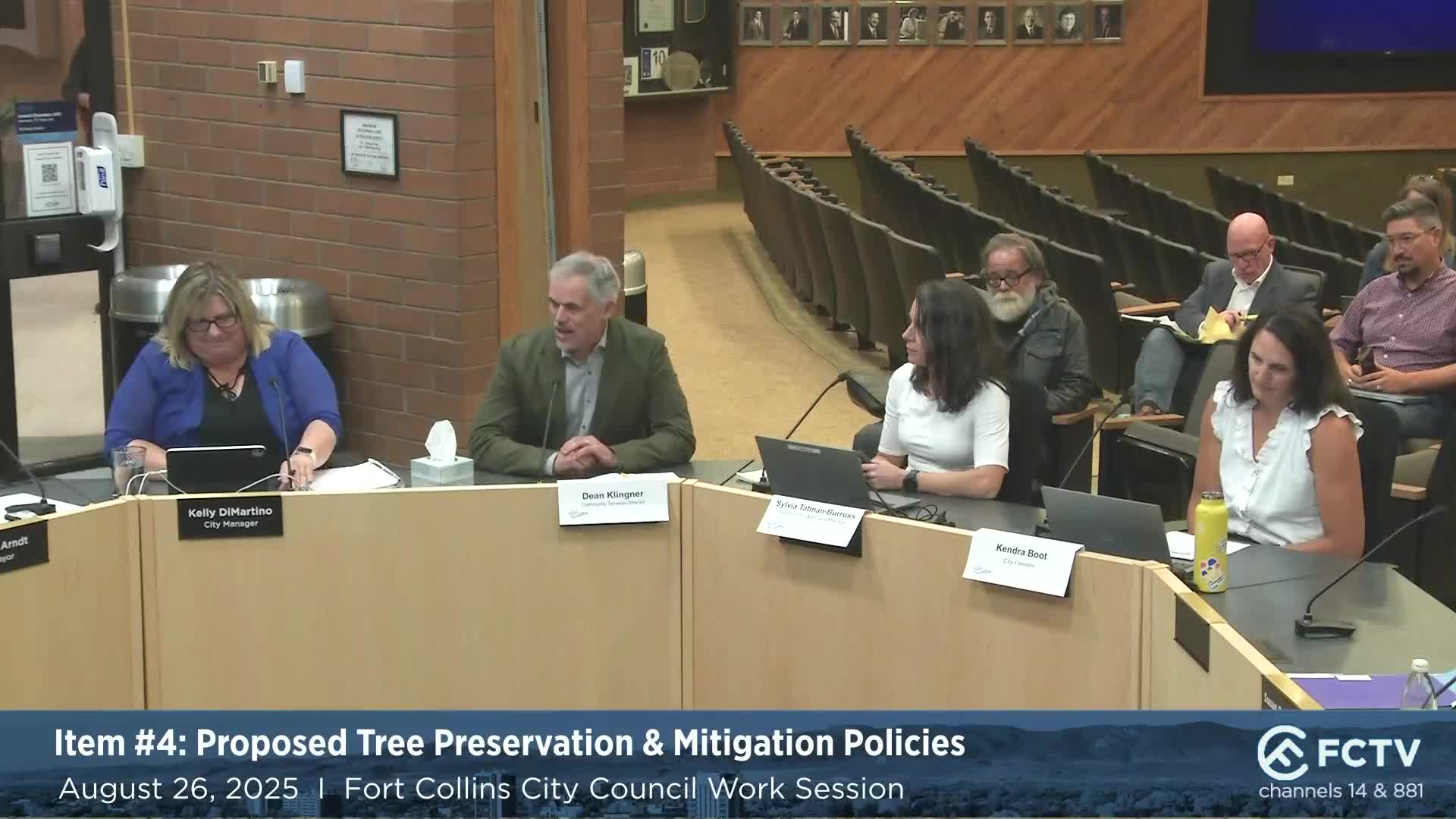
Director of Community Services Dean Klinger framed the work as a focused follow‑up to the March Urban Forest Strategic Plan. City forester Kendra Boot and policy lead Sylvia (last name not provided) outlined five proposed changes: (1) a commercial tree removal permit to require review before removing large trees on existing commercial properties; (2) enhanced construction‑phase protection measures (clearer fencing/ signage and best practices); (3) a three‑year establishment period after which the city assumes responsibility for newly planted street trees; (4) raising the mitigation thresholds for certain undesirable species (Russian olive, ash, Siberian elm) to simplify mitigation rules; and (5) a restructured tree mitigation schedule that assigns replacement values by size class, keeps payment‑in‑lieu as an option, removes off‑site planting as difficult to track, and provides mitigation reductions when projects preserve trees on site or deliver public benefits such as affordable housing.
Kendra Boot said staff had modeled the proposed mitigation formula against a set of recent development projects. The proposed structure increases replacement credit for large trees and offers a 50% reduction in mitigation obligations when developers preserve trees on site (75% for affordable housing projects), plus additional fee reductions when developers invest in enhanced planting methods (for example, Silva Cells) or wider parkways to improve survivability.
Councilmembers asked for clarifications and raised concerns. Several said the proposal risks increasing development costs during a housing shortage. Councilmember Julian described the overall trade‑offs between conserving older canopy and allowing housing development and asked whether the city risked preserving short‑lived large trees while blocking opportunities for long‑term housing supply. Councilmember Olsen asked for clearer justification for changing thresholds (for example, raising ash mitigation from 8 to 11 inches) and for examples showing how developers could have changed plans to save trees under the new system. Staff said the mitigation changes generally aim to be cost‑neutral across recent project examples and to prioritize preservation of large, healthy trees while simplifying administration.
Staff proposed next steps: refine analyses, provide clearer worked examples of how the proposed formula would change mitigation for sample projects and meet individually with interested councilmembers for detail. Staff said the commercial tree removal permit would be administered with existing resources by working through licensed arborists and zoning/forestry inspectors.
Ending: Councilmembers split on direction. Some supported the clarifying and procedural updates (construction protection, 3‑year establishment, thresholds for undesirables). Others said the mitigation proposal needs more work and asked staff to return with vetted examples that show how the new formula affects affordable and market housing projects before any first reading or code change.