
Downtown board approves second freestanding sign for Tejon Street restaurant
Get AI-powered insights, summaries, and transcripts
Subscribe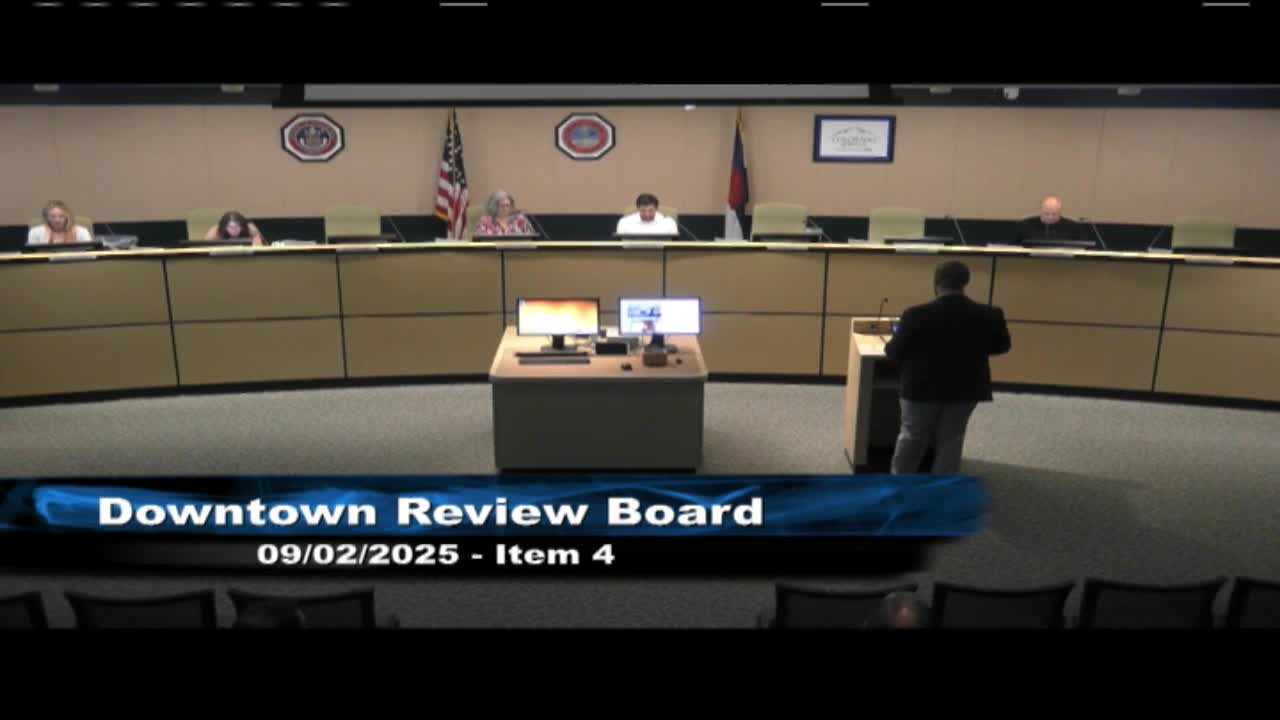
Summary
The Downtown Review Board unanimously approved a warrant to allow Latin Social at 316 N. Tejon St. to install a second freestanding sign where code generally allows only one per site, citing unique site conditions and pedestrian wayfinding needs.
The Downtown Review Board voted unanimously Sept. 2 to approve a sign warrant allowing Latin Social, a new restaurant at 316 North Tejon Street, to install a second freestanding sign where the form‑based code generally permits one per site. The board approved the warrant after staff and the applicant detailed why the site’s layout and separate entrances justify an additional freestanding sign.
Board approval came after the city’s sign program administrator explained why the application had required review. Staff found the proposal met the form‑based code’s approval criteria and the downtown master plan goals, and one nearby business group supported the request.
The applicant, represented by Ethan Shaffer and Scott Shuster of Echo Architecture, said the building at 316 N. Tejon — currently occupied by Sushi Row and the proposed Latin Social — sits well back from the pedestrian way and uses circulation and retaining‑wall elements that make wall‑mounted signage insufficient for clear identification. Shaffer described the proposal as complementary to the building’s materials and pedestrian improvements. Shuster said the request responds to the practical distinction between a wall sign and a freestanding sign under the Unified Development Code and stressed the need for clear identification of two separate tenant entrances.
Kurt Schmidt, the city’s program administrator for sign review, told the board that the permit initially was denied administratively because the code allows one freestanding sign per property. "We ended up having to deny the application because of the criteria in city code that allows only 1 sign per parcel or property," Schmidt said, adding that the combined area of both signs would be within the property’s allowable square footage and height limits but that classification rules treat signs attached to a retaining wall as freestanding.
Ryan Tiefertiller, urban planning manager in the city planning department, said freestanding signs are relatively rare in the downtown form‑based zone because buildings typically sit at the front lot line and use wall or window signage. "We don't have a lot of freestanding signs within the downtown form based zone," Tiefertiller said, and noted that multi‑tenant properties typically use one freestanding sign with multiple tenant panels, which the applicant said would not work at this site.
Board members raised precedent concerns but supported approval after hearing the site‑specific rationale. One board member said the proposed sign is integrated into an existing retaining wall and not a freestanding pole sign that could set a broad precedent for other downtown properties. Another board member noted the functional difference created by separate entrances and circulation and said that, given that, they supported the warrant.
Staff’s file shows the application was submitted Aug. 5, 2025, completed one review cycle and was ready for agenda on Aug. 22, 2025; 98 mailed notices were sent to properties within 500 feet and one comment was received from the Downtown Partnership in support. The site is zoned FBZ‑T2A (form‑based zone, transition sector 2A) and is 0.43 acres; the proposal would allow two freestanding signs where the code normally allows one. The Downtown Review Board made a finding that the request meets the approval criteria in form‑based code section 5.4 and approved the sign warrant.
The board’s approval is subject to the city’s appeal process. Staff read the appeal instructions referencing the Unified Development Code: an affected party may file an appeal with the city clerk within 10 days of the board action, accompanied by a $176 fee; the appeal must address specific zoning code requirements the board did not adequately address. The deadline stated at the meeting was Friday, Sept. 12, 2025.
No formal conditions beyond code compliance were read into the record during the meeting. The board noted the matter in context of an upcoming October agenda that will include a downtown master plan update presentation and annual ethics training for members.