Get Full Government Meeting Transcripts, Videos, & Alerts Forever!
Get email alerts on the Energy Platte River topic
No spam. Unsubscribe anytime.
Fort Collins staff back updates to Platte River contracts to support rapid decarbonization
Summary
City staff outlined proposed updates to the Platte River Power Authority (PRPA) organic contract and the city’s power supply agreement with PRPA to extend terms to 2075, modernize governance, and enable flexibility for organized‑market participation and distributed energy resources. Owner communities will consider the organic contract and power‑s
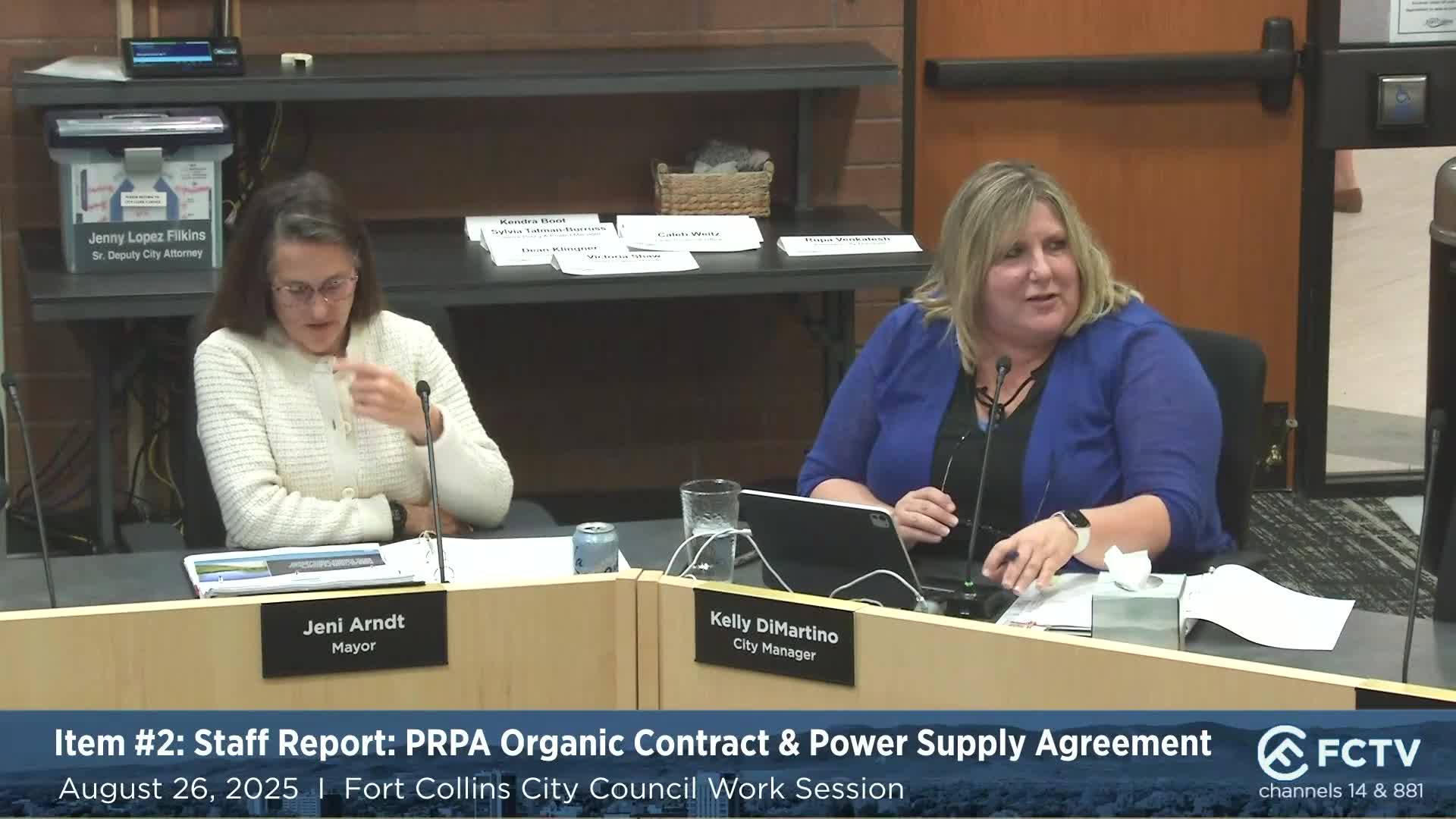
City staff told the council they support proposed updates to two foundational documents that govern Fort Collins' relationship with the Platte River Power Authority, saying the changes are intended to provide long‑term stability for rapid decarbonization and to modernize governance language.
Tyler Marr, deputy city manager and one of the city's representatives on the PRPA board, said the organic contract — the intergovernmental agreement among the four PRPA owner communities — functions as PRPA’s governing charter and currently runs through 2060. “As we get ready to spend hundreds of millions of dollars to achieve that rapid decarbonization,” Marr said, extending the contract to 2075 would give a long‑term signal to markets and the owner communities.
Travis Walker, director of Light and Power, reviewed the separate power supply agreement each owner community has with PRPA: an “all‑requirements” agreement under which PRPA supplies nearly all wholesale power to each owner community and revenues support PRPA’s bond financing and operations. Walker said the proposed changes modernize net‑metering language, clarify interconnection and distribution delivery points, and make the agreements compatible with participation in an organized market.
Why it matters: PRPA is planning to join the Southwest Power Pool regional transmission organization next year. Marr said joining an RTO is becoming a standard pathway for utilities seeking to integrate large volumes of renewable generation and avoid reliability problems; contract modernization and extended terms help PRPA plan resource purchases and financing.
Key proposed changes discussed by staff included: - Extending both the organic contract and power supply agreements to 2075 to support long‑range planning and bond financing; - Modernizing governance language so board membership is either the mayor or another elected official or a staff member with fiduciary responsibilities; - Adding flexibility to authorize new products and services (for example, virtual power plant arrangements and distribution‑side batteries) and to clarify when PRPA will deliver power at distribution versus substation interconnection points; and - Updating net‑metering and rate provisions to align with recent state changes and with organized‑market participation.
Marr and Walker said the organic contract is an agreement among the four owner communities and will be considered by each city council; staff expect owner communities to consider the items in September and for PRPA to approve the power supply agreements. The city’s first reading of the organic contract was scheduled for Sept. 16 per the staff timeline provided to council.
Ending: Councilmembers asked follow‑up questions about environmental recourse and renewable energy credits (RECs), and staff said the resource diversification policy and PRPA’s 2018 board policy remain in force. Staff also agreed to provide additional detail about accounting for RECs, how purchased RECs would be used in Fort Collins’ accounting, and a written briefing before first reading of the contracts.