Get Full Government Meeting Transcripts, Videos, & Alerts Forever!
Get email alerts on the Public Health topic
No spam. Unsubscribe anytime.
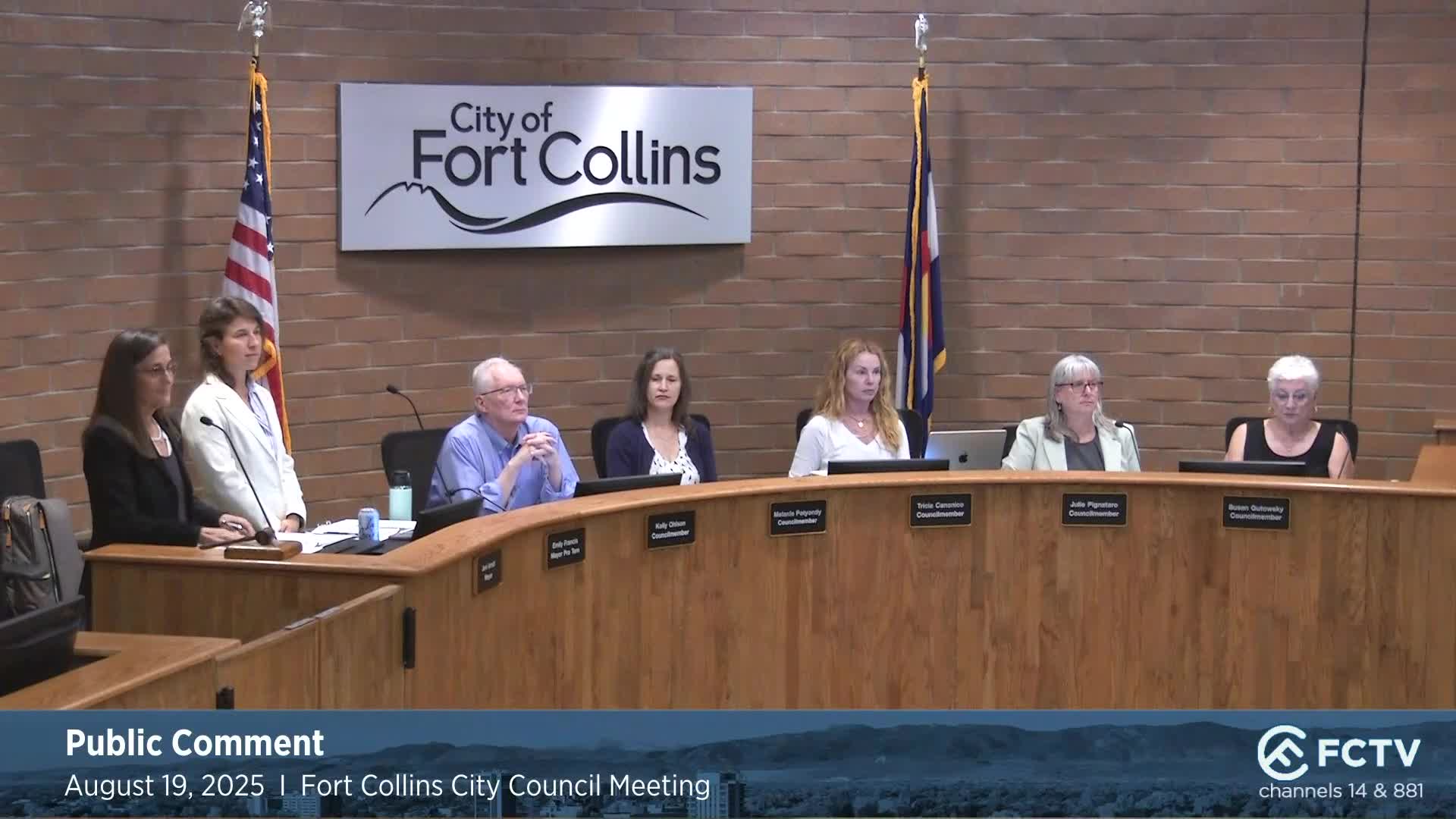
Residents press council on mosquito spraying; city staff describe targeted West Nile program and opt-outs
Summary
Residents raised concerns about Fort Collins’ mosquito-spraying program, citing health and environmental risks from adulticide chemicals; city ecological stewardship staff described the program’s larval-control focus, testing, adjusted spraying timing and existing opt-outs for pesticide-sensitive properties and businesses.
During the public comment period, several residents urged the City Council to reconsider or halt blanket adulticide spraying for West Nile virus, citing studies and concerns about impacts to pollinators, waterways and human health. The speakers named active ingredients—permethrin and PBO—and said repeated neighborhood sprayings were occurring. One commenter reported six sprayings so far in the season and presented studies they said showed environmental persistence and toxicity.
Why it matters: West Nile virus surveillance and mosquito management touch public-health, environmental and operational trade-offs. Residents raised concerns about non-target impacts on pollinators and small wildlife, and about potential persistence in soil and water; others on council reminded the public the city must also consider animal and human illness associated with mosquito-borne disease.
Staff response: The city’s ecological stewardship manager, Matt Parker, who oversees the West Nile program, described the city’s approach as primarily larval control and data-driven surveillance. Parker said the city spends roughly $400,000 per year on West Nile management and that this year the primary challenge has been infection rate rather than mosquito abundance. He said staff monitor insecticide resistance, adjust timing to reduce pollinator exposure (for example, spraying later or earlier when pollinators are not active), and carefully follow label dosages. Parker also described two opt-out mechanisms: a state-run pesticide-sensitive registry for medical reasons and a business opt-out showing economic hardship; in those cases the city will honor buffers around the property.
Follow-up and guidance: Staff advised residents who grow certified-organic produce to rinse produce after spray events and explained the city offers two opt-out buffers for the adulticide program: a state pesticide-sensitive registry and a documented business hardship buffer. Council members asked staff to continue reviewing policy, to provide more outreach materials about exposure reduction (for example, washing gardens), and to bring any future policy alternatives back for council review.
What the public asked for: Several speakers called for discontinuing blanket adulticide spraying and adopting integrated pest management alternatives; some asked for clearer options for notification and for broader use of traps and larval-control measures. Staff said they would continue to assess resistance and non-target impacts and to refine timing based on pollinator activity.
No formal decision: This item was handled as public comment with staff follow-up; council did not take formal action to change the program during the meeting.