
Kitsap County holds public hearing on updated 2025 sewer standards; no public testimony
Get AI-powered insights, summaries, and transcripts
Subscribe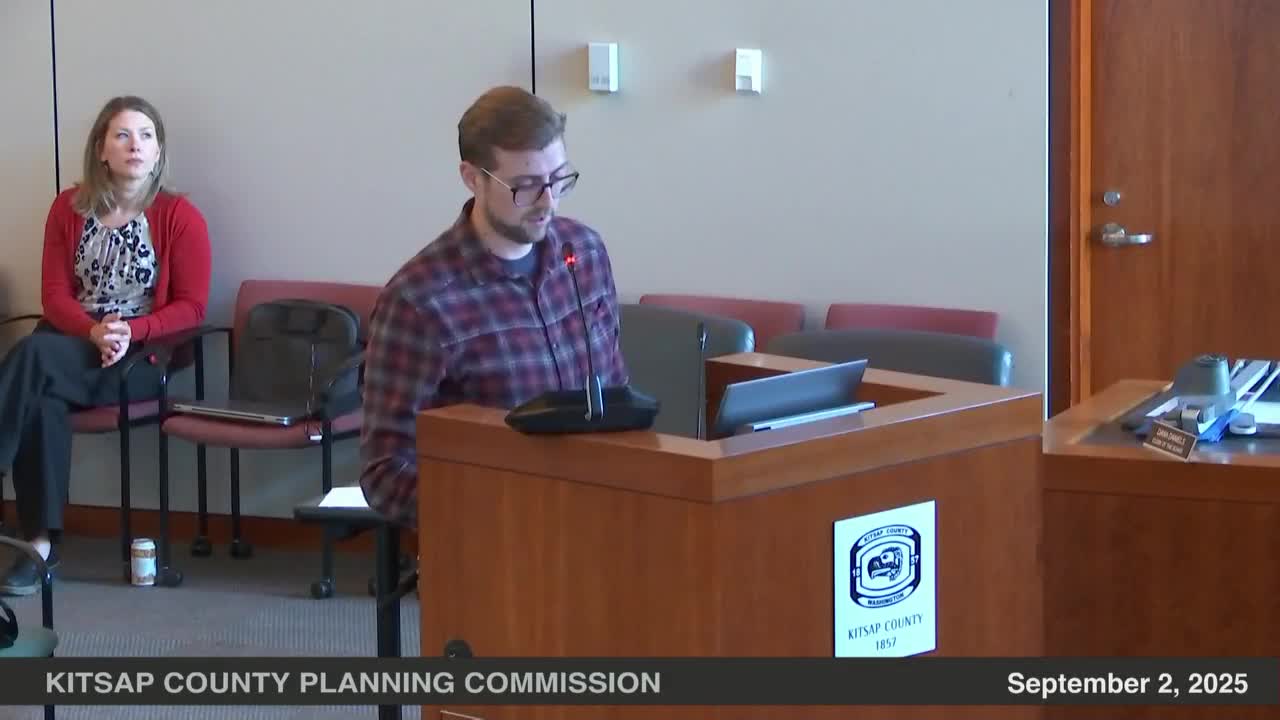
Summary
Kitsap County Planning Commission opened a public hearing Sept. 2 on proposed 2025 sanitary sewer standards introduced by Anthony Burgess, capital project manager for the countys Public Works sewer utility division.
Kitsap County Planning Commission opened a public hearing Sept. 2 on proposed 2025 sanitary sewer standards introduced by Anthony Burgess, capital project manager for the countys Public Works sewer utility division. Burgess said the update "Tonight we are hosting the public hearing for the 2025 sewer standards update." The commission received no oral public comments during the hearing and informally closed the public comment period.
The proposed standards package is intended to replace standards first adopted in 1996 and to incorporate work done in more recent, informal updates. Burgess told commissioners the county has republished the standards in a reorganized format, updated means-and-methods sections to reflect current construction and inspection practices, and divided the document into two implementation priorities: Priority 1 (jurisdictional means and methods) and Priority 2 (development issues raised by builders and the public).
The county emphasized the operational scale underpinning the update: Kitsap operates four wastewater treatment plants, including the Central Kitsap Treatment Facility; the system covers roughly 220 miles of sewer pipe and more than 65 pump stations. Burgess said three treatment plants are regulated by the Washington State Department of Ecology and one by the U.S. Environmental Protection Agency.
Burgess described several substantive changes summarized in workshops with builders and staff: reformatting the standards into 13 clearer sections from the older seven-division structure; clarifying developer-facing policies; updating technical construction figures; and adding policy language adapted from Bremerton for homeowner reimbursement in limited cases. On development questions, staff said they revised a prior proposal to allow neighborhoods on private streets to avoid dedicating sewer pipe and removed that item from active consideration after workshop feedback. The draft also includes targeted flexibility for geotechnical certifications and clarifies how accessory dwelling units (ADUs) are treated for connection fees.
County staff also reported steps taken under the State Environmental Policy Act: Burgess said the countys SEPA determination of nonsignificance has been published and that the SEPA comment period has closed. No written or oral SEPA appeals were raised at the Sept. 2 hearing.
During the meetings general comment periods, a resident who identified himself as Mr. Palmer urged the commission to give advance notice when staff cancel meetings: "My comment this evening has more to do with a question as to why all the cancellations of planning commission meetings..." Cecilia Olson of the county Department of Community Development responded that meeting cancellations reflected scheduling conflicts for the county chambers, noting "The meeting that is canceled on the sixteenth is actually being rescheduled to the 20 third and then, upcoming November 4, the chambers are also going to be in use for elections. So that meeting is going to, we're exploring alternative dates either the week before or adding another date to make up for that because we won't be able to use the chambers for the meeting."
Staff asked commissioners whether they supported combining deliberations and findings of fact into a single future meeting package; Burgess said he would prepare materials assuming that approach unless commissioners objected. He asked whether the consolidated deliberation should be scheduled for the "20 third" (a Sept./Oct. date referenced in the meeting). Commissioners did not raise formal objections during the Sept. 2 session.
No formal adoption vote on the standards occurred at the Sept. 2 meeting. The public hearing record was closed and the planning commission will consider next steps, including deliberation and findings of fact at a subsequent meeting after staff finalizes the packet and scheduling.
Background: Kitsap County last attempted a formal update in 2020 but used interim guidance unofficially; previous update efforts did not complete public engagement, SEPA review and formal board adoption, according to staff. The sewer utility said the 2025 standards are a "living document" that may be revised further after formal review and commissioner deliberation.