Get Full Government Meeting Transcripts, Videos, & Alerts Forever!
Get email alerts on the Sewer Rate Model topic
No spam. Unsubscribe anytime.
County, consultants present long-term sewer rate model and 75‑year asset forecast tool for scenario testing
Summary
King County and consultants said they have extended the sewer rate forecasting tools to 20 years, developed a companion 75‑year asset renewal tool, and will use scenario testing to show trade-offs among capital portfolios, policy choices and rate outcomes.
King County staff and outside consultants briefed the Regional Water Quality Committee on Sept. 3 about a long-term sewer rate forecasting tool the county said it has used since 2020, and a new capital-forecasting tool that projects asset renewal and replacement needs up to 75 years.
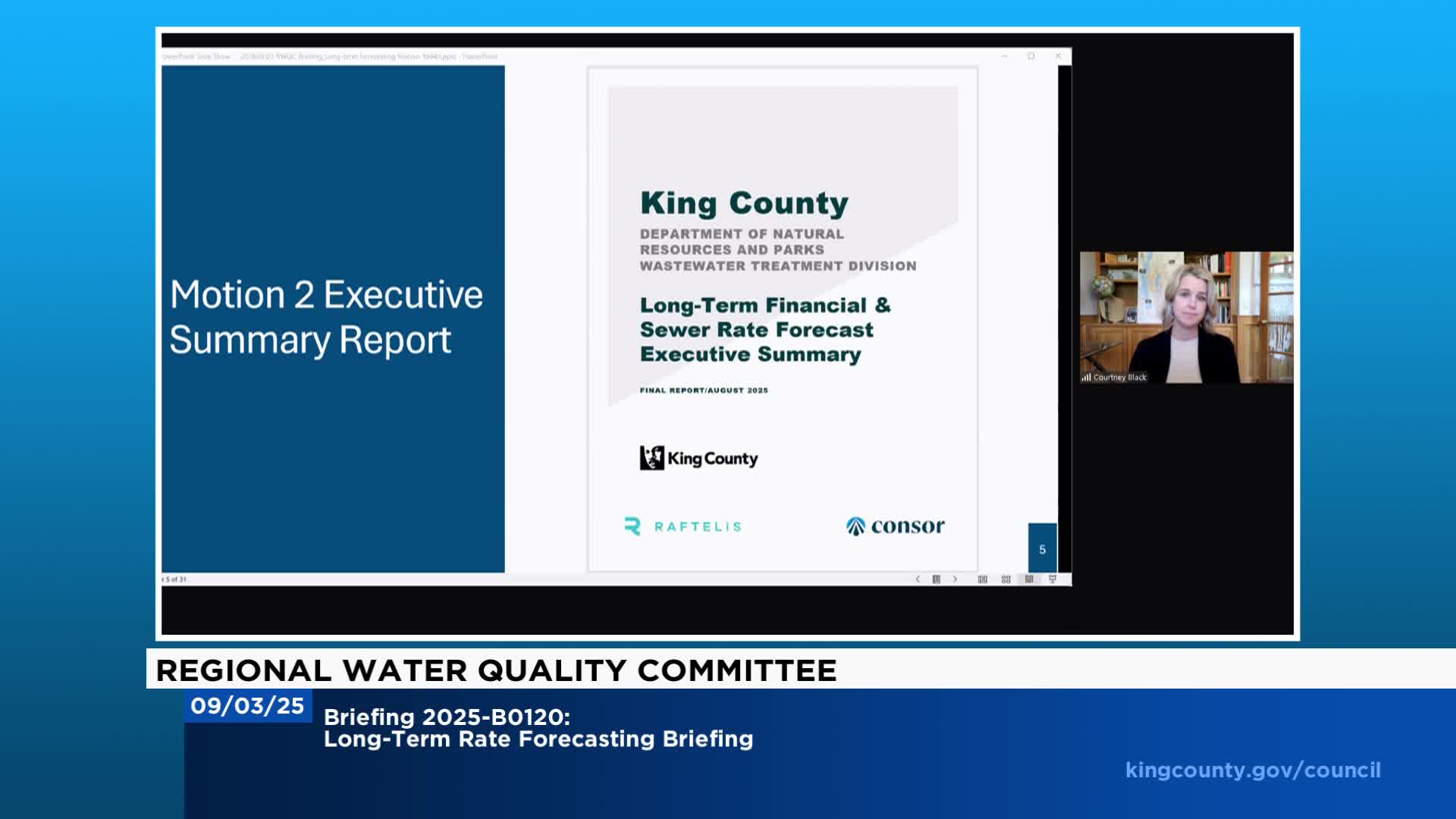
"We developed [the rate model] back in 2020," Courtney Black, chief financial officer for the Wastewater Treatment Division, said. Black said the division engaged Raftelis Financial Consultants to provide an independent advisory recommendation and to prepare an executive summary that describes the model's methodology and outputs.
Joe Kria, vice president at Raftelis, said the firm builds long-range financial models for utilities nationwide and helped develop a new asset renewal and replacement forecasting tool. "The tool gives us long-term visibility out 75 years for some of the key capital requirements that WTD is going to need to kind of consider as we think about future needs," Kria said.
How it works: County staff described the model as a dynamic financial planning engine that combines short- and long-term capital plans, operating costs, debt-service schedules and policy settings (for example, the county's cash-funding target for capital) to produce revenue requirements and rate scenarios. The new companion tool maps known asset inventories, installation dates and assumed useful lives to estimate replacement timing and cost. That capital-forecast output can be summarized by decades and fed into the rate model to test scenarios.
Examples and scenarios: Staff presented sample sensitivity runs. One hypothetical test doubled the estimated cost of two remaining combined sewer overflow projects and showed how rate peaks would rise relative to the adopted forecast. Another test removed expected savings from variable-rate junior lien debt and indicated that the modeled sewer rate would be about $3 higher in 2035 under that assumption.
Transparency and next steps: The division said it provided the executive-summary materials to the committee and to the Municipal Utility and Public Advisory Committee (MUPAC) and offered an in-depth model "tour" for technical stakeholders. Black said the model will be used to inform the 2027 rate proposal and that the division will work with a MUPAC rate-model subcommittee to identify which model details should be shared for transparency and review.
"We are committed to continuously improve our tools, improve our processes, and make sure that the visibility and transparency around rate forecasting is at the forefront of how WTD is engaging with its stakeholders," Kria said. The county plans to return to RWQC and to MUPAC with scenario briefings and additional sensitivity analyses.
No vote was taken on the model today; staff asked the committee to review the executive-summary materials and said further discussion will occur at future meetings.