Get Full Government Meeting Transcripts, Videos, & Alerts Forever!
Get email alerts on the Behavioral Health Tax Renewal topic
No spam. Unsubscribe anytime.
Council committee advances renewal of 0.1% behavioral health sales tax amid questions on spend plan
Summary
The Budget and Fiscal Management Committee voted to advance an ordinance to renew a tenth-of-a-cent sales tax that funds behavioral health services and therapeutic courts, while members pressed for a clear, time-limited implementation plan and assurances the existing plan will be extended until a new plan is adopted.
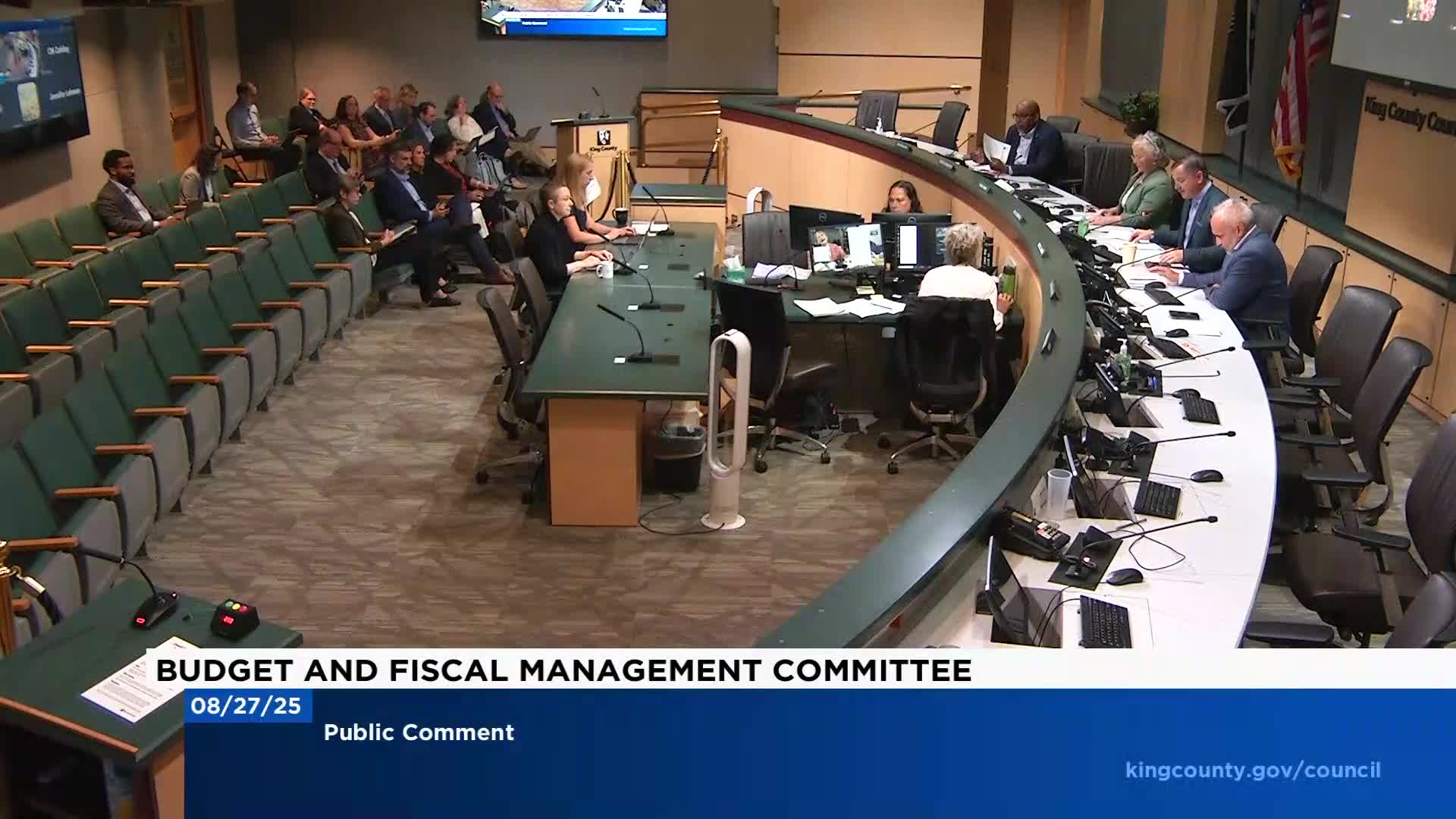
The Metropolitan Key County Council’s Budget and Fiscal Management Committee on Aug. 27 voted to advance an ordinance renewing the county’s tenth-of-a-cent sales tax for behavioral health services and therapeutic courts, while members sought firmer timelines for the executive’s implementation plan. The committee gave a due-pass recommendation to proposed ordinance 2025-0212 as amended.
Sam Porter, Council Central Policy Staff, told the committee the proposed ordinance would “continue the collection of the one tenth of one percent mental illness and drug dependency or MID additional sales and use tax for another term of 9 years to expire 01/01/2035.” Porter said the tax has been imposed since 2008 and is set to expire Jan. 1, 2026, and that, according to the July 2025 OIFA forecast, MID revenues are now projected to generate more than $1 billion over the nine-year renewal period.
Why it matters: MID funds a range of behavioral-health and diversion services that county leaders say reduce jail bookings and emergency room use and support therapeutic courts. Council members emphasized the importance of continuity for service providers while asking for clearer council oversight of how future MID dollars would be spent.
Most committee members said they support renewing the tax but want the executive’s implementation plan — the service-improvement plan that guides expenditures — aligned with the tax authorization. Susan McLaughlin, director of the Behavioral Health and Recovery Division, confirmed the executive’s intent is to transmit a new MID implementation plan in 2026 and that the executive intends to propose legislation in the fall to extend the existing implementation plan until a new one is adopted.
Key details and timeline: Porter said the State Department of Revenue must be notified of renewed tax legislation by Oct. 18 to avoid interruption of collections. The proposed ordinance as briefed would extend the MID tax through Jan. 1, 2035, and executive staff project the renewed tax will generate significant revenue over the renewal term. Porter noted a technical amendment recommended by council legal counsel to add the word “additional” so the ordinance correctly refers to the tax as an “additional sales and use tax.”
Committee discussion and concerns: Several council members urged a closer link between authorization and spending. Council Member Balducci asked whether the four MID plan components that currently expire on Jan. 1 — policy goals, the service improvement (implementation) plan governing expenditures, the evaluation plan with annual reporting requirements, and the binding partnership agreement and related requirements — would be extended; McLaughlin confirmed the executive intends to extend all four components pending transmittal of a new plan. Council Member Perry and others said they support the renewal but expressed reservations about authorizing a multi-year tax without first approving a new implementation plan or a time-limited extension that would require additional council action in the near term.
Council process: The committee advanced the ordinance with a due-pass recommendation to the full council. Committee members moved and adopted a technical amendment recommended by legal counsel. The committee vote on the amended ordinance was recorded as 7 ayes, 0 noes.
Next steps: The executive is expected to transmit an implementation plan in 2026; executive staff told the committee they plan to transmit legislation with the fall budget that would extend the current service improvement plan until the new plan is adopted. Council members indicated intent to use the next months to work with the executive on priorities and possible time-limited approaches to align authority and oversight.
Ending: The committee advanced the renewal to full council with an expectation that the fall transmittal will contain a proposal to extend the current implementation plan pending a 2026 replacement; members said they will press for explicit oversight and reporting requirements when the new plan is transmitted.