Get Full Government Meeting Transcripts, Videos, & Alerts Forever!
Get email alerts on the Traffic Signal Network topic
No spam. Unsubscribe anytime.
Lake County DOT details PASSAGE traffic signal network, fiber and camera system
Summary
Lake County DOT staff presented an overview of the county’s PASSAGE traffic management network: 314 miles of fiber, hundreds of cameras and controllers, integration with IDOT and municipalities, snapshot video retention policy, and plans for adaptive signal pilots and a connected vehicle demonstration using federal funds.
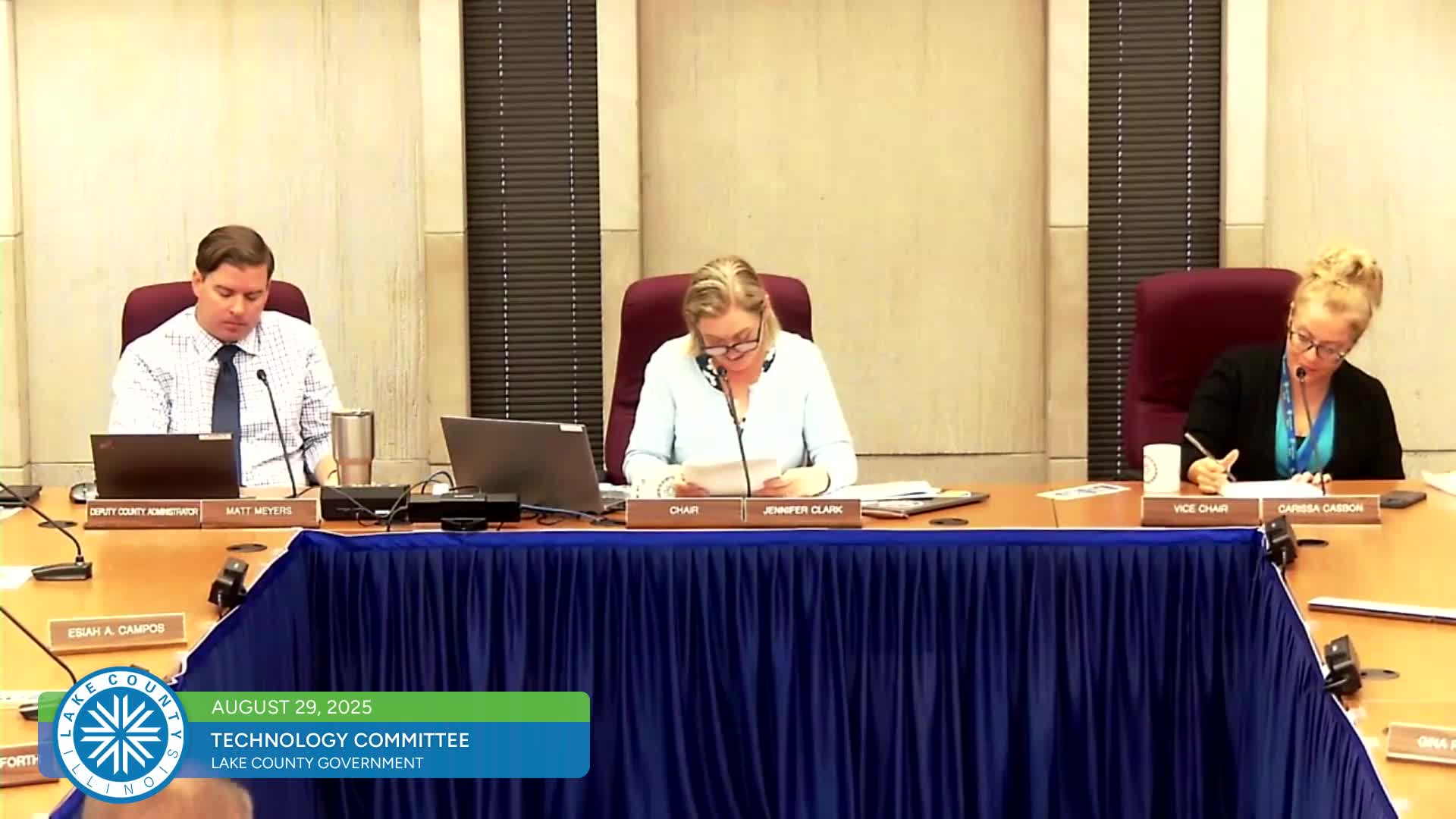
Lake County Department of Transportation staff on Aug. 29 gave the Technology Committee a detailed briefing on the county’s PASSAGE arterial signal synchronization and travel‑guidance system, describing infrastructure, operations, security and future projects including adaptive signal control pilots and a federally funded connected‑vehicle demonstration.
John Nelson, assistant county engineer, and Ryan Legree, Traffic Management Center (TMC) manager, said the county’s network includes fiber connecting signal cabinets and cameras across multiple jurisdictions and is integrated with several outside agencies. "So today, we have about 314 miles of fiber that we use," Nelson said. He said the network links more than 677 traffic signals and approximately 467 pan‑tilt‑zoom ("pencil zoom") cameras; Legree later said the county views more than 480 cameras and more than 1,000 total camera/detection data sources when detection cameras are included.
Nelson and Legree described signal‑cabinet components (controllers, malfunction management units, load switches, field wiring, network switches) and noted each cabinet has battery backup that can power an intersection for roughly four to six hours depending on usage. They said the county is rolling out accessible pedestrian signals (APS) required under PROWAG and the Americans with Disabilities Act and replacing push buttons with talk/beep devices for accessibility.
Legree described software systems used by the TMC: a sentraX controller communication platform, an Automated Traffic Signal Performance Measures (ATSPM) system that collects high‑resolution controller data for engineering analysis, adaptive control pilot software on Butterfield Road in Libertyville, an inventory database for roughly 3,000 network devices, and integrations with Police CAD, Waze’s Connected Citizens Program, Google/Apple feeds and Samsara (plow tracking). He said the county currently posts snapshot images from cameras on the public PASSAGE website every three to five minutes and retains those snapshots for 10 days; the county does not continuously record camera streams for long‑term retention.
Legree described routine operations: the TMC is staffed weekdays from 6 a.m. to 7 p.m., with remote secure access available for after‑hours incidents; the TMC maintains a disaster‑recovery backup site to provide redundancy. On public safety, Legree said police and fire dispatch agencies have access to camera streams under memoranda of understanding for response purposes; the county can restrict access if needed.
Looking ahead, Nelson said the county will continue expanding cameras, fiber and signal connections and is preparing details for a connected‑vehicle demonstration funded with federal dollars. He said the county has been holding the federal funding until standards and industry directions matured; staff attended an international ITS conference to evaluate options.
Committee members asked whether adaptive control operates autonomously. Legree said pilots currently operate within engineered parameters and that fully autonomous AI‑driven adaptive systems exist but require additional inputs (camera/detection and connected‑vehicle data) and traffic‑engineer oversight. He said the county’s installed Ethernet‑based controllers and cabinet switches position it to adopt advanced systems without wholesale replacement.
The presentation did not include any formal vote; it was informational. Nelson and Legree said staff will return with expansion project proposals and that they are working on measures to reduce winter conduit/fiber outages and to deploy additional APS signals.