Get Full Government Meeting Transcripts, Videos, & Alerts Forever!
Get email alerts on the On Site Wastewater topic
No spam. Unsubscribe anytime.
Lake County delegates on-site wastewater enforcement at Ports of Sullivan Lake to village
Summary
The Lake County Health and Community Services Committee approved an intergovernmental agreement giving the Village of Lakemore delegated authority to enforce county on-site wastewater rules at the Ports of Sullivan Lake after years of holding-tank issues and intermittent HOA compliance.
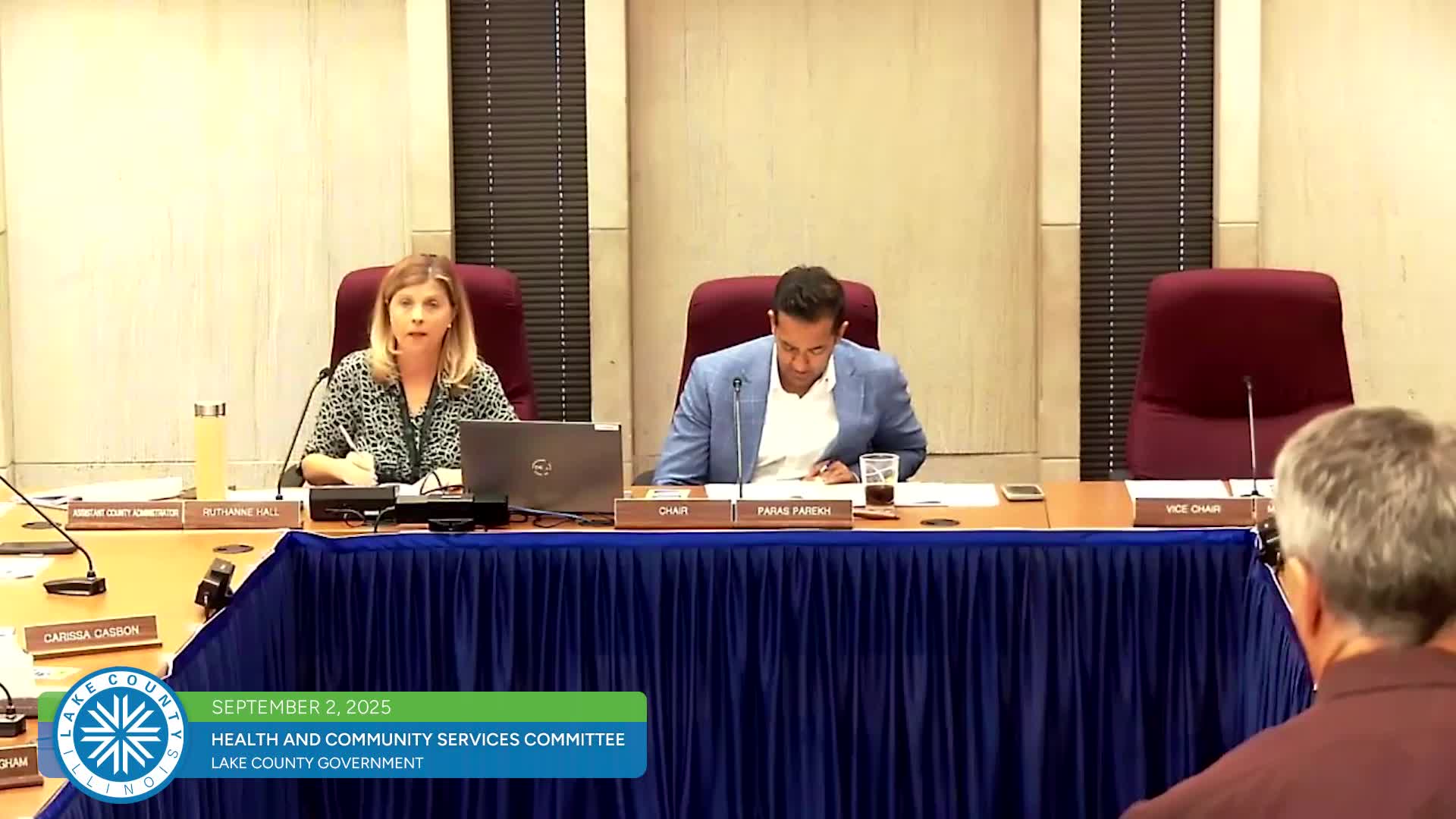
The Lake County Health and Community Services Committee voted Sept. 2 to authorize an intergovernmental agreement delegating enforcement of on-site wastewater provisions for the Ports of Sullivan Lake to the Village of Lakemore.
County health officials said the area, which began as a seasonal RV park and has since developed into lots with permanent trailers, relies largely on individual holding tanks rather than in-ground septic systems. Kristoff, executive director of the Lake County Health Department, told the committee the village asked to be delegated enforcement authority so it could issue fines and help monitor problems on site.
“This is kind of an unusual situation. This is a, area that used to be an RV park, a seasonal RV park back in the 19 eighties, which was regulated by the Illinois Department of Public Health,” Kristoff said. He added that the site “evolved into permanent residents, trailers and different things” and that homeowners’ association agreements had not solved recurring maintenance and overflow issues.
The county’s approach will let village staff carry out enforcement of the county’s Chapter 171 on-site wastewater ordinance while the health department remains involved, Kristoff said. He listed past attempts to manage the site through agreements with an HOA and said the county vetted the current arrangement with the state's attorney.
Committee members asked how many units are affected and how severe the violations have been. Kristoff estimated “approximately 150 or so” individual lots with holding tanks. He described the typical problem as tanks that must be pumped frequently; when owners do not maintain them they can “start to overtop,” and in rare cases someone might “pump their own tank out into the wetland.”
Member Danforth, questioning whether the site remains an RV facility, said, “These aren't homes. These are just RV facilities.” Kristoff responded that the site has morphed into permanent trailer lots and that many lots are taxed and owned individually.
Paul Frank asked whether the property sits next to a body of water. Kristoff said the site borders Sullivan Lake, “a very ... wetland. Basically, it's only, like, 4 or 5 feet deep,” and noted that the lake drains into the chain of lakes. Kristoff said the department does not have “concrete information” that overflows are reaching the lake but that overflowed tanks have been observed.
Committee members emphasized that the agreement includes a clause allowing the county to change tactics if village enforcement does not achieve compliance. “I appreciate you highlighting the section of the agreement that allows us to pivot to alternative methods if not successful, because the goal obviously is compliance,” one member said during discussion.
The resolution was moved by Member Cunningham and seconded by Member Casman; the committee voted in favor and the motion passed.
Why it matters: the agreement moves enforcement to the local village to increase on-site monitoring capacity while preserving the county’s ability to take further legal action if necessary. Holding tanks require frequent maintenance, and overflow near wetlands poses potential environmental risk if sewage reaches Sullivan Lake or connected waterways.
Next steps: the village will begin enforcing county Chapter 171 provisions on the site; county staff will continue oversight and may pursue other remedies if the village’s approach does not secure compliance.