Get Full Government Meeting Transcripts, Videos, & Alerts Forever!
Get email alerts on the Advanced Nuclear topic
No spam. Unsubscribe anytime.
North Dakota panel opens study of advanced nuclear power, issues RFPs and hears industry briefings
Summary
A Legislative Management interim committee launched a state study of advanced nuclear energy, reviewed a background memorandum and the legal and regulatory landscape, authorized consultant contracting under a $300,000 appropriation, and heard industry presentations on technology, supply chains and demand drivers including data centers.
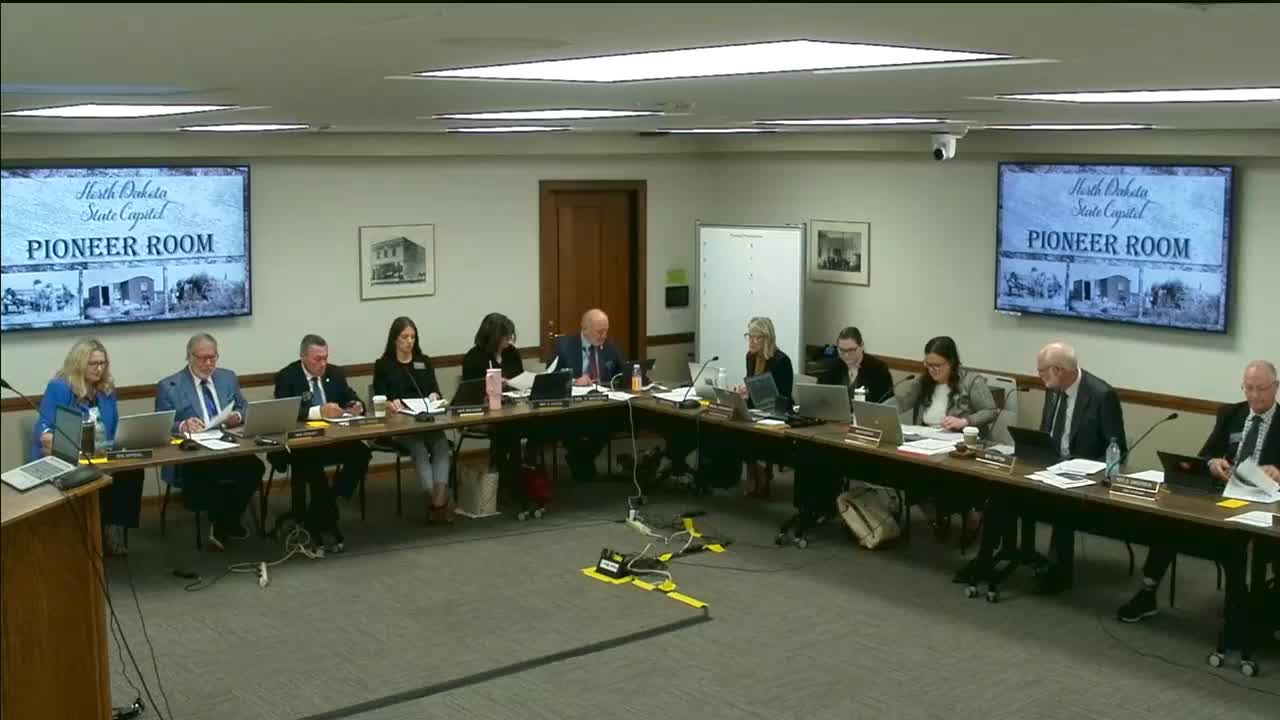
The Advanced Nuclear Energy Interim Committee of the North Dakota Legislative Management opened a study of the feasibility, siting and deployment of advanced nuclear power in the state, reviewing a background memorandum and beginning a formal consultant selection process to support the work.
The study was established by House Bill 1025, which also included a $300,000 appropriation to the Legislative Council to contract consulting services and directed staff to seek matching funds from the private sector, Legislative Council staff Megan Gordon told the panel. Gordon provided a background memorandum that summarized federal statutes, regulatory pathways and model state actions that the committee will consider.
Why it matters: Committee members and invited speakers told lawmakers that data centers, artificial intelligence and other big electric loads are increasing demand for reliable, carbon-free electricity and that states that act now may capture long-term economic and workforce benefits. Presenters said advanced reactors and microreactors could provide firm, low-emission power for industrial users, data centers and utilities, but highlighted unresolved issues including fuel supply, waste management and licensing timelines.
Federal and state context Megan Gordon, legislative counsel for the committee, summarized the statutory and regulatory framework the committee must consider. She cited foundational federal laws including the Atomic Energy Act of 1954, the Energy Reorganization Act of 1974, the Nuclear Waste Policy Act of 1982 and later measures such as the Nuclear Energy Innovation and Modernization Act (2019) and the ADVANCE Act (2024) that aim to modernize licensing for advanced reactors. Gordon also noted North Dakota statutes (Century Code Chapter 30-82) that currently prohibit placement or disposal of high-level radioactive waste within the state and that the state has a High-Level Radioactive Waste Advisory Council established by statute.
Gordon said the background memorandum (LC27908101000) lays out the committee’s two problem-solving pathways: the technical questions about building and licensing reactors, and the questions about how produced power would be used, permitted and accepted by local communities.
Presentations and technical takeaways - Michelle Zitlow Miller, state engagement lead for the Department of Energy’s Gateway for Accelerated Innovation in Nuclear (GAIN), told the committee that advanced nuclear technologies range from microreactors (tens of megawatts) to small modular reactors (SMRs, roughly up to 300 MW) and large reactors (gigawatt scale). She described differences in fuel and cooling approaches, and explained the potential advantages of some advanced designs: “microreactors, SMRs and non‑light‑water concepts can reduce site footprints and use passive or inherent safety features,” Miller said. She gave specific examples: newer designs can shrink emergency planning zones from roughly 10 miles to about 1 mile and reduce plant footprints from roughly 600 acres to “tens of acres, up to about 60.”
- Miller explained fuel considerations, noting the industry’s interest in high-assay low-enriched uranium (HALEU, 5–20% enrichment) and that U.S. industrial HALEU production is still being developed. She described current spent fuel storage practice — cask storage at reactor sites — and said DOE is pursuing collaborative siting approaches for consolidated storage. On costs she cited Ontario Power Generation’s announcement for four GE BWRX‑300 units (1,200 MW total) with an estimated total program cost of about $15 billion and a first-unit estimate of roughly $4.4 billion, noting unit costs are expected to fall with repeat builds.
- Katie Austin, director of public engagement for the Nuclear Energy Institute, summarized industry demand and regulatory trends. She said existing U.S. reactors provide large shares of clean, firm electricity and that multiple studies and DOE analyses foresee sustained demand for new firm, low‑carbon generation through mid‑century. She described progress on NRC licensing for various advanced designs and said a handful of demonstration and first‑of‑a‑kind projects are advancing toward construction and operation in the late 2020s and early 2030s.
- Industry scale and state operations: Gavin McCollum, chief operating officer at Basin Electric, and Pam Gorman Prohaska of Xcel Energy described local generation scale and utility load. McCollum noted Basin Electric’s recent Pioneer plant additions (about 580 MW) and the planned Bison generation station (about 1,500 MW) and placed those projects in the context of the cooperative’s roughly 5,000 MW fleet. Gorman explained Xcel’s service footprint and its Prairie Island (two 550‑MW units) and Monticello (about 670 MW) nuclear units.
Consultant procurement and proposals Gordon also briefed members on the request for proposals (RFP) for consulting services to support the study. The RFP (issued 07/22/2025) sought proposals to analyze feasibility, siting, transmission and economic effects. Gordon told the committee nine proposals were received and attached a one‑page appendix for each in the materials packet. The committee drew presentation order by lot and began hearing proposals and pitches from prospective contractors and industry partners in the afternoon session.
In the first industry pitch, Jeff Comer, CEO of Juniper Power, proposed a commercial, site‑driven approach based on work Juniper has done in Wyoming to pair near‑term natural gas and carbon‑management projects with eventual advanced nuclear siting. Comer said the firm would use lessons from Wyoming and leverage a partnership with BWXT (which makes naval reactors and is active in microreactor development) to support both project development and supply‑chain planning. “This is personal for me…I want to be a part of writing chapter one in North Dakota’s nuclear energy playbook,” Comer said.
Isaac Orr of Always On Energy Research described a proposal to model economic, reliability and transmission impacts of alternate generation portfolios for North Dakota, with detailed cost modeling and siting analysis tied to utility and market constraints.
Committee directions and next steps The committee decided that nonlegislative members appointed to the panel would have the opportunity to vote, a point Chairman Patton made early in the meeting after a brief discussion. Staff will continue to manage the consultant selection process; presentations by the nine proposers will proceed under strict 25‑minute time limits and the committee will discuss consultant recommendations after presentations are complete.
The study timetable in the background memorandum observes that the committee must submit a final report and any bill drafts to Legislative Management at the conclusion of the interim. Gordon also reminded members of rules governing remote attendance, meeting scope and required approvals for substantially expanding the committee’s work.
What the committee said it will watch next Members and presenters repeatedly flagged near‑term priorities for the committee’s work: identifying likely customers and offtakers for new nuclear capacity (utilities, data centers, heavy industry and possibly DOD sites), mapping transmission and site characteristics, clarifying fuel‑cycle and HALEU supply pathways, and outlining state policy options and incentives to derisk initial projects.
The committee will continue presentations from proposers and industry groups, evaluate consultant bids and then decide whether to contract external expertise to produce site‑ and policy‑specific recommendations for advanced nuclear deployment in North Dakota.