Get Full Government Meeting Transcripts, Videos, & Alerts Forever!
Get email alerts on the State Water Plan topic
No spam. Unsubscribe anytime.
New Mexico agencies lay out 50‑year water action plan, prioritize conservation, new supplies and watershed protection
Summary
State Environment Department and Office of the State Engineer presented an 11‑item 50‑year water action plan focused on water conservation, new supplies and watershed and water‑quality protections; agencies emphasized science‑based planning, interagency coordination and measurable goals.
New Mexico state water officials on Wednesday presented a science‑based 50‑year water action plan that lays out 11 specific actions across three categories — conservation, new supplies and water/ watershed protection — and identified measurable targets and ongoing programs to implement them.
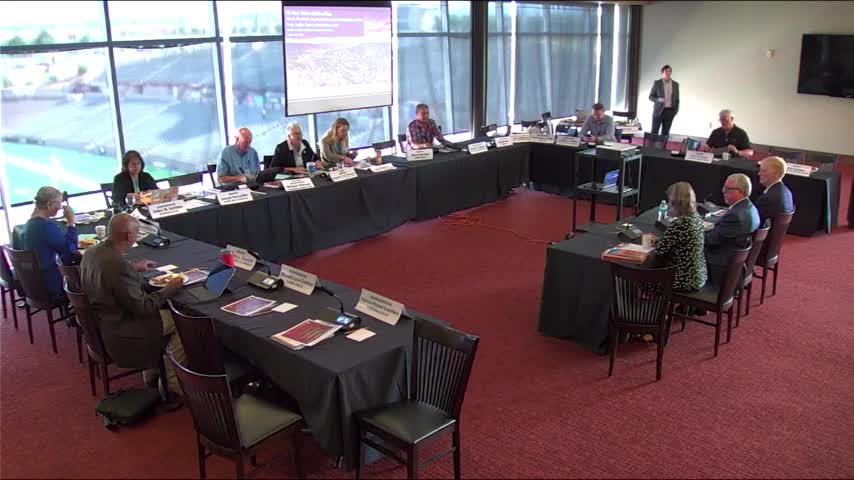
The plan was presented to the legislative committee by Tanya Trujillo, Deputy State Engineer, and John Roderick, Deputy Cabinet Secretary for Administration at the New Mexico Environment Department, who said the plan responds to a governor’s directive to ground long‑range planning in technical research and to make the work “actionable.”
“This is based in technical research … and the punch line that you’ve heard before is we may be facing on the order of 25% less water in the future,” Trujillo said, summarizing the scientific outlook the plan uses. The document groups actions under water conservation, new water supply development and water‑quality/watershed protection, and is being distributed in hard copy to committee members.
Why it matters: The plan is intended to guide state investments, regional planning and regulatory work over decades as New Mexico faces hotter, drier conditions. It links near‑term program steps, such as curricula for water education and targeted grant programs, with longer‑term technical work including aquifer mapping and reuse rulemaking.
Key elements and early progress - Water education and conservation: The plan includes a statewide education campaign and school curricula developed with the Public Education Department and higher‑education partners; the plan also coordinates public messaging under the “mainstreamnewmexico.org” effort. Trujillo said the plan emphasizes making information accessible to communities and integrating education with municipal and agricultural conservation efforts. - Agricultural conservation: The Legislature appropriated $5 million for an agricultural water resilience program administered in part through the New Mexico Water Resources Research Institute at NMSU; the institute reported it received 61 grant applications addressing delivery systems, evaporation reduction, modern irrigation and other technologies. Dr. Reynald (Sam) Fernald said the program will report simple, repeatable metrics such as water saved per year, acres affected and changes in crop‑yield per water consumed. - Municipal conservation and leak detection: NMED is scaling a satellite‑based leak‑detection pilot that identified distribution leaks in Truth or Consequences and Cloudcroft with an approximately 90% verification rate; John Roderick said closing leaks in Cloudcroft will save roughly 150 million gallons of treated water. The plan pairs detection with funding options for repairs. - Reuse and reclamation: NMED is expanding reuse rulemaking under its groundwater quality regulations to include potable and indirect potable reuse and industrial reuse. Roderick said New Mexico has a long history of reuse and is advancing rules that would clarify potable/indirect potable reuse pathways and industrial reuse options. - New supply and technical mapping: The plan highlights a strategic water supply initiative (see separate article) and expanded aquifer mapping and monitoring led by New Mexico Tech’s Bureau of Geology and NMSU research partners to improve understanding of groundwater quantity and change over time. - Watershed protection and cleanup: The administration reported $20 million appropriated for contaminated‑site cleanup (see separate article) and noted that forestry and watershed restoration work is ongoing, funded in part through the Land of Enchantment Fund and other federal and state sources.
Discussion vs. decisions - Discussion: The presentation included technical background, program descriptions and timelines. Lawmakers asked about tribal settlements, adjudication and the balance of agricultural water use, and panelists noted those are parallel, high‑priority efforts that the 50‑year plan is designed to complement rather than to preempt. - Direction: Agencies said they will continue interagency and tribal coordination, develop public dashboards tracking progress and roll out specific grant opportunities for components of the plan. - Formal actions: The committee received the presentation; no formal vote or binding adoption of the plan occurred during the hearing.
Context and limitations - The presenters repeatedly emphasized the plan is a starting point, grounded in scientific projections and a package of discrete actions to put before the Legislature and communities. - The plan does not change legal water rights, substitute for adjudication processes, nor does it reassign tribal allocations; when asked about tribal water settlements and possible leasing or purchases, Trujillo said options such as leasing must conform to the federal legislation that authorized specific settlements and the agencies will work within those parameters.
Ending Trujillo and Roderick said the plan is being tracked and that agencies are preparing public‑facing dashboards and upcoming funding solicitations tied to the plan’s action items. Committee members pressed for baseline metrics and repeated public reporting; Trujillo referenced the 2020 Water Use and Conservation Report as a likely baseline for measuring progress against the targets.