
Legislators, council officials review 300-year history of New Mexico land grants and modern policy needs
Get AI-powered insights, summaries, and transcripts
Subscribe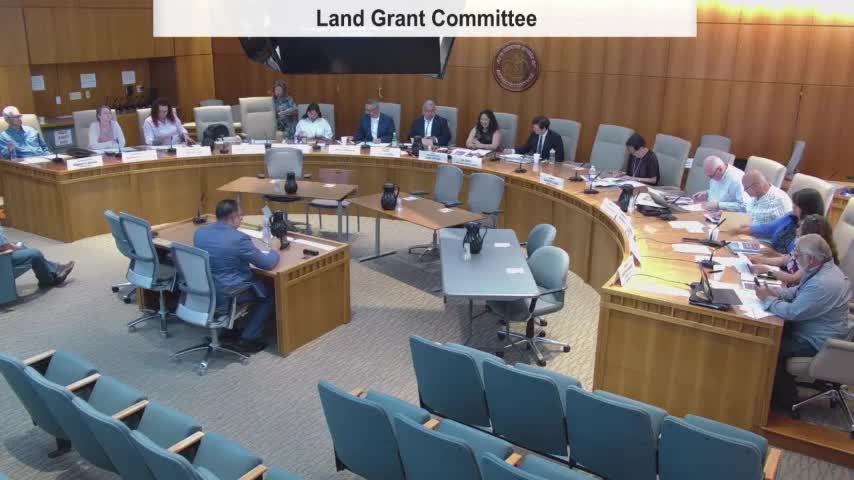
Summary
At the Land Grants Interim Committee meeting in Santa Fe, University and council officials summarized the history of Spanish and Mexican land grants, the legal changes since U.S. sovereignty, and current legislative priorities including infrastructure funding, subdivision authority, watershed protection and stable revenue for land grants.
Madam Chairwoman Linda Serrano opened the Land Grants Interim Committee meeting in Santa Fe on May 30, calling for an overview of the history, law and current priorities affecting New Mexico’s historic land grants.
The committee heard a 20‑minute briefing from Arturo Archuleta, director of the New Mexico Land Grant Council and the UNM Land Grant Studies Institute, who said land grants are “centuries‑old communities that were established between 1692 and 1854” and described how common lands were central to those communities’ economies and governance. Archuleta told the panel that, after a long period of adjudication and other losses, roughly three dozen land grants remain active and 28 are now recognized in statute as political subdivisions.
Why it matters: recognition as political subdivisions, statutory changes since 2003, and the creation of dedicated funding have changed the legal and practical landscape for land grants. Committee members said those changes enable land grants to pursue community infrastructure, cultural preservation and affordable housing, but that gaps remain in financing and statutory authority needed for some projects.
The committee discussion and Archuleta’s presentation focused on these main points: the Spanish and Mexican origins of community land grants and common lands; the legal transition under the Treaty of Guadalupe Hidalgo and subsequent U.S. adjudication processes that reduced many grants to small parcels; statutory changes since 2003 that granted political‑subdivision status and local zoning authority; and modern priorities including an infrastructure fund and statutory fixes to allow land grants to manage subdivisions on former common lands.
Archuleta provided several quantitative details to frame the issue. He said the 28 recognized land grants together manage about 200,000 acres of common land and that the largest remaining grant, Anton Chico, now manages about 104,000 acres (down from roughly 300,000 historically). He told members the Land Grant Assistance Fund and the Land Grant Council now provide recurring support but that the council’s budget has been flat for two years and that the community governance attorney program is operating at roughly half capacity.
Committee members seized on practical policy questions raised in the presentation. Representative Miguel Garcia and others urged more attention to transfers and federal land disposals that affect former common lands. Archuleta summarized pending legislative priorities the committee may revisit during the interim: creating a dedicated Land Grant and Acequia Infrastructure Trust Fund, minor fixes to the Land Grant Assistance Fund distribution rules, statutory authority to exempt land grants from the state subdivision act so they can proceed with internal affordable‑housing subdivisions, and funding for watershed protection and rehabilitation after wildfire.
Archuleta also described program and budget figures cited in committee materials: the acequia infrastructure program at $2.5 million recurring, an adjudication assistance fund of $800,000, and smaller recurring amounts for other programs that committee members and staff said are not commensurate with need.
The committee did not take final statutory action on any of the policy items during the meeting. Instead members asked staff to pursue follow‑up analysis and scheduled deeper briefings during the interim.
Ending: The committee’s work plan will guide additional hearings and site visits across the state; members said they expect more detailed fiscal analysis and presentations from state and federal agencies in coming meetings.