
Analyst warns of shortages, data gaps in New Mexico health care workforce projections
Get AI-powered insights, summaries, and transcripts
Subscribe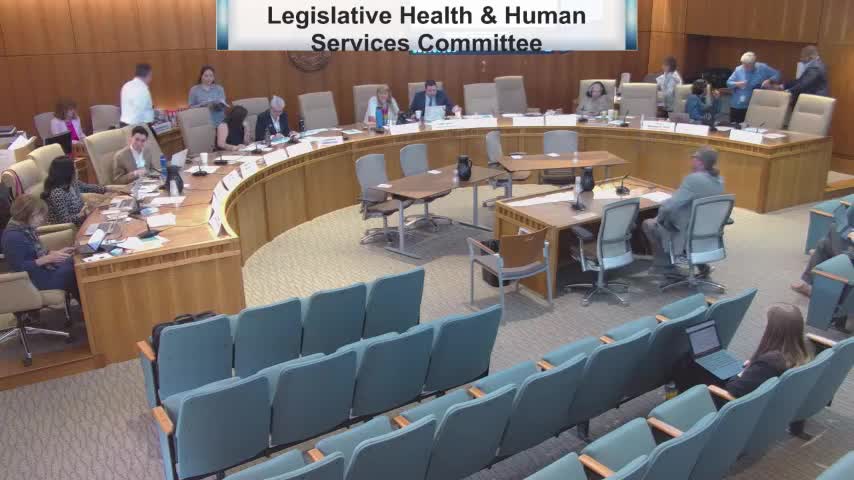
Summary
A Legislative Finance Committee analyst told lawmakers the state faces shortages in primary care and nursing and pointed to inconsistent data sources, limited access to the All Payer Claims database, and projected surpluses in nurse practitioners and physician assistants as planning challenges.
Harry Rommel, a health and human services analyst, told the Legislative Health & Human Services Committee that New Mexico faces chronic, geographically uneven shortages of health professionals and that available data sources disagree. "We know about the shortages," Rommel said, and he cautioned that different benchmarks and datasets can give different results.
Rommel reviewed multiple federal and state data sources, including HRSA27s Health Professional Shortage Area (HPSA) designations and projections from the Health Resources and Services Administration's Bureau of Health Workforce. He reported that 32 of 33 New Mexico counties carry some HPSA designation and that benchmarks produce different estimates: HRSA HPSA data showed a need for about 200 primary care physicians while a separate state health care workforce report used alternative benchmarks and estimated a 330-physician need for the state. On nursing, Rommel said the supply-and-demand model projects needing roughly 5,750 registered nurses by 2030, at about 71% adequacy.
Data and access constraints: Rommel emphasized that no single "source of truth" exists for workforce planning and that the All Payer Claims database (APCD), held at the Department of Health, is the most useful source but is not accessible in the needed de-identified, unit-level form for the Legislative Finance Committee. He said the National Provider Identifier (NPI) database is large and difficult to analyze but can be used for longitudinal work. Members noted licensing records show registrations but not active practice locations, complicating retention and exodus analysis.
Workforce composition and projections: The HRSA supply-and-demand projections highlighted likely shortages in several physician specialties and behavioral health roles (notably addiction psychiatry and child psychiatry) and projected a surplus of nurse practitioners and physician assistants by 2030. Committee members challenged that finding: UNM27s Nathan Bush said the UNM physician assistant program admits about 26 students a year and retention figures for graduates were not available in the meeting. Rommel acknowledged the federal projection model but said it was county-level and sophisticated.
Committee reaction and next steps: Lawmakers pressed for improved, transparent data. Several members urged staff to pursue access to the APCD and recommended using NPI and licensure data cautiously because they can overstate in-state active practice. Rommel said he would continue refining analyses and coordinate with UNM and other stakeholders to get county-level detail and to attempt to answer retention and exodus questions.
Ending: The committee asked LFC and DOH for follow-up, and Rommel said he would return with additional, county-level analysis if the necessary data could be obtained.