Get Full Government Meeting Transcripts, Videos, & Alerts Forever!
Get email alerts on the Dei Materials Transparency topic
No spam. Unsubscribe anytime.
Parents and residents confront school leaders over DEI materials; board and staff outline existing policies
Summary
Several residents spoke at the public forum alleging that diversity, equity and inclusion (DEI) materials and a cultural fluency training slide deck were shared with students and later restricted; the board discussed district policies for curricular materials and librarians’ review process and voted to take public comments under advisement.
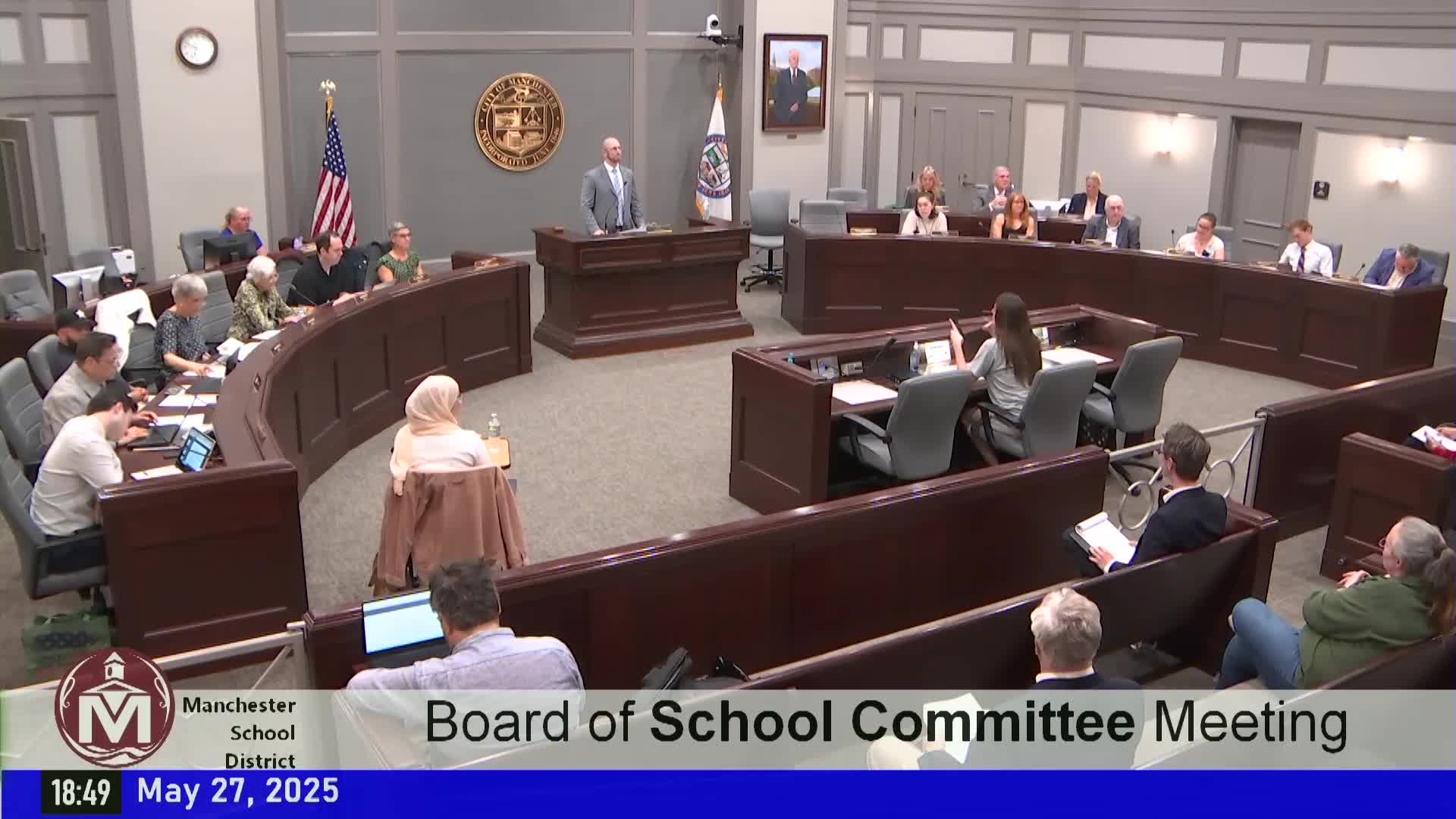
Several residents used the public forum at the May 27 Board of School Committee meeting to press the district for more transparency after they said diversity, equity and inclusion (DEI) materials used in staff training or classroom assignments were shared with students and then restricted from distribution outside schools.
At the start of the forum, Camille Chaffee said a memo from the district’s executive director of student engagement indicated a “cultural fluency training PowerPoint” had been shared as part of a class assignment, and she alleged the memo instructed staff that slides “should not be shared outside of the school…or even local press.” Chaffee told the board she regarded the combination of classroom use and guidance to withhold the material from families as “deeply problematic,” and used the term “grooming” — later defining it for the board — to describe her concern about secrecy around materials.
Other commenters, including Sue Hannon, president of the Manchester Education Association, and Patricia Anglin, a school nurse and union rep at Central High School, urged restraint in public accusations and asked for a full, transparent investigation. Hannon said the assignment given to teachers differed from the document circulating in the community and emphasized that professional development is intended to inform classroom practice. Anglin praised Assistant Superintendent Forrest Ransdell and did not address DEI materials directly.
During the public discussion the board and administration explained the district’s existing policies for curricular materials and library holdings. A district speaker (identified in the meeting as the administration’s curriculum representative) outlined that curriculum is adopted through a committee process and that librarians and media specialists vet library purchases; Instruction 145 (Exceptions to the use of specific course materials) was cited as the policy requiring at least two weeks’ notice to parents when certain human sexuality or human growth curriculum will be used and offering inspection and alternate materials upon request.
Committee member Arderopoulos moved that the board “take all comments under advisement and further to receive and file any documentation presented” and to include remaining public comment minutes in the meeting record; the motion was seconded and carried on a voice vote. Chairman O’Connell later answered public comment with remarks thanking Assistant Superintendent Ransdell for his service and reiterating the district’s commitment to transparency; several committee members also asked for the administration to provide more direct communications to families if material becomes contested.
Board members asked the administration to provide: (1) confirmation of whether the referenced PowerPoint had been used in class; (2) the timeline of communications to parents; and (3) the district’s process for vetting professional development and classroom assignments. Administration staff said an investigation was underway and that details — including whether the circulating slide deck was the exact document used in professional development — were still being confirmed.
The board did not take disciplinary or policy-action during the meeting; it recorded residents’ testimony, directed staff to receive documentation, and asked for follow-up information to be posted to the board and sent to families as appropriate.