
Developmental Disabilities Council outlines state waivers, special-education ombuds and assistive services
Get AI-powered insights, summaries, and transcripts
Subscribe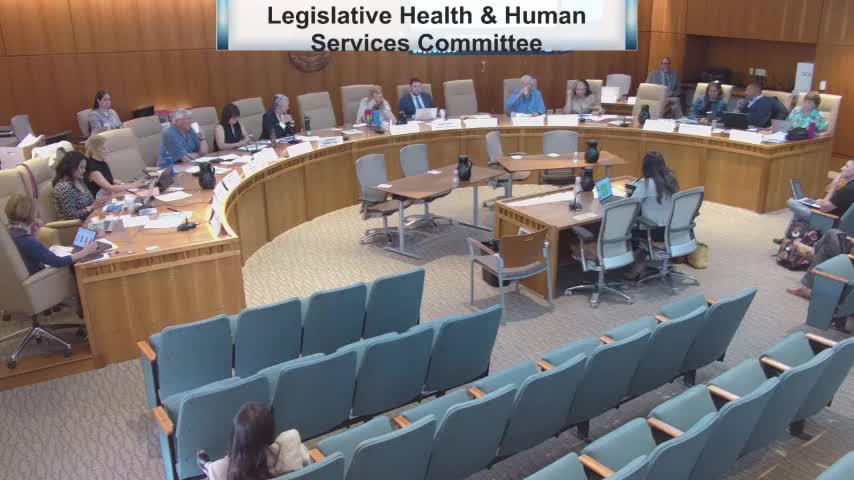
Summary
The Developmental Disabilities Council briefed the Legislative Health & Human Services Committee on federal DD Act definitions, state waiver programs, the Office of Special Education Ombuds and other statewide resources including RAMP and the New Mexico Technology Assistance Program.
Alice Lou McCoy, executive director of the New Mexico Developmental Disabilities Council, told the Legislative Health & Human Services Committee that the federal Developmental Disabilities (DD) Act defines developmental disability as a severe, chronic disability manifested by age 22 that results in substantial functional limitations and may make a person eligible for certain services.
McCoy described four main Medicaid waiver programs administered through the Developmental Disabilities Support Division (DDSD) now housed at the Health Care Authority: the comprehensive DD waiver, the self-directed MiVIA waiver (budgeted, participant-directed supports), a $10,000-a-year supports waiver created when the DD waiver waiting list was long, and a medically fragile waiver for people with medically complex needs. She told lawmakers that about 7,000 people in New Mexico are served on the DD waiver.
McCoy outlined additional state resources and partners: the UNM Center for Developmental Disabilities (the state’s UCEDD), Disability Rights New Mexico (the state protection and advocacy agency), the Governor’s Commission on Disability (which runs the Residential Accessibility Modification Program, RAMP), and the New Mexico Technology Assistance Program (NMTAP), which lends assistive technology for trial use. She urged legislators to consider funding needs across these programs and warned that proposed federal budget cuts could reduce funding for UCEDDs and protection-and-advocacy agencies.
On education, McCoy described the Office of the Special Education Ombuds placed at the DDC in 2021 to support students and families during individualized education program (IEP) processes. She said the ombuds is explicitly an advocacy-focused office for students and families — the first model of its kind — and that public school districts and charter schools are statutorily required to post ombuds contact information in prominent locations. Senator Shannon Pinto told the committee she had not seen the ombuds posting in schools in her district, and McCoy said that, under state law, failure to post (physically in the school building) would be noncompliance.
McCoy also described workforce and early-intervention programs: the Family Infant Toddler (FIT) program for early identification, the Public Education Department’s Office of Special Education, and Vocational Rehabilitation for employment supports. Representative Kate (first name not specified in transcript) and other members noted resources and programs for employers and housing providers to improve accessibility.
In public comment, Jim Jackson, registered lobbyist and chair of the Disability Coalition for Disability Rights New Mexico, told the committee the DD waiver waiting list had been eliminated through recent state action but cautioned that other Medicaid-related waiting lists remain for home- and community-based services for people whose income is above typical Medicaid eligibility but below a higher threshold.
McCoy gave contact names for DDC programs and described the council’s intake process for guardianship applications and ombuds services, and she urged members to connect constituents to the council when they need assistance.