
LFC: $7 billion in active capital outlay balances, committee directs staff to draft overhaul steps
Get AI-powered insights, summaries, and transcripts
Subscribe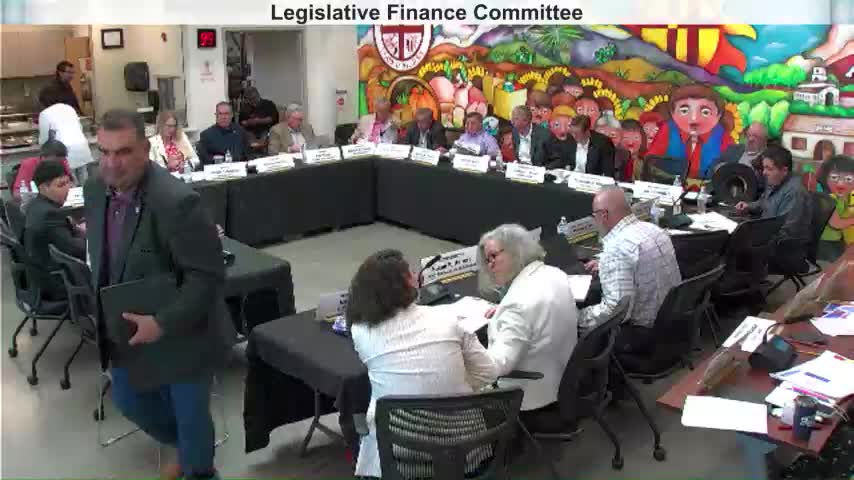
Summary
Legislative Finance Committee staff reported more than $7 billion in outstanding capital outlay balances across roughly 6,500 projects and the committee directed staff to draft legislation to limit reauthorizations, strengthen vetting and route reversions into a capital development reserve fund.
The Legislative Finance Committee was told that outstanding legislative capital outlay balances have topped $7 billion across roughly 6,500 active projects, and members directed staff to draft proposals aimed at speeding project completion and prioritizing larger, ready-to-build projects.
Kelly Carswell, LFC capital outlay analyst, told the committee the balance reflects several factors: historically large appropriations in recent years, a backlog of small local projects, and funds flowing into earmarked programs such as the Water Project Fund. "At the end of '25, our outstanding capital outlay balances have crossed $7,000,000,000 across about 6,500 active projects in the state," Carswell said.
Why it matters: Committee members said the large unspent balances limit the Legislature's ability to fund larger, higher-priority infrastructure projects and create perceptions of inefficient spending.
Key report points and figures
- Composition of balances: About $4.2 billion of the outstanding balance is projects authorized by the Legislature (local capital outlay, state agencies and higher education). The Public School Capital Outlay Fund balance approaches $2 billion, and severance tax bond programs account for roughly $850 million of active balances, Carswell said.
- Earmarked programs: The Water Trust Board has received significant revenue increases in recent years. The LFC said the Water Trust Board awarded roughly $150 million of a $200 million supplemental appropriation and expected to award an additional roughly $51 million in a subsequent meeting. The Water Trust Board had notices of intent requesting roughly $575 million in the next cycle, the LFC said.
- Colonial (colonias) and Tribal funds: The Colonias Infrastructure Fund had awarded about $52 million of approximately $81 million available for the cycle at the time of the report; the Tribal Infrastructure Fund received 56 applications requesting about $243 million and awarded its full FY25 capacity to 28 projects.
Committee direction and next steps
Members discussed reforms that LFC staff had outlined earlier and asked staff to draft legislation for committee review. Key elements the committee directed staff to develop included:
- A pilot for the capital development program funds (HB 253 distribution) to support planning/design grants and criteria-based construction awards for local and tribal governments; committee members specifically asked staff to develop application criteria and caps for planning funds and to ensure rural and frontier communities receive prioritization options.
- Limits on reauthorizations: Draft language to allow only one reauthorization per appropriation (standard reauthorization period to remain two years), permit narrowly defined reauthorizations for drafting errors, and develop an encumbrance/expenditure threshold that shows activity before reauthorization is allowed.
- Reversions: Direction to draft options that would route future reversions from general-fund capital appropriations into the capital development and reserve fund to bolster future capital capacity and reduce ad-hoc reversions.
Motions and committee action
Senator Munoz moved and Representative Vincent seconded a motion directing staff to develop the capital development program criteria; the motion carried without opposition. Later, members moved and approved direction to staff to draft legislation limiting reauthorizations and addressing reversions; leadership said the proposed bills would return to the committee for endorsement before being introduced.
Questions from members
Lawmakers pressed staff on rural capacity, local procurement preferences, how to prevent scope inflation ("Taj Mahal" designs) after planning grants, and whether earmark boards such as the Water Trust Board should have their approval timelines shortened to reduce delays caused by mandatory legislative authorization. Carswell and NMFA staff said they will follow up with additional analysis and recommended technical assistance measures for small communities.
Ending note
LFC staff will draft bill language and provide additional data on underfunded projects and potential reversions for committee review before the 2026 session. Committee leaders said the reforms are intended to move state dollars from a large collection of small, slow-moving projects toward better-vetted, fundable projects that can be completed in a reasonable timeline.