Get Full Government Meeting Transcripts, Videos, & Alerts Forever!
Get email alerts on the Rezoning Concrete Plant topic
No spam. Unsubscribe anytime.
Commissioners deny conditional rezoning for 10.5-acre concrete plant on Caratoke Highway
Summary
The Currituck County Board of Commissioners voted to deny a request to conditionally rezone 10.5 acres on Caratoke Highway for a batch concrete plant, citing inconsistency with the county’s Imagine Currituck 2040 land-use plan and concerns about location and visibility from the highway.
The Currituck County Board of Commissioners on an up-or-down vote denied a developer’s request to conditionally rezone 10.5 acres on Caratoke Highway for a batch concrete plant, rejecting the application after staff said the proposal conflicted with the county’s Imagine Currituck 2040 plan and residents raised environmental and land‑use concerns.
The request, filed as PB‑25‑09 by CRMP Inc. (Commercial Ready Mix Products), would have rezoned a 10.5‑acre portion of a larger parcel at 5235 Caratoke Highway (Tax Map 83, Parcel 5A, Papa Branch Township) from Agricultural to Conditional Heavy Industrial to allow construction and operation of a batch concrete plant. County planning staff told the board the Technical Review Committee (TRC) could not recommend approval because the site is located in a G‑1 transect on the future‑land‑use map, an area the plan designates for low‑density residential and agricultural uses and where preservation of farmland is encouraged.
Planning staff also told the board the requested heavy‑manufacturing zoning would be visible from Caratoke Highway and that the master planning called for the Mid‑Currituck Bridge area — which the land‑use plan recommends be master‑planned with community engagement — has not yet been completed. Jason (planning staff) told commissioners, “It’s safe to say you’ll be able to see it,” when asked whether buffers would fully screen the tallest portions of the plant.
The planning board, by contrast, recommended approval. It concluded the request complied with the Unified Development Ordinance and could support county economic goals — notably the need cited by the applicant for ready‑mix concrete in proximity to the proposed Mid‑Currituck Bridge construction.
Applicant representatives told the board they had reviewed alternatives and concluded this location offered “unique locational advantages” for producing quality concrete for a large bridge project. Casey Barnell, the applicant’s attorney, said the conditional rezoning would limit the site to the batch plant the applicant proposed: “This isn’t opening up a Pandora’s box,” he said, adding that the approval would not authorize other heavy‑industrial uses beyond those conditions.
The applicant provided a copy of a commercial appraiser’s report they said found no measurable decline in surrounding property values in a comparable situation; the report’s author was not present at the hearing. Engineer Michael Strader described site geometry, distance to the nearest residences (which he estimated in the thousands of feet), and proximity to an existing Dominion power‑line easement that the applicant said reduces impacts on surrounding farmland.
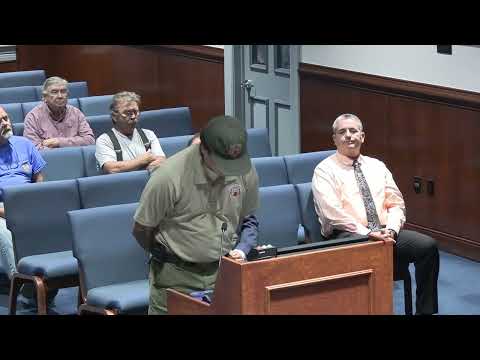
Public commenters urged denial, raising environmental, scenic and quality‑of‑life concerns. Tom Wright, who identified himself as a lifelong Currituck resident, told commissioners the rezoning would “irreversibly damage” wetlands, duck impoundments and the rural character of the area. Karen Pierce and Jennifer Simons cited concerns about visibility from the highway and the lack of certainty that the Mid‑Currituck Bridge — a principal justification advanced by the applicant — has funding or permits in hand; Simons said, “as it stands today, July 2025, there is 0 money for this bridge.” Several speakers urged conservation easements on the remaining farm acreage if any rezoning were allowed.
Proposed site conditions offered by the applicant included a conceptual development plan, secure gated access with surveillance cameras, an extended concrete apron to Caratoke Highway, and use of washed aggregate or asphalt millings on the driveway to reduce dust. The applicant estimated the tallest plant structures would be about 60 feet high.
After commissioners debated the application, one commissioner moved to deny the rezoning request, citing inconsistency with the Imagine Currituck 2040 vision plan and the absence of completed master planning for the Mid‑Currituck Bridge area; another commissioner seconded the motion. The motion carried; the board denied PB‑25‑09. The meeting record contains no detailed roll‑call vote in the transcript excerpt available to staff and the public record distributed at the meeting stated only that the motion carried.
Why it matters: The decision keeps the subject parcel in its agricultural designation and underscores the county’s emphasis on following the Imagine Currituck 2040 guidance for the Mid‑Currituck Bridge area and protecting lower‑density, agricultural uses along the Caratoke corridor. The hearing highlighted a recurring planning tension: whether to prioritize immediate, project‑specific economic needs (the applicant argued proximity to bridge construction requires a nearby concrete plant) or to adhere to a community land‑use vision developed through the county plan.
What’s next: The applicant may pursue other locations or modify the proposal; residents who testified asked the county to pursue conservation easements on the remainder of the family parcel if any development occurs.